Furnace in Hanover, MD

6 Possible Reasons Why Your Furnace Isn’t Heating

When temperatures plummet in Hanover, MD, your furnace becomes one of the most critical appliances in your home or business. Even if you have the right clothes to keep your body warm while indoors, you’ll still need a properly functioning furnace to heat your space. When an ideal temperature is maintained in your home, there will be a reduced risk of illnesses, and you and your family will enjoy better sleep, among other benefits. You’ll also have high productivity rates in your workplace since employees enjoy working in a comfortable environment.

Unfortunately, you may turn on your heating system only to realize it doesn’t warm your indoor space as expected. This is a frustrating experience, especially when you hear the furnace clicking on but the system doesn’t blow that toasty hot air into your building. In this article, we’ll go through some of the common reasons that may cause your furnace to stop heating.

1. Thermostat Issues

The wrong thermostat setting is one of the simple reasons your furnace might not emit heat. Since the thermostat is the control center of your heating unit, an incorrect setting means your system won’t work as expected. Make sure you set the thermostat at the ‘Heat’ or ‘Auto’ position and about five degrees above the temperature in your house. Also, try switching the fan to the ‘On’ position for the furnace to blow hot air continuously. If the furnace still doesn’t work, you will have to rely on the expertise of our team at Beltway Air Conditioning and Heating to check for other issues.

Sometimes, the problem could be the thermostat batteries. Once the batteries die, the thermostat will no longer control your heating system. Replacing the batteries at least once per year is an excellent way of avoiding this problem. In other cases, a thermostat may malfunction, making it impossible to control how the furnace works or how much heat it generates. We can help you replace it with a modern and more reliable device that will give you hassle-free service for years to come.

2. Clogged Air Filter

If your furnace fires up but doesn’t heat your building, it could be due to clogged air filters. The filters in your heating system trap dirt, dust, and other debris like pet dander and hair. Although this is great for your indoors, these particles block or restrict vital airflow through your heating unit over time. Blocked airflow can lead to overheating in the system’s heat exchanger, and your equipment won’t work as it should.

The most efficient way of solving this problem is by changing the dirty air filters. We recommend replacing your furnace filters every one to three months to keep your home clean, warm, and safe during cold days. Also, ensure your air registers and vents remain unobstructed. They shouldn’t be blocked.

3. Faulty Ignition Sensor

A faulty pilot light or ignition sensor is another common culprit and could be the reason why your gas furnace might fail to produce heat. When you have a faulty ignition sensor, you will hear your heating system initiating the start cycle or clicking on, but it fails to fire up. Clogs or dirt in your furnace can result in your ignition sensor going out.

While diagnosing this issue, our professionals will turn off the gas furnace and locate the ignition sensor near the burners. We will first clean the ignitor if it’s dirty, fix it precisely as it was before, then turn up the heating unit. Alternatively, if we notice your system has a cracked, warped, chipped, frayed, or damaged ignitor, our team will replace it. Note that to avoid damaging the furnace and your property you shouldn’t try fixing the pilot light yourself.

4. Dead Blower Capacitor

The blower capacitor in your heating system usually looks like a big battery. Once the thermostat instructs the furnace to turn on, the capacitor starts the heating system. If your system has a broken capacitor, it can’t start the furnace. Also, due to the capacitor’s tolerance levels, running the blower at excessively low RPM can easily lead to a malfunction.

After assessing your system, our trained technicians can easily tell if the capacitor in your furnace is the cause of the problem. The best solution for this issue is to replace the faulty blower capacitor. After the replacement, we’ll also take time to test your unit to ensure it’s heating your building effectively.

5. Gas Line Issues

Your heating unit might also fail to heat your home or business due to gas line issues such as malfunctioning gas valves, gas leaks, or blocked gas lines. A closed gas line means your unit doesn’t receive fuel and, consequently, doesn’t heat your house. You can check whether the gas line is turned on at the shut-off valve outside your house. Another way to tell whether you have gas supply issues is by starting different gas-burning appliances in your home, such as a stove.

If the gas line is not the issue, you’ll have to seek assistance from our team to assess your heating system. Plus, if you believe there is a leak or a smell of gas around your furnace, call our technicians to evaluate it immediately. A gas leak poses a significant danger to you, your family, and your property, so ensure you notify our team and the utility company as soon as possible.

6. Unprofessional or Poor Maintenance

Heating systems can last for several years. However, they can’t perform at their peak level without proper maintenance from a professional. Maintenance processes such as cleaning your furnace can go a long way toward keeping your system in tip-top shape. For instance, your unit can stop working if the filters and other critical components are dirty. Additionally, dirty blowers can lead to unexpected system failure. Sometimes the burners may have accumulated a lot of dirt after an extended period, so they won’t work as they should.

By scheduling regular maintenance, you can avoid having a furnace that isn’t heating your home or one that breaks down during winter. Our technicians will clean your unit and check every part of your system to ensure it’s in good condition. This way, you won’t have to worry about staying in the cold when temperatures drop significantly.

Your Furnace Repair Service Team

You can experience various problems with your furnace, but having a unit that won’t heat your house is decidedly the worst. Staying indoors without heat during the winter months can result in lots of discomfort for your family and other occupants in the building. Fortunately, you can always call our seasoned technicians to diagnose and fix your furnace.

At Beltway Air Conditioning and Heating, we offer speedy and dependable services to both residential and commercial property owners in Hanover and Arbutus. We’re a locally operated company committed to providing 100% satisfaction on every task. No matter how complex the issue may seem with your equipment, we’ll find the right solution. We train our technicians on all the new industry trends and provide all the necessary tools for their assignments so you can trust us to deliver quality services. Our team offers both heating and cooling equipment installation, repair, and maintenance as well as indoor air quality services and duct cleaning. Contact us at Beltway Air Conditioning and Heating today to book an appointment.

Heating Systems in Hanover, MD

Hybrid Heating Systems Offer Efficiency and Reliability

Here in Hanover, MD, heat pumps are offering homeowners unprecedented heating efficiency at affordable prices. The one problem heat pumps suffer from is that they lose their efficiency on extremely cold days. Since our area has its fair share of cold days in the winter, this gives plenty of people pause when they weigh the pros and cons of heat pumps. What if, they wonder, their new heat pump can’t provide enough heat to keep their family warm if there’s a cold snap?

It turns out there’s an option that can eliminate those worries. It’s called a hybrid heating system. This system leverages the latest in heating technology to provide ultra-reliable heat and unmatched efficiency in all situations. Here’s everything you need to know about hybrid heating systems and why they’re a great option for Hanover homes.

What’s the Problem With Heat Pumps?

If you’re not aware, heat pumps rely on their ability to extract heat energy from the outside air to heat the interior of the homes they serve. Although that would seem to indicate that they’d be useless on cold days, that’s not the case. Since heat pump technology uses refrigerant as a heat transfer medium, they’re still able to extract heat energy even when the air temperatures drop as low as 30 degrees Fahrenheit.

Also, since they don’t rely on electricity or gas to create heat and instead use electricity simply to move heat from one place to another, they’re extraordinarily efficient. The average heat pump provides a home with four units of heat for every unit of electricity consumed. That’s an astonishing 400% efficiency rate, which is something no other type of heating technology can match.

The problem is that those efficiency levels start to decline as the outdoor temperature dips below 30 degrees Fahrenheit. At the kind of low temperatures we see in the winter here in Hanover, heat pumps can struggle to deliver an adequate heat supply to maintain your desired indoor temperature. For that reason, most heat pumps come equipped with a small auxiliary electric heater to provide a backup heat supply on cold days.

Electric heaters, though, aren’t very efficient. So, those auxiliary heat systems can rob heat pumps of their most attractive features — energy efficiency and low operating costs. That’s where hybrid heating systems come in.

What’s a Hybrid Heating System?

A hybrid heating system is a term used to describe a heat pump that relies on an auxiliary gas-powered furnace for extra heat when needed. It’s a best-of-both-worlds approach that guarantees a reliable heat source for your home even when the temperature drops below the heat pump’s ability to function well.

Unlike heat pumps that come with electric auxiliary heat systems, hybrid heating systems don’t lose anywhere near as much efficiency on cold days. The secret is their use of high-efficiency gas burners. The burners used in hybrid systems feature efficiency rates of 95% or higher, which may be nothing compared to peak heat pump performance, but it still beats the efficiency of electric heat sources by a wide margin.

The other major advantage of hybrid heating systems is that they don’t only switch on their gas burners when the heat pump can’t keep up with demand. They feature sophisticated control mechanisms that can monitor the system’s efficiency at all times. This allows them to turn on their gas burners as soon as the efficiency of the heat pump falls below that of the auxiliary system. In other words, they won’t wait until your home’s desperate for heat. Instead, they’ll switch on the gas burners as soon as the system determines that they’re the more efficient option.

On top of all of those benefits, hybrid heating systems also often feature multi-speed fans, allowing for more precise operations. That further decreases their cost of operations and helps them maintain the highest possible efficiency in all situations.

Does Your Home Need a Hybrid Heating System?

At this point, you may be wondering if a hybrid heating system is a good option for your Hanover home. The answer to that question is a resounding yes. That’s because homes here see an average of three months out of every year when temperatures could reach lows where heat pumps struggle. During especially cold winters, that can translate into 90 days or more when homes with heat pumps in Hanover need auxiliary heat.

With a traditional heat pump, those extra cold days add up to significant heating cost increases. A hybrid system eliminates that problem by leveraging a heating solution that’s close to 100% efficient at its worst. They offer homeowners a way to keep their heating costs low no matter what Mother Nature has in store each winter.

Plus, heat pumps provide air conditioning in the summer, and that includes hybrid systems. During the summer, a heat pump consumes up to 50% less energy than a traditional central air conditioning system. So, they offer excellent efficiency and cost savings all year round. This also allows them to be an even better up-front value since they take the place of a home’s existing heating and cooling solutions.

Are There Downsides to Hybrid Heating Systems?

Even though hybrid heating systems are a close-to-perfect solution, there are some things about them you might consider less than ideal. They require your home to have a connection to a gas supply line, and they cost a bit more up-front than heat pumps or furnace-only heating solutions. These systems also rely on fossil fuels that harm the environment, and they can cost more to maintain due to added system complexity.

It’s worth pointing out that Maryland may be on the verge of prohibiting all new natural gas connections to buildings. The idea was a part of a proposed energy bill late in 2022, and natural gas faces an uncertain future here. That means homes that don’t have an existing natural gas connection may soon lose hybrid heating systems as an option. However, there are hybrid heating systems that can substitute propane or oil as fuel for their operation. They’re not always as cost-effective as natural gas-powered models, though.

Rely on the Hybrid Heating Professionals

At Beltway Air Conditioning and Heating, we believe that hybrid heaters remain a cost-effective, reliable option for homes in Hanover. They give homeowners here the option of embracing heat pump technology without the worry that their system could lead to cold nights or skyrocketing operating costs each winter.

By combining the two most efficient heating options available today, hybrid systems eliminate uncertainty and offer the cheapest possible operating costs, no matter what the winter brings. That’s why we never hesitate to recommend them as an option when we talk to customers about the pros and cons of heat pumps.

Beltway Air Conditioning and Heating is a leader in residential heat pump sales, installation, and service in the Hanover area. We also offer a comprehensive slate of furnace and AC services to help you keep your home’s heating and cooling systems in peak operating condition at all times. Our other services include duct cleaning and installation, indoor air quality solutions, and commercial HVAC services. So, if you’re considering a hybrid heating system to keep you warm for this and many winters to come or you want to set up an appointment for another service, call Beltway Air Conditioning and Heating today!

6 Reasons Why Converting From Oil to Gas Heating May Be a Wise Choice

Even though you’re seeing fewer oil furnaces these days, some older East Coast homes still use oil in the fall and winter for their heating needs. However, experienced companies like Beltway Air Conditioning and Heating from the Hanover, MD area frequently recommend converting to gas heat as a reliable solution to the harsh winters of New England.

Doing this will not only help you reduce energy usage and save money over time, but if you decide to sell your home in the future, it will make your home more appealing to potential homebuyers. Not to mention, you won’t have to worry that you’ll run out of fuel on a cold winter day.

If you’re thinking about making the change, you may just need a little extra push. The following covers some of the top reasons to convert from oil to gas heating.

1. Gas Heating Is Cheaper

If you’re thinking about switching out your older oil heating unit, chances are you’re already comparing oil and gas heating and are crunching the numbers to see which is the cheaper option. According to the U.S. Energy Information Administration, heating a home with oil can cost around $1,700 a year on average, but it’s only a little over $700 a year for gas. When oil prices peak, the cost to heat with oil can be, on average, around $2,000 a year. Heating with natural gas at peak prices, however, would only be $900 annually. Oil heat can typically be up to 50% more each year than gas heat.

Keep in mind that a utility company pipes natural gas right into your home, unlike oil which comes by truck delivery. Therefore, switching to gas will require there to be a gas main under your road. Most suburban and urban areas have gas lines, even in the Northeast’s oil-dominated neighborhoods. If your neighborhood doesn’t, you can try to get enough neighbors to come together and put in a request to convince the utility company to come and install a gas main.

Also, if you’re making the switch, there are some upfront costs to consider, such as the costs of equipment and hookup installation. Oil-fired equipment costs more than gas-fired equipment, but there are two components to the gas connection process: setting up connections inside your home and outside your home. The utility company runs an underground pipe to your home from the gas main and installs a meter. There are upfront costs to this, as well as other associated costs. However, at the current oil prices, you’ll likely get your upfront costs back in less than five years through your fuel-cost savings.

2. Secure Your Investment

Investment security is among the most convincing reasons to make the switch to gas heat. You’ll find oil prices constantly fluctuate. Not only this, but oil is a finite natural source that’s becoming scarcer. This translates to insecurity with the cost of oil since it’s most likely going to continue going up and cost you more each year to heat your home.

Along with this, certain countries are moving to ban new oil heating system installations in an effort to tackle climate change. While this hasn’t occurred in the U.S. yet, it could be a possibility in the future. When you combine all the above factors, gas heat becomes a great option to ensure you’re heating your home cost-effectively.

3. Easy and Efficient to Maintain

Older heating equipment may only be around 50% to 80% efficient, and this wastes a lot of the fuel you buy. Newer natural gas boilers and furnaces have an up to 98% efficiency rating, which translates to less energy required to maintain a comfortable home in the winter.

While it’s important to consider energy efficiency, it won’t really matter unless your furnace operates at peak performance. Maintenance is essential if you want to guarantee a properly functioning heating system. But, when it comes to how much maintenance is required, it will vary between oil and gas heat.

Throughout the year, gas furnaces require minimal maintenance since they’re considered clean. Oil furnaces, on the other hand, burn less clean than gas and, therefore, require more frequent and thorough maintenance because debris and dirt can collect on the inside of the unit. The costs of oil or gas heat will also depend on the maintenance required.

4. Clean and Green

Of all fossil fuels, natural gas is the cleanest. This makes it better than oil for the environment. It’s good to know you’ll be emitting up to 100% less sulfur dioxide and 40% fewer greenhouse gases and reducing your environmental footprint with a new natural gas heating system.

5. Increase the Value of Your Home

Converting to natural gas heat can also help you add to your home’s value and increase how many potential buyers will even look at your home since it’s an expense they won’t have to think about until a later date. Many potential homebuyers will only look at homes with natural gas heat. So, installing a new gas system can lead to a quicker home sale.

6. Gas Furnaces Run Quietly

If your oil furnace isn’t in the basement but closer to the living spaces of your home, you’ll notice a lot of the noise it makes. Gas furnaces are much quieter, so you won’t notice as much noise from your heating system. Keep in mind that this won’t be as much of an issue if your furnace (gas or oil) is located in your basement. But, it’s something to take into consideration, especially if your heating system is in or near your living spaces.

It’s always a good time to make the switch to gas heat, so don’t wait until your old oil boiler or furnace stops working on a cold winter day to reach out to us for help. Ensure your continued comfort by making the switch to gas heat now. While you will have an initial investment to make the switch from oil to gas, it will eventually pay itself back with the money you save each year in heating costs. A new heating unit can be one of the largest purchases you’ll make as a homeowner, but gas heating is a far more economical and energy-wise fuel choice, which is why many homeowners are deciding to make the switch.

Hire the Professionals to Make the Switch for Your Home Today

Converting from oil to gas heating will require a trained professional. You don’t want to leave your new heating unit installation in the hands of just anyone. Converting from oil to more efficient gas heat will be a whole lot simpler when done by a trusted HVAC professional.

Beltway Air Conditioning and Heating provides oil-to-gas conversion services for customers throughout Hanover, MD and the surrounding area. With our help, you can enjoy all the benefits mentioned here. In addition to our conversion services, our team repairs, maintains, and installs furnaces and air conditioners. We also provide duct cleaning, custom ductwork installation, indoor air quality solutions, and commercial HVAC services. Contact us today to learn more about our services or schedule an appointment.

What Is the Most Cost-Effective Residential Heating System?

To keep your family and your home safe during the winter season, you need to invest in a home heating system. With so many options on the market today, it can be a bit overwhelming to determine which heating system is best for your home. If you’re like most folks, you’re looking for a heating system that is both effective and affordable.

What Are Your Options?

When it comes to heating systems, there are three main types that you can opt to purchase. These are a heat pump, furnace, and boiler. Heat pumps run primarily on electricity and also work to cool your home in the summertime.

Furnaces are the most popular choice for homeowners and can run on electricity, propane, heating oil, or natural gas. Furnaces use a forced-air blower system to deliver hot air throughout your home. Boilers heat up water or steam and pipe it to radiators through a home. Boilers can run on heating oil, propane, electricity, or natural gas.

Average Replacement Cost Per Unit Type

To help give you a good picture of what these units cost to have installed, we’re going to evaluate the five most popular. These are a heat pump, gas boiler, gas furnace, electric furnace, and electric boiler. Each cost figure will include both an installation fee that your installer will charge for their labor and a system cost that is the flat rate for the heating system itself. All price estimates are for installations and vary depending on the size of the house.

Depending on the system you choose for your home, an electric boiler is going to be the cheapest system to have installed in your home. Conversely, a heat pump is going to be the most expensive.

Existing Infrastructure

All of the estimates above are based on the replacement cost of a heating system. This assumes that there is already adequate infrastructure in place, such as ducting or radiators. Most older homes already have this existing infrastructure, and all homeowners need to worry about is finding a system that fits that existing infrastructure. It’s always going to be cheaper to buy a replacement heating system that matches the existing infrastructure of your home as compared to purchasing a heating system that requires a different infrastructure.

Installing Infrastructure

If you’re moving into a new home or you’re considering switching to a different type of heating system that requires a different infrastructure setup, then you’ll need to evaluate the purchase price of the infrastructure that you need. In general, there are two different infrastructure setups.

The most common is the forced-air system. This requires an air handler and ducting to be installed throughout the floors and walls of your home. If you’re building a new home, having this ducting infrastructure installed will cost about $1,300. If you’re considering having ducting installed in a home that is already built, the price can climb to over $6,000. This is because the installer will have to remove and replace drywall and other structural features of your home to insert the ducting.

The second type of infrastructure is a hot water or hot steam radiator system. These are necessary for boilers, and their cost will highly vary depending on whether you’re having a new home built or you already have existing drywall and flooring installed in your home.

A Note on Energy Efficiency

When you purchase a new heating system, you want to take into account how efficiently it will operate. Just because a system is cheaper to install than the next doesn’t mean that it’s going to be cheaper to run. In fact, some of the cheapest heating systems on the market are the least energy efficient out there.

To determine how energy efficient a particular heating system is, it’s given an AFUE rating. This allows consumers like you to compare different types of heating systems to determine which one meets your efficiency needs. AFUE stands for annual fuel utilization efficiency. This number is given in a percentage format and indicates how much energy a system produces per unit of fuel it receives.

The higher the AFUE rating, the more energy efficient a heating system will be. This translates to lower energy bills for you during the winter months. Below is a list of the AFUE ratings for different heating options available to you:

  • Geothermal heat pump – 400%
  • Gas boiler – 96%
  • Gas furnace – 98%
  • Electric furnace – 100%
  • Electric boiler – 100%

Climate Considerations

The climate that you live in will have a large impact on the heat options that you have available to you. More specifically speaking, heat pumps are not highly recommended for homes in the northeast part of the country. This is due to the fact that heat pumps don’t work well at temperatures below freezing. While heat pumps can offer four times better efficiency than other heating options available to you, they can struggle to keep your home adequately warm if there are cold spells that drop the temperature below freezing.

If you would really like to take advantage of the energy savings that a geothermal system can offer you, then you may want to consider installing two types of heating systems. You can make your geothermal heat pump the main heating option for your home. Then, purchase a backup electrical or heating oil furnace that works to heat your home when temperatures plummet below freezing. This gives you the best of both worlds as you can cash in on energy efficiency while the weather is fair and still have a viable heating option when the temperature drops below freezing.

Others Important Factors to Consider

When making a decision about the appropriate heating system for your home, price is only one factor to consider. You’ll want to consider the system’s operating costs, expected lifespan, energy efficiency, warranty, maintenance needs, tax rebates, and so forth. It’s best to evaluate the inclusive long-term costs associated with a particular heating system so that you can get a clearer picture of what the actual cost is going to be. For example, geothermal heat pumps are the most expensive to install, but they last 10 to 15 years longer than your average residential gas, propane, electric, or oil furnace or boiler.

Quality Heating Services

Beltway Air Conditioning and Heating offers quality heating service for the entire Hanover, MD area. We’re also here for all of your cooling, custom ductwork, indoor air quality, and commercial HVAC needs. Contact our office today to schedule your next service appointment with one of our highly knowledgeable technicians.

How to Find the Best HVAC Service for Your Needs

Finding the best HVAC service for your needs can be a daunting task. With so many options available, how can you be sure you’re making the right decision? Here are some tips to help you make the best choice for your needs.

1. Make Sure They Are Licensed and Insured

When you’re looking for HVAC companies to hire, the first thing that you should do is make sure they have a valid license. HVAC jobs can be dangerous, and having a business with a license means that the state has vetted them to ensure their quality of work meets all safety standards.

You also want to make sure that the company has insurance in case something goes wrong. Even the most honest businesses can make a mistake, and you want to make sure that your chosen HVAC company will be able to cover any cost or damage that may arise.

2. Ask About Their Specialties and What Sets Them Apart

When you’re looking for HVAC companies to hire, you want to make sure that they focus on your specific needs. Look at their website and see what kinds of services they offer. Ensure that the type of job you need is included in their range of expertise. If it isn’t, this probably isn’t the best option.

Some of the common HVAC systems that companies specialize in are heat pumps, air conditioning units, and furnaces. Ensure that the company you select has the expertise to do the job properly.

3. Ask for a Quote

Once you have found a few companies that look like they could help, it’s time to ask them for a quote. Make sure that you are clear about what service you need from them and where the job will be located.

If you aren’t specific, then there’s a good chance that the quote the companies provide will not fit your needs. Once you have their quotes, make sure you compare this to other HVAC services in the area to see if they offer competitive pricing. After all, price should not be your deciding factor when selecting an HVAC company, but it can be helpful when making your final decision.

4. Check Reviews and References

In the internet age, it’s easy to find out what people think about certain companies. Simply search for their name and see what other people have experienced with them. Make sure that you read reviews from various sources before making your final decision.

If they have a lot of negative reviews or complaints, then this is not going to be the right company for you. However, online reviews aren’t always accurate and shouldn’t be your only source of information. If possible, call the company and ask them about their services directly or talk to people they have previously worked with. This can give you a better idea of how well they work and if they would be a good fit for you.

You can also check with the Better Business Bureau to see if they have any complaints or problems filed against them. You want to go with a company with an A+ rating and an extensive list of satisfied customers.

5. Ask About Their Schedule and Availability

One of the most important things you should consider when looking for companies is their availability. What days of the week do they schedule appointments? Can they come out in emergencies or last-minute requests?

It’s a good idea to ask these questions before committing to a company. In some cases, you might find that you cannot hire them because of their limited hours or extensive waiting list. However, it’s important to remember that the best companies usually have busy schedules, so a little patience may be necessary.

In addition, check if you can book your appointment online. This can save you a lot of time and energy, especially if the company is in high demand.

6. Learn About Their Guarantees and Warranties

In the world of HVAC companies, you want to ensure that you get a guarantee on all of their work. This is especially important for new HVAC purchases and installations. Some companies will offer a one-year warranty on their parts, and others might have more extensive coverage.

Look for companies that offer at least a one-year warranty on their parts and labor. If the company has been around for a while, you should be able to find information about their warranties online or from other customers who have utilized their services before.

7. Ask About Specials and Promotions

In the end, you might also want to ask about any specials or promotions that they might have. Sometimes, this can give you a better idea of how much their services will cost and if they fit your spending budget. These can be especially helpful if you are on a tight budget and don’t want to overspend.

For example, some companies offer discounts for seniors or military members. You could even find a company that offers a small discount for first-time customers. Depending on the service and item, there is always going to be a special promotion available somewhere.

8. Ask About the Brands They Work With

The most important information you should obtain from HVAC companies is which brands they work with. They shouldn’t be limited to a certain product line and instead have a wide range of options for their customers.

When it comes down to it, this will give you more choices when making the final decision about what type of unit you want to have installed in your home or office. Some of the most popular brands include Goodman, Daikin, Trane, and Lennox.

9. Work With a Local Company

One of the reasons you want to find local HVAC companies is that they will be more knowledgeable about your local weather and climate. This means that they can save you money and time by providing better advice and services.

Since they’re based in your area, they will also know about any local codes and regulations that you need to follow. If you are in Hanover, Beltway Air Conditioning and Heating will provide you with all of the information you need to stay in compliance with local laws.

10. Ask About Their Payment Options

Finally, you should make sure to ask about their payment options. While some companies may require all payments upfront, others may be willing to work with you and accept payment in installments. Some even offer financing solutions, so be sure to explore all of your options, and find something that works well for you.

Beltway Air Conditioning and Heating in Hanover, MD, has been a part of the community for many years and is a company that you can count on. Our technicians are completely factory trained and certified, which means that you can expect high-quality workmanship. Our services include residential heating and air conditioning installation, maintenance, and repair, as well as indoor air quality solutions. We also offer commercial HVAC design-build services, repair, and maintenance services. Our 100% satisfaction guarantee ensures that you will be happy with our work.

If you’re looking for a company that can provide the best service in Hanover and the surrounding areas, give us a call today.

5 Common Heating Problems and How to Fix Them

The winters in the northeast can be bitterly cold, and few things are worse than finding out your heating system isn’t working properly when the weather dips below freezing. Suddenly finding yourself with little or no heat in the middle of winter can be a frightening situation. Still, there is no reason to panic as many heating problems can be caused by fairly minor issues that you may be able to resolve on your own.

1. Some Rooms Won’t Heat Up as Much Others

Uneven heating in the home is a fairly common problem and one that can be caused by numerous potential issues. For instance, if you find that only one room in the house isn’t heating up properly, it might be something as simple as the vents in the room being clogged or obstructed.

If several rooms in the home aren’t heating up properly, the issue could be a result of leaking ductwork, a dirty air filter or a problem with your furnace itself. The first thing you should do when you notice this problem is check your air filter to make sure it isn’t overly dirty or clogged. A dirty air filter can drastically reduce the airflow coming into the furnace, which results in it producing much less heat than it should. This same problem can also make it more difficult for the blower fan to properly circulate air throughout the entire house. To avoid this problem, make sure that you check your air filter regularly and change the filter every 30 to 90 days.

Damaged or leaky ducts can also result in the same uneven heating issues. Any duct leaks can allow the hot air from your furnace to escape before it reaches every room in the house. Leaks also make the blower fan work much harder and make it more difficult to properly circulate air through the entire building. If your home has exposed ductwork, you can inspect it to see if you see any visible damage or feel any air leaking out of it. However, it is usually best to call in a professional to have your ducts inspected and sealed if necessary.

The issue could also be result of a problem with your furnace itself. For instance, it might be that the furnace is shutting off before it can complete its entire heat cycle. Known as short-cycling, this is a fairly common problem that can be caused by numerous issues, but the end result is that the furnace can’t produce enough heat to adequately warm up every room. In this case, you will definitely need to have an HVAC technician inspect your furnace in order to diagnose and repair the underlying issue.

2. Cold Air Coming Through the Vents

If you notice cold air coming through your vents when the heating is turned on, this often indicates a problem with either the thermostat or pilot light. The first step to diagnosing this issue is to check and make sure your thermostat is turned on and set properly. You will also want to make sure it is set to Auto instead of Fan On. If it is set to Fan On, this will cause your fan to run constantly and potentially circulate unheated air throughout the house. You should also try to turn up the heat on the thermostat to see if this changes anything. If nothing happens when you adjust the thermostat, it could indicate that either your thermostat is broken and needs to be replaced or that the furnace isn’t turning on for some reason.

3. Furnace Won’t Turn On

If you think your furnace isn’t turning on, the first things to check are that the pilot light is lit and that the circuit breaker isn’t tripped. Your furnace obviously won’t turn on if it doesn’t have power. Therefore, you’ll want to check your electrical panel to see if the breaker for your furnace is tripped. You can also reset the breaker by turning it off and then back on.

If the pilot light isn’t lit, you should follow your furnace manufacturer’s directions for relighting it. If you can’t get it to relight, then this usually indicates that gas isn’t getting to the furnace for some reason. In this case, you will need to contact a professional to see what is causing the problem.

If you have a high-efficiency furnace that won’t turn on, the problem is likely caused by dirty or faulty sensors within the unit that detect whether the gas is turned on or not. Newer high-efficiency furnaces utilize an intermittent pilot light and electronic ignition instead of a conventional standing pilot. In this type of system, the pilot light only ever comes on when the main burner is on, which means you won’t actually see a light if the system isn’t running. Unfortunately, these systems tend to be much more difficult to troubleshoot and will require the help of a professional.

4. Furnace Won’t Turn Off

If your heating system won’t turn off, this is almost always a sign that either your thermostat isn’t working properly or there is an issue with your blower fan. Leaky ductwork or a clogged air filter may also cause this issue by making it impossible for your heating system to ever reach the set temperature. In this situation, first make sure that the thermostat is set to the Auto setting so that the system automatically shuts off the blower fan when it reaches the set temperature. If this doesn’t rectify the situation, you may be dealing with a broken thermostat, faulty blower motor or some other issue that is preventing your furnace from producing enough heat. In this case, you’ll need to have your thermostat, furnace and blower fan professionally inspected.

5. Unusual Smells Coming From the Furnace or Vents

Noticing any strange smells coming from the furnace or vents can be a sign that there is something wrong with your heating or your ductwork. If you smell moldy or musty odors coming from the vents, this usually indicates that you have mold growing inside your ductwork. In this case, it is essential that you have the ducts professionally cleaned to ensure the mold doesn’t damage your health.

It is normal to notice a slight burning smell when you turn your heating system on for the first time in the winter. This is simply the dust and debris that has collected on the furnace burning off. In most cases, this is nothing to worry about and the smell should go away within a few minutes. However, if the smell persists, this could be a sign that your air filter is clogged. If this isn’t the case, you should immediately turn the heating system off and unplug your furnace until you can have it professionally inspected.

Beltway Air Conditioning and Heating has years of experience helping customers in Hanover and the surrounding areas overcome their heating issues. No matter what issue you’re facing, our professional HVAC technicians can identify the problem and ensure that your heating system is running as efficiently and effectively as possible. We also offer the entire range of air conditioning services for residential and commercial customers including installation, maintenance and repair. Don’t struggle without adequate heat one minute longer. Contact Beltway Air Conditioning and Heating today to see how we can help.

Is a Heat Pump or Furnace Right for Your Home?

As a homeowner, you face many decisions. One of the biggest is how you’re going to heat your home during the cold winter months. Two of the most popular options on the market today include the heat pump and the furnace.

How Do They Work?

With around 45% of your home’s total energy cost going towards wintertime heating, you need to be highly informed before you make a large decision of which type of heating system to get. Both furnaces and heat pumps can utilize ductwork to distribute heat throughout your living space. However, one of their biggest differences is in how heat is obtained.

Furnaces essentially burn fuel to generate heat. They can utilize propane, heating oil, electricity, or natural gas. For furnaces that utilize heating oil, propane, and natural gas, harmful carbon dioxide fumes must be safely vented to the outside of your home. Heat pumps, on the other hand, utilize heat that is found outside and transfer it into the inside of your home. They do not burn any type of fuel to create heat.

Air-Source vs. Geothermal Heat Pumps

Most heat pumps that homeowners have installed are air-source heat pumps. These systems transfer heat from the air outdoors to the inside of your home. Geothermal heat pumps are less common due to their high upfront cost. These heat pumps are placed below the frost line and transfer heat from the ground to the indoors via refrigerant lines.

Your Climate Matters!

When you’re comparing furnaces to heat pumps, you need to consider the climate that they’ll be used in. Air-source heat pumps drastically reduce their ability to heat your home when the temperature dips down below freezing. However, a furnace’s capability to heat your home is only affected by whether you have adequate fuel or not.

Those who live in the southern portion of the country can better benefit from heat pumps. This is because their wintertime temperatures rarely dip below freezing. Those who live in the northern parts of the country, including Maryland, are better off investing in a furnace. This is because temperatures in the north regularly get down below freezing for long periods at a time.

It’s important to note that geothermal heat pumps can be the sole source of a household’s heat regardless of where the home is positioned in the country. Since the ground below the frost line stays between 40 and 50 degrees Fahrenheit all year round, these heat pumps can consistently transfer heat from the ground to the inside of your home.

Lifespan of Heating Systems

Another essential factor that you’ll want to consider in your decision of which heating system to buy is its estimated lifespan. While furnace lifespans will vary depending on the specific fuel that they utilize, their average lifespan is between 20 and 25 years. Air-source heat pumps, the most popularly used, have an average lifespan between 10 and 12 years. Ground-source heat pumps, the more expensive of the two options, have a lifespan of about 25 years.

Space Requirements

When you’re having a new heating system installed, you also need to consider the space requirements of the system and how much space you have available in your home. Furnaces tend to take up a good bit of space indoors. You’ll need an area for the furnace, its air exchanger, and safety clearance around the unit.

Conversely, heat pumps tend to require much less indoor space. Rather, their main component, the compressor, is situated outdoors. The only component of a heat pump that will need to be indoors is the air exchanger. This is a small unit that can be positioned out of the way in a corner or high up on a wall.

Comfortability for Your Family

While both furnaces and heat pumps provide adequate heated air for your home, the amount of comfort that they can offer your family varies greatly. Furnaces tend to produce hotter air that is much drier. Heat pumps will circulate warm air with natural humidity in it from outdoors to the inside of your home. The air transferred by a heat pump can feel more comfortable and not overly hot.

A Note on Ductwork

If your home doesn’t have any existing ductwork, you’ll need to factor in the additional cost of adding it to your furnace. While a heat pump can utilize ducting to circulate warm air, it doesn’t have to. With heat pumps, you have the option of installing ductless mini-split units.

These units are simply mounted on the wall, each with its own internal blower fan. Instead of ducting, you’ll simply need to have two-inch diameter holes drilled through your external wall so that small piping can run from the indoor unit to your outdoor compressor unit. Ductless mini-split units can be much cheaper to have installed as compared to installing ducting in an already constructed home.

Heat Pumps Offer Air Conditioning Too

One added benefit of heat pumps is that they can also produce air conditioning for your home in the summer months. This is done by simply operating these systems in a reverse fashion. Instead of the pressurized refrigerant lines transferring heat from outdoors into your home, it can transfer the heat from inside of your home to the outdoors. There is no additional equipment required in order to have air conditioning when it comes to heat pumps. Furnaces, on the other hand, only produce heat.

Assessing Air Quality

Air quality is another crucial factor that you’ll want to consider when determining which heating system will best meet your needs. With adequate maintenance, your furnace can produce a fair indoor air quality level. However, as your furnace warms up the air, it can drastically reduce its moisture content. This can lead to uncomfortable, dry skin and can irritate some respiratory conditions. Since heat pumps use natural heat from the outdoors, it naturally produces a higher humidity level that keeps your skin happy and healthy.

Energy Efficiency

You simply can’t choose a superior heating system without taking a look at its energy efficiency. Gas furnaces tend to have the highest energy efficiency of all furnace types, operating at about 95% efficiency. This means that they produce 95% more energy than they consume, assuming optimal working conditions.

Heat pumps, on the other hand, can reach efficiency levels of around 300%. That means that they can adequately produce 300 times more energy than they consume. When you compare the two, it’s clear that heat pumps are much more energy-efficient than furnaces.

A Note on Dual Fuel Systems

As you’ve discovered, both furnaces and heat pumps come with many of their own positives. Instead of having to choose between the two, if your budget allows, you can invest in a dual fuel system. This is where an electric heat pump is combined with a gas furnace. You can get the best aspects of both heating systems with a dual fuel system.

Outstanding Heating Services

Beltway Air Conditioning and Heating offers outstanding heating services for the Hanover, MD, area. We’re also here for all of your cooling, ductwork, indoor air quality, and commercial HVAC needs. Simply pick up your phone and give us a call today!

New Year, New Goals: Maximizing Your Heater’s Efficiency

As we approach another year, it’s time to think about your new goals. If you’re a homeowner, you may want to set goals regarding your household. A great area to focus on is your heater to ensure that it’s working efficiently so that you can better manage your energy and fuel bills.

Join an Annual Maintenance Plan

Probably one of the most essential tasks that you have as a homeowner in regards to your heating system is making sure that it gets professional maintenance every year. This cleans up your unit and ensures it’s working efficiently. Additionally, it allows you to be alerted of any foreseeable problems so that you can plan a fix on your own time. Remembering to schedule annual service can be a real pain. Instead, opt for joining an annual maintenance plan so that your HVAC service provider can remind you when it’s time for heater maintenance.

Check Your Air Filter More Often

Look anywhere online, and you’ll find many recommendations stating that your air filter should be changed every three months. The problem with this is that every home is going to be different. Homes with lots of pets, young children, and a lot of foot traffic are going to need their HVAC’s air filters changed more often than other homes.

A good habit to get into is to check your air filter every few weeks. Whenever you can’t see through it, replace it. You’ll want to keep a few air filters on hand so that you can change a clogged one immediately.

Don’t Ignore Unusual Noises and Smells

When your heating system is working effectively, you shouldn’t be able to smell anything odd or hear any unusual noises. However, when something is amiss, your heating system will alert you by having an odd noise or smell. Don’t ignore this alert, as the problem could end up creating more damage to your system over time. And, more damage typically results in a higher repair bill.

Upgrade Your Thermostat

If you have a dial thermostat, it’s time to throw it out and replace it with an updated model. Both programmable and smart thermostats are great options. They both allow you to set the temperature for every day of the week and hour of the day. This means you can lower your household temperature during the workday when no one is at home. Then, you can raise the temperature back up just before you arrive home. This way, you arrive home to a nice, warm house.

If you opt for investing extra money in a smart thermostat, you can enjoy even more convenient features. These thermostats can be easily controlled via an app on your smartphone, which means you can adjust the temperature setting in your home when you’re not actually there. Additionally, they have eco modes that will learn your previous heat usage activity and make recommendations on how to best save energy with alternative settings.

Actively Keep Those Drafts Out

If you’ve ever walked by a door or window in your home to feel an icy cold draft, it’s likely that you thought about fixing it. However, if you’re like most homeowners, you haven’t got around to it yet. Make it your new year’s resolution to proactively get rid of those unwanted drafts throughout your home. Using weatherstripping, door snakes, and door sweeps are all great options to block cold air from drafting into your home.

Bump up Your Insulation

If you moved into an existing home, its insulation might not be up to the recommended level in your area. Do yourself a favor and evaluate the insulation in your attic. If it’s below the recommended R-value for your region, then upgrade it. If you know that some exterior walls in your home lack insulation, consider having foam insulation added. The more insulation you have, the more significant barrier you’ll have to keep the cold air out.

Assess Your Air Vents

There are air vents that run throughout all the rooms of your home. Their jobs are to deliver warm air and remove cold air. For these vents to work efficiently, there needs to be open space around them. Unfortunately, homeowners tend to put objects and furniture in front of these vents without even realizing it. Do yourself a favor and assess the air vents in your home at least once a month. Any obstructions that are blocking the free flow of air around these vents should be removed immediately.

Clean Your House Frequently

While we all try to clean our homes on a frequent basis, it doesn’t always happen. Rather, cleaning tends to get put on the backburner while we enjoy funnier activities. Unfortunately, the longer you let your home go without cleaning, the more time airborne particles have to get into your ductwork and your heating system. Remember that your vents pull air in on a consistent basis. When you keep your home fairly clean, it will reduce the amount of dust, pollen, and other airborne debris that makes its way inside of your heating system.

Clean Your Vents and Ducting

When you’re sweeping your floor or dusting your coffee table, it can be easy to overlook your air vents. Unfortunately, a lot of dust and other debris can accumulate on the grates of your vent. When you’re undertaking your regular weekly cleaning, take the time to clean your vents.

If your vents pop out, soak them in soapy water. Just make sure to completely dry them before reinserting them into the wall. Otherwise, they can create the perfect breeding ground for mold and mildew. While you have your vents out, clean up the inside of the ducting that you can reach. Again, remember to make sure they dry out before running your system.

Find the Right Temperatures for Your Comfort Level

When the winter months hit, it can be easy just to revert back to the temperature that you had set last year. The reality is that you should invest the time in testing out different indoor temperatures. Most experts recommend setting your thermostat between 68 and 72 degrees in the winter.

Start with 68 degrees and see how your day goes. If you’re cold, bump it up one degree and go from there. You may currently be running your thermostat at 72 degrees when you’re perfectly comfortable with it at 68 degrees. Having it set at 72 degrees, in this scenario, is simply a waste of your hard-earned money.

Learn More About Your HVAC System

As a homeowner, the more you learn about your HVAC system, the more it’s going to benefit you. From performing easy repair work to determining the right replacement unit to meet your needs, it’s worth the investment. Make it your new year’s resolution to sit down a couple of hours a week and learn about your heating system. Think about learning about the different parts, how they work to produce heat, and new technology for more energy-efficient operation.

Top-Quality Heating Services

Beltway Air Conditioning and Heating provides top-quality heating services for the Hanover, MD, area. Also, let us help you with all of your cooling, ductwork, indoor air quality, and HVAC design needs. Call us today to set up an appointment with our knowledgeable professionals.

Should You Panic If You See Rust on Your Furnace?

Updated: September 12, 2023

Rust may be reddish-brown or yellowish flakes found on iron or steel. Rust forms because of oxidation. You will typically see rust in areas where there is high humidity. There must be metal, water, and oxygen for rust. That is why it is unsurprising to see rust form on a water heater.

However, your furnace doesn’t heat or use water as part of the heating process. It is understandable if you are curious about why rust forms in your furnace. You may also wonder what problems rust on your furnace or HVAC system could cause.

Why Is There Rust on Your Furnace?

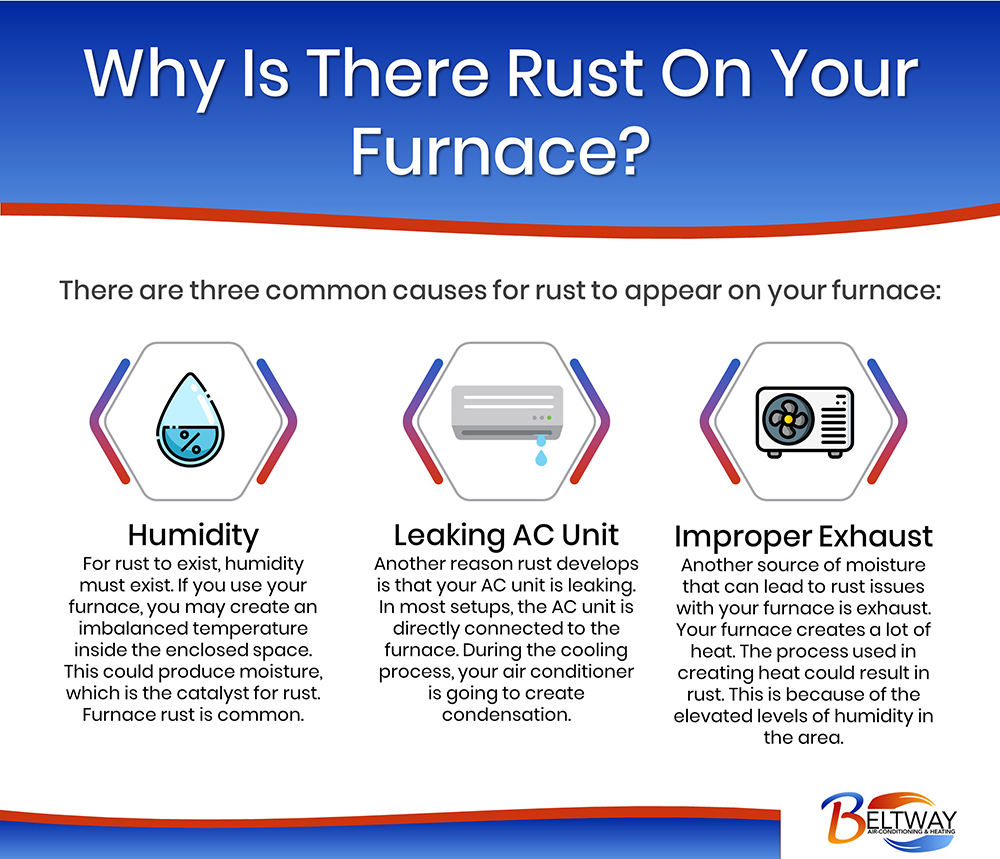
There are three common causes for rust to appear on your furnace:

Humidity: For rust to exist, humidity must exist. If you use your furnace, you may create an imbalanced temperature inside the enclosed space. This could produce moisture, which is the catalyst for rust. Furnace rust is common.

There is typically much moisture in the air if you live in a humid climate. You may inadvertently make the problem worse by adding more moisture into the air by not repairing water leaks or filtration in the area around your furnace.

why is there rust on furnace

Leaking AC Unit: Another reason rust develops is that your AC unit is leaking. In most setups, the AC unit is directly connected to the furnace. During the cooling process, your air conditioner is going to create condensation.

Your AC unit should have a condensation tray to collect this moisture. However, the condensation tray may be full or broken. This allows water to infiltrate your furnace, creating conditions where rust can form.
Additionally, your air conditioner is integrated into the same ductwork as your furnace if you have central AC. If there is any leak in your AC unit, it can find its way into your heating system and then produce the circumstances where rust can develop.

Improper Exhaust: Another source of moisture that can lead to rust issues with your furnace is exhaust. Your furnace creates a lot of heat. The process used in creating heat could result in rust. This is because of the elevated levels of humidity in the area.

Your furnace will raise the temperature of the surrounding air to a high level. However, that air will cool quickly as it leaves the burners. This will generate enough moisture in the system’s interior, leading to rust production.

Remember that your furnace, like every other heat exchanger, uses the process of condensation, evaporation, convection, and combustion to heat and move air.

Some energy-efficient furnaces have two heat exchangers. The second heat exchanger takes any water vapors from the hot flue gases and condenses them. This way, more heat can be extracted, allowing you to heat your house more efficiently. However, when there is condensation, there is water and the potential for rust.

When everything is working correctly, your condensation drain should remove the water from your furnace. However, your condensation line may be damaged or inefficient.

During frigid winters, your condensation line can freeze. Or your drain line may become clogged with dirt, algae, or another residue. In some cases, a leaky drainpipe is causing your furnace to rust over time.

Should You Be Concerned About Rust on Your Furnace?

Just about every furnace is going to rust eventually. Most furnaces are designed to work for between 10 and 15 years. Rust does not happen overnight. It is a gradual process that occurs as your furnace repeats the heating and cooling process.

If you notice that an older furnace has rust, there is no reason to panic. Beltway Air Conditioning and Heating has experienced HVAC technicians who can evaluate your furnace’s condition and provide you with solutions to either repair damaged areas or start the process of replacing your furnace.

If your heat exchanger is rusting and you do not replace or repair the unit, you risk having carbon monoxide enter your home. While a small amount of rust on an older furnace is not a significant cause for immediate concern, rapidly expanding rust on a newer model or a lack of rust on your older furnace would merit further investigation.

The Dangers Produced by a Rusting Furnace

If left unchecked, rust will make your system degrade faster than it typically would. For example, rust on the burner jets will eventually clog them, diminishing their effectiveness. This means that your unit will need more fuel to provide the same level of heat. This inefficient performance leads to an increase in carbon monoxide being released into your home. This is dangerous for you and your furry friends.

Rust may affect your unit’s fuel supply lines. If this happens, you are in a hazardous situation. A life-threatening and property-damaging fire or explosion could occur. A severely rusted furnace is more than just an eyesore. If you notice that the exterior of your furnace has rust, the interior is likely already corroded by rust.

Purchasing a furnace is a considerable investment. You want your furnace to last for as long as possible. Thankfully, you can do a few things to keep your furnace working its best.

Monitor and Prevent Rust With Annual Furnace Maintenance

Yearly furnace maintenance includes an in-depth inspection of your system. It is affordable and will save you money in the long run, especially when you compare the price of maintenance to the cost of repairing or replacing your unit. Our HVAC technicians will thoroughly inspect your unit during a maintenance check, so you will know that your system is working as it should.

Fix Furnace Issues Quickly

A severely rusted furnace not only impacts how well the furnace functions, but it also puts the health and well-being of your family at risk. Therefore, you should make it a priority to repair HVAC issues immediately.

The goal is to identify the reason behind the rust in your furnace. Resolve those issues or eliminate them promptly. Once the problems have been resolved, all corroded parts should be repaired or replaced.

In some cases, depending on the age of your furnace and the severity of the degradation, your system may require more than just a repair. The expense of bringing your furnace back to safe conditions may be more than what the unit is worth. Please consult with our HVAC technicians. We will be happy to help you with any rust furnace problems.

If You See Rust, What Should You Do?

If you see rust on your furnace, contact our experienced HVAC technicians. Rust means that there is condensation somewhere, which could indicate a more significant problem. Remember, just because you see rust, it doesn’t mean that you will necessarily have an expensive repair bill.

At Beltway Air Conditioning and Heating, we have been serving Handover and the surrounding area by providing top-notch HVAC system installation and repairs for years. We are proud to be distributors of the most energy-efficient, dependable furnaces, boilers, air conditioners, and heat pumps on the market. Whether residential or commercial, our technicians have the experience, skills, and tools needed to keep your space comfortable.

Do you need your furnace inspected? Do you need to heating repair or furnace replacement? If so, contact us today. We have the knowledge, expertise, and experience to do the job right.

Heating System Installation Costs: What You Need to Know

A central heating system is instrumental to homeowners, especially to people living in cold areas. Installing a heating system may sound hectic and expensive. However, you don’t have to worry about that when you have Beltway Air Conditioning and Heating doing the work for you. We offer the best services with our qualified technicians at affordable rates. Our technicians are highly skilled and will efficiently install or replace your heating system. Enjoy a new functional, effective heating system that’s reliable.

Factors That Affect the Cost of Installing a Heating System

The cost of installing a heating system encompasses many other activities, such as the system’s cost, labor, removal, and disposal of an old furnace. The cost also includes any upgrades if possible. Installation costs of a furnace are affected by several factors.

For instance, the size of your home is essential. It would be best if you had a furnace whose size is comparable to the size of your house. A system too big will not heat your house well, while a minor system will struggle to heat the home. This might damage or overwork the system, causing damages that might result in unnecessary costs. This will affect the costs as a bigger house requires a more extensive system and more labor to install.

The energy efficiency of the system is also an important matter. Heating systems are rated by the Annual Fuel Utilization Efficiency (AFUE). They rate how much energy is converted to heat by a furnace. The higher the AFUE, the higher the efficiency of a system. A more efficient system is constantly compared to a lower-rated one. In the long run, the lower-rated one may be cheaper, but it may result in more hidden costs such as repair costs. You may also have a house that is not well heated, which may result in health complications.

The level of comfort you want will also affect the cost of the system. Homeowners who wants a basic furnace will pay less than those who want a more elaborate one where they control nearly all aspects, such as fan speeds.

In addition, the cost of installing your heating system will depend on how long you want to live in your current house. If you have plans to move to a new prospective home in the near future, it may be wise to install a basic model that might not cost you much. If you plan on staying longer, it’s better to invest in a quality heating system to get the best of the home.

Before installing your heating system, you should consult technicians from Beltway Air Conditioning and Heating who can give you the best advice on the type you should get. Don’t get a system that will not benefit you.

The Cost of Installing a Heating System

Considering the factors we have discussed, the average cost of installing a unit furnace ranges between $2,672 and $6,575. This will depend on the location of your furnace, the size of your home and the type of furnace you want to be installed. The total costs of installing a furnace, including labor and other expenses, will range between $4,820 and $9,350.

Depending on the type of furnace, the installation costs differ, too. For instance, on average, a natural gas furnace will cost $1,825 and $5,500 to be fully installed. A propane gas furnace will cost roughly $1,400 and $3,750 to be fully installed. An oil furnace will cost roughly $1,500 and $4,000 to be fully installed, and an electric furnace will cost roughly $850 and $3,000 to be fully installed.

Consult our technicians at Beltway Air Conditioning and Heating to get more info and a personalized budget on installing your heating system.

Why Heating System Maintenance Is Important

A heating system, just like any other mechanical device, requires maintenance to function well and for longer. We offer maintenance and repair services at affordable costs. One benefit of maintaining a heating system is reduced costs of energy. A well-maintained heating system does its work seamlessly hence uses less energy to function. A system that is, for example, dirty uses more energy to raise the temperature.

A well-maintained system enhances the comfort of the occupants of the home. The system has no leaks and heats the house consistently according to the setting you want. It also maximizes the best airflow; hence the house does not feel congested. All these benefits enhance comfort.

A sound heating system also ensures enhanced air quality. As the air is being heated, it goes through the ductwork in your home. If the ductwork is dirty or has loose items such as trapped dust, the dust may be carried along and make the air uncomfortable. You may also have weird smells in your house that may come with leaked gases. These issues may affect anyone in the house who has respiratory conditions.

A well-maintained heating system also ensures the safety of the occupants of the house. The venting system carries away any carbon monoxide formed. A faulty system will have some of this carbon monoxide leaking into the home. We all know carbon monoxide is a poisonous gas and may affect the people in a house adversely, such that it may cause death in extreme conditions.

If your heating system is well maintained, it will be reliable. This is because scheduled checks and repairs get rid of any problems that may arise. Without maintenance, the issues may grow and become harder to repair or become more expensive. A well-maintained heating system will serve you for a long time. It will also cost you minimal repair costs as the issues are detected and dealt with earlier.

Routine maintenance also reduces wear and tear on your unit. Any unit especially that functions mechanically is prone to wear and tear on its parts. This may cause reduced efficiency and general damage to the system. It’s wise to conduct routine maintenance checks to resolve any causes of wear and tear. Ignore this and you might incur higher costs in repair later or a total overhaul of the system.

Contact Beltway Air Conditioning and Heating to get maintenance services at an affordable cost. Our maintenance service includes:

  • Cleaning air ducts and air filters
  • Lubricating any moving parts of the system
  • Inspecting ductworks
  • Tightening loose parts

A heating system is essential in a home. A heating system ensures the homeowners are comfortable in the house by distributing heat efficiently. A heating system also prevents dust and other particles from circulating around in your home. This is a plus in keeping the home clean and keeping people healthy.

At Beltway Air Conditioning and Heating, we offer quality heating installation and replacement, routine maintenance services for your heating services, repair and servicing of heating system and indoor air quality service. Dealing with your heating system is very difficult and may cost a lot. That is why we are here. We will take care of everything for you, making sure you get quality heating in your home.

We have qualified technicians on call who are well equipped to handle all your heating problems. Your heating system is essential for you. So, why not let the best handle it for you? For a free quotation, contact Beltway Air Conditioning and Heating in Hanover, MD, now. We provide heating, cooling, and indoor air quality solutions.

Book Online

"*" indicates required fields

This field is for validation purposes and should be left unchanged.
Phone confirm*