Why Your Thermostat Isn’t Reaching The Set Temperature

One of the smartest ways to save money on energy bills is to invest in programmable and smart thermostats. Smart thermostats provide remote control and adaptive learning. Both technologies let you schedule energy-efficient temperature changes. These devices lead to enhanced personalized comfort and significant energy-saving capabilities. Maintaining the thermostats regularly enables precise temperature readings and optimal performance. Battery replacement, cleaning, and calibration are of the utmost importance. If you ignore thermostat maintenance and care, you may end up with a device that can’t reach the set temperature. When this happens, expert help is almost always necessary.

1. Incorrect Thermostat Settings

When it comes to home comfort and efficiency, nothing is more important than having the thermostat set correctly. Homeowners sometimes make the mistake of setting their thermostats too hot in the winter or too low in the summer. This makes it difficult for the system to achieve the proper temperature. For example, leaving the fan on the “On” setting is an example of an incorrect setting that might make it difficult to reach the set temperature.

2. Dead Batteries

The average life span of a thermostat battery is six to 12 months; however, this might vary with use. The thermostat’s inability to maintain the desired temperature due to dead or low batteries will cause problems with the HVAC system like ineffective heating and cooling. In order to keep the thermostat running smoothly, it is important to check and replace the batteries on a regular basis.

3. Dirty or Malfunctioning Sensors

The system will not be able to attain the set temperature if the thermostat’s sensors are dirty or not working properly. Erroneous readings caused by dust, dirt or malfunctioning sensors might result in improper heating or cooling cycles. For accurate temperature regulation and peak efficiency from your HVAC system, have a professional clean and maintain the sensors regularly.

4. Poor Thermostat Placement

Misplaced thermostats make it difficult to get reliable temperature readings. As a result, this makes it impossible for the system to attain the set temperature. Do not put thermostats in drafty places or close to heat sources. Placement on inside walls, away from light, windows, and appliances, is ideal.

5. Malfunctioning Heat Anticipator

A premature system shutdown may occur if the thermostat’s heat anticipator isn’t working properly, which throws off the timing of the heating cycle. This can cause the thermostat to fall short of its target temperature, leading to insufficient heating. If you want your thermostat to reliably predict when to turn off the heat for maximum comfort, an expert needs to check and modify the heat anticipator regularly. This mainly applies to older thermostats. Digital thermostats don’t have heat anticipators.

6. Software Glitches

Smart and programmable thermostats rely on complex software for tasks like learning, scheduling, and remote control. These operations are susceptible to disruption by software bugs, which may lead to faulty temperature settings or system failures. To avoid software-related problems, it is vital to update firmware regularly and troubleshoot as needed.

7. Power Supply Problems

If the power goes out or there are variations in the electrical current, the thermostat won’t be able to achieve the temperature you’ve programmed it to. This can lead to false temperature measurements and even a full system shutdown. For the thermostat to consistently work and keep the temperature under control, it is essential to have a steady power supply and to use surge protection. A whole-house surge protector is the best option for protecting your HVAC system against power surges. These devices protect thermostats and other HVAC appliances against sudden spikes in electricity. To further fortify your home’s HVAC system, you can install surge-protected power strips and point-of-use surge protectors for certain equipment.

8. Loose or Damaged Wires

Thermostats malfunction and provide erroneous temperature readings if their wires break or become loose. Experts will double-check the electrical connections during regular HVAC maintenance. The transmission of signals between the HVAC system and the thermostat relies on the correct wiring. It’s very important that you don’t attempt to perform any electrical work yourself. Trained and licensed HVAC workers have the expertise and skill that it takes to perform electrical work safely.

9. Faulty Relay Switches

Thermostats and HVAC systems lose connection if the thermostat’s relay switches are faulty. This can cause the system to malfunction, fail to attain the desired temperature and provide erroneous temperature control. To make sure the relays work properly, have a professional check them often, test them, and replace broken ones.

10. Dirty Air Filter

A dirty air filter limits airflow in an HVAC system. This makes it impossible for the thermostat to achieve the desired temperature. Plus, the system has to work harder due to the reduced airflow, which might cause overheating or overcooling. The easiest way to avoid this problem is by changing the air filter every one to three months, or any time that it is dirty.

11. Corroded Contacts

Thermostats have contact sensors that regulate the temperature, turn the fan on or off and perform other functions. When contacts get corroded, they interfere with these operations and make it harder for the thermostat to attain the set temperature. Humidity, condensation, and contamination are common reasons for corrosion. To keep the contacts from corroding, homeowners should keep the thermostat dry and schedule timely repairs whenever they notice rust.

12. Sensor Calibration Errors

Thermostats use a variety of other sensors. Some sensors gauge the ambient temperature. Humidity sensors measure moisture levels. Occupancy and proximity sensors detect resident activity and user interactions. Flaws in the calibration of these sensors can give rise to inaccurate temperature readings. Because of this, the thermostat may fail to heat or cool the home according to the desired setting because it misreads the ambient temperature. The best way to avoid this issue is by having a professional calibrate the thermostat sensors during every HVAC maintenance visit.

13. HVAC Compatibility Issues

Problems with HVAC compatibility can make it difficult for a thermostat to regulate the temperature. Problems like these occur when the thermostat isn’t designed to work with the specific wiring or technology of the HVAC system. Because of this, homeowners should check to see whether a thermostat is compatible with their HVAC system before buying it. It also helps to talk to experts in the field or read the manufacturer’s compatibility specifications.

14. Display Problems

Electrical problems, broken parts and software errors can all cause thermostat displays to fail, leading to flickering or blank screens. This can make it impossible to know what the set temperature is. Experts take precautions during installation, tie wires securely, and update the thermostat’s software to prevent these issues. To avoid display problems in the future, it’s important to protect the device from power surges and to schedule expert checkups.

Homeowners in Hanover, MD rely on our technicians at Beltway Air Conditioning and Heating to meet all of their thermostat needs. We also help homeowners with HVAC installations, repairs, and maintenance, as well as indoor air quality testing and duct cleaning. Contact us today to schedule a thermostat inspection.

A Homeowner’s Guide to HVAC Ductwork

The ductwork in your Hanover home is a vital part of the HVAC system. All homeowners should know about the common issues, the various components that make up their system, and the maintenance needs of ductwork. This will all help you to quickly recognize problems and keep your home’s ductwork in the best condition possible.

Ductwork Components

Several parts make up your home’s ductwork system. The supply ducts are usually on ceilings, walls, or floors. They are responsible for transporting the air to the rooms in your home from the HVAC system. You will find the return ducts in a central location, such as ceiling cavities or hallways. These will take air from your rooms and return it to your HVAC unit.

The grilles and air registers function as intake points for return air. They also control the level of airflow in rooms. There are plenums at the ductwork and HVAC unit junction that connect your duct system to your HVAC unit.

HVAC Ductwork Types

You can choose from different types of HVAC ductwork. Flexible ducts have a metal inner cord or flexible plastic, an outer layer, and insulation. This type is versatile, easy to install, and ideal for areas that have limited access. Sheet metal ducts are usually galvanized steel. They are long-lasting, durable, and less vulnerable to damage.

Fiberglass duct board has an outer coating over fiberglass insulation. It is resistant to moisture, lightweight, and good for thermal insulation. There are also rigid fiberglass ducts made from rigid fiberglass boards that are particularly durable with strong insulative properties.

Installing Ductwork

It is imperative to have a professional install your ductwork. With proper installation, you will have reduced energy waste, efficient airflow, and enhanced system performance. A professional will come and inspect your home to ensure that the ductwork is the right size and matches the capacity of your HVAC system.

Professionals will properly seal all of the connections and joints to minimize the leakage of air. They do this via the use of metal or mastic tape. In unconditioned spaces, they will insulate the ducts to prevent heat gain or loss. They will also ensure the proper location of your ductwork so that it works as efficiently as possible.

Ductwork Maintenance and Cleaning

The general recommendation is to have ductwork cleaning and maintenance every three to five years. They will start by doing a visual inspection to look for loose connections, damage, or disconnected sections. This part of the process also includes looking for possible obstructions and ensuring that airflow is consistent.

You should have a professional thoroughly clean your ducts on a regular schedule. This will remove dirt, debris, and other impurities. Without proper cleaning, these impurities get pushed out through the vents and can harm your home’s indoor air quality.

They will check the insulation and sealing of your ductwork. To prevent air leaks, they will reseal any joints or connections that need it. A professional will replace any sections of insulation that have damage. They will pay particular attention to unconditioned areas of your home, such as crawl spaces or your attic. These may require additional insulation to reduce the risk of the air passing through the ducts to experience temperature changes.

Talk to a professional about changing your HVAC filters if you don’t already know how to change them on your own. You should use the manufacturer’s guidelines and the professional’s advice to ensure that you change them regularly to help ensure efficient and clean airflow.

Optimizing Ductwork Efficiency

Regular cleaning and maintenance are vital for optimal ductwork efficiency, but there are some other things you can do too. Throughout your home, you can balance the airflow. A professional can help you to properly adjust your ductwork dampers for this purpose.

Use a high-efficiency air filter for your HVAC system. This helps reduce debris and dust to keep your ductwork cleaner for longer. A professional can help you to choose the best and most efficient filter for your HVAC system.

Consider installing air dampers in your ducts. These allow you to adjust and control the flow of air to different spaces in your home. You can determine the individual needs of the different rooms in your home and optimize the airflow for each one.

Common Ductwork Problems

Homeowners should be aware of the most common ductwork problems. Recognizing these issues and understanding why they occur can help you to know when to call in a professional.

Leaky ductwork can cause conditioned air to leak out, wasting energy. This could also cause uneven cooling or heating throughout your home. If you notice that your home’s airflow is uneven or certain rooms feel drafty, your ductwork may be poorly balanced. A professional can come in and adjust your dampers. With properly balanced airflow, every room in your home will receive sufficient and even airflow and maintain a steadier temperature.

In some cases, something could be restricting the airflow. Check the air vents and make sure that there are no obvious obstructions, such as boxes, debris, or furniture. If this does not solve the issue, you should call a professional to come in and inspect your ductwork. Your ducts may have too many turns, bends, or sharp angles, which could reduce efficiency and make it harder for air to flow smoothly through your duct system.

Over time, aging or poor insulation could lead to disconnected ducts. Air will escape before it can reach your vents and throughout your home. You might notice that the temperature in your home does not match the thermostat. Age-related damage in your ducts, such as tears or punctures, could be to blame. A professional can assess the damage and determine if they can fix it or if they need to replace the damaged ductwork.

Inadequate return air is a relatively common issue. If this occurs, it could result in reduced system efficiency and pressure imbalances. Make sure that there are no obstructions by your return air vents. A professional can also look at them to ensure that they are the right size since improper sizing could also cause this problem.

Ducts in cool spaces without insulation could be susceptible to condensation if there is excessive humidity. This is a potential issue for ductwork in crawl spaces or basements. Over time, this moisture could cause duct material deterioration, mold growth, and reduced efficiency. A professional will come out and inspect all of your ductwork to see if they can make improvements to the insulation to prevent condensation problems.

HVAC Experts in Hanover

With this information, Hanover homeowners can maintain their ductwork more effectively and efficiently. Our team is here to help with any maintenance, cleaning, or repairs you need. We can also assist with all of your home’s other HVAC needs as well as your carbon monoxide detectors and indoor air quality needs.

Contact Beltway Air Conditioning and Heating in Hanover today to learn more about maintaining your home’s ductwork.

How to Measure Your Home’s Indoor Air Pollution

How to Measure Your Home’s Indoor Air Pollution

Maryland homeowners take great pride in their properties. They understand the importance of providing their families with safe and comfortable places to live. However, for a lot of homeowners, it’s easy to disregard indoor air quality and the role it plays in their comfort. Understanding, monitoring, and improving the air you breathe is crucial because poor indoor air quality can have detrimental impacts on your health and well-being. As your reliable HVAC and indoor air quality experts, we’ve put together this detailed guide to help you understand the importance of clean air in your home, how to spot the warning signs of poor air quality, and what instruments and solutions you can use to make the air healthier.

Benefits of Good Indoor Air Quality

There are a number of reasons for Maryland homeowners to improve the quality of air inside their homes. Good indoor air quality not only reduces the presence of airborne pollutants, but it also promotes respiratory health. This is especially advantageous to those with existing allergies or respiratory conditions. Air quality also affects how comfortable your home is. It eliminates unpleasant odors and provides a better living environment.

It’s also worth noting that indoor air quality affects how well you sleep. The dirtier the air, the harder it can be to fall asleep and stay in restful slumber. Poor indoor air quality also makes it difficult to focus, which can affect your productivity levels. Lastly, indoor air quality affects your furnishings and appliances. The dirtier the air is, the harder the HVAC system has to work to keep the home at a comfortable temperature. This can cause the HVAC system to endure lots of unnecessary wear and tear. As a result, poor indoor air quality can end up resulting in costly HVAC repairs and replacements.

Common Indoor Air Pollutants

Indoor air pollutants include a wide range of chemicals that have the potential to degrade the air quality inside dwellings. Allergens such as dust mites, pet dander, and pollen can all cause respiratory problems and allergies when they are present in high enough concentrations. Mildew and mold are health hazards because they multiply in wet places and release spores into the air. A number of common home items, including paints and cleaning materials, release volatile organic compounds (VOCs) that can irritate the respiratory system and your eyes.

Carbon monoxide, produced as a byproduct of combustion equipment, is a gas that may be lethal in large doses; it is colorless and odorless. A radioactive gas known as radon can seep into houses via the soil and cause lung cancer if inhaled. It is essential to identify and eliminate these contaminants to have a healthy home environment.

Signs of Poor Indoor Air Quality

When it comes to keeping a home a healthy and pleasant place to live, indoor air quality is paramount. There are a number of warning signals that poor air quality might send your way, and you shouldn’t disregard them. Improving the overall quality of the air you breathe inside the home and addressing any concerns requires you to recognize these indications.

Unpleasant Odors

To a greater or lesser extent, the presence of disagreeable smells is indicative of low indoor air quality. Mustiness, cooking fumes, or mold are all lingering odors that could be a sign of airborne contaminants. The first step in improving air quality and making a room more pleasant to live in is to determine where these smells are coming from and eliminate them.

Respiratory Issues

Coughing, sneezing, wheezing, or worsening allergies are typical symptoms of poor indoor air quality. A variety of airborne pollutants, including dust, pet dander, and mold spores, may aggravate the respiratory system and cause discomfort. You should definitely take action to improve the air quality in your home if you or anybody in your family has chronic respiratory issues.

Visible Mold or Mildew

Surfaces that have mold or mildew growing on them are a clear sign of high humidity and poor air quality in the home. Airborne mold spores are a health concern and a major factor in respiratory issues. To improve air quality and avoid future problems, it is essential to address the source of moisture, improve ventilation, and remove mold.

Excessive Dust Accumulation

Particles of dust, which might include pollutants and allergens, can impact how clean your house is. Excessive dust collection on surfaces, even after frequent cleaning, may indicate poor indoor air quality. To reduce excessive dust, it’s helpful to improve air filtration, use air purifiers and keep the surroundings dust-free.

Feeling Fatigued or Unwell

Indoor air quality might be a problem if you often feel sick to your stomach, lightheaded, or exhausted while you’re indoors. If you breathe in polluted air or have poor ventilation, you can experience these symptoms. If you find that getting outside makes you feel much better, it’s time to make some changes to your inside surroundings.

What Happens During Indoor Air Quality Testing?

To determine how healthy the air is in your house, a professional can do an extensive indoor air quality test. After an initial evaluation of your concerns and any visible problems, qualified experts carry out a comprehensive checkup. During the testing, experts will take air samples from different parts of your house to measure the levels of pollutants, allergens, and other particles in the air. Mold, radon, CO, and VOCs are some of the contaminants that may undergo targeted testing. After taking the samples, they are carefully analyzed to determine the kinds and concentrations of pollutants. Based on their findings, air purifiers, ventilation systems, and humidity controllers are some of the remedies that the experts might suggest to help you achieve better indoor air quality.

Types of Air Quality Monitors

There are several types of air quality sensors that you can use to improve your home’s indoor air quality. These sensors include smoke detectors, VOC detectors, and carbon monoxide detectors. VOC detectors help homeowners find and address high levels of VOCs. Carbon monoxide detectors identify the presence of this odorless gas, which can be deadly if left unaddressed.

Benefits of Whole-Home Humidifiers and Dehumidifiers

To create a healthy interior atmosphere and reduce the likelihood of respiratory discomfort and allergies, it is important to maintain regulated humidity levels. Dry skin, congested nasal passages, and static electricity are all things that a humidifier can help you avoid. These gadgets reduce the likelihood of mold and dust mite development by putting moisture into dry air. Dehumidifiers cut down on extra moisture, which means mildew and musty smells are less likely to be an issue. All of these things working in harmony make sure that your house stays at the perfect humidity level, which is good for your health and comfort.

Are you ready to make your home a healthier place to live? If so, Beltway Air Conditioning and Heating is here to help with our wide variety of indoor air quality services. We can also make your home more comfortable thanks to our heating and cooling services, including duct cleaning. Give us a call today to learn more about improving your Hanover home’s indoor air quality.

Thermostat repair in Hanover, MD

6 Common Thermostat Issues and How To Solve Them

Although you might not think about it much, your home’s thermostat is critical to your comfort. It has the important job of sensing the temperature conditions in your home and activating your HVAC to meet your comfort preferences. When the thermostat is working well, it’s easy to ignore. When it’s not, however, your home’s comfort will likely be at the top of your priority list. Here are six of the most common thermostat issues and how you can solve them.

1. Your Home Never Reaches Your Desired Temperature

One of the most common thermostat problems occurs when you set your desired temperature, but your home never reaches it. This can happen for a variety of reasons. The first thing to check is whether your thermostat is in the proper mode. If it’s winter and you’ve left your thermostat set to cool, it won’t activate your home’s heat to reach the temperature you’ve set.

You should also check that your thermostat’s fan setting is in the auto position. This allows the thermostat to control the function of your HVAC’s blower fan as necessary. If you have it set to the on position, the fan won’t ever turn off and may interfere with your thermostat’s ability to reach your desired temperature.

2. Your Thermostat’s Temperature Reading Is Wrong

If you’ve ever noticed that your thermostat shows an indoor temperature that doesn’t match what you’re feeling, you may not be imagining it. It is possible for a thermostat to register an erroneous temperature for a variety of reasons. One of the most common is a dirty thermostat.

If it’s been a while since you’ve cleaned your thermostat, try dusting it to see if it fixes the temperature reading. You may also want to use a can of compressed air to blow out any dust that’s gotten inside the thermostat.

If cleaning your thermostat doesn’t do the trick, it may be miscalibrated. Most thermostats have a calibration mode that allows you to correct their temperature readings to compensate for installation conditions. To fix this problem you need to find your thermostat’s instruction manual. Using a thermometer, follow its calibration procedure to correct its temperature reading.

3. Temperature Readings Fluctuate

If you notice that your thermostat seems to read the temperature differently at different times of day, it may be installed in the wrong place. Your thermostat’s temperature readings can get thrown off by excessive sunlight, drafts, or any other sources of abnormal temperature fluctuations. However, fixing the problem isn’t necessarily easy.

If sunlight from a nearby window is interfering with accurate temperature readings, you can try to solve the problem using blinds or curtains. However, if your issue is hot or cold drafts that you cannot control, you might need to relocate the thermostat. Call Beltway Air Conditioning and Heating for help. Alternatively, you can purchase a thermostat with a remote temperature sensor and put that in a more appropriate and draft-free location.

4. Thermostat Display Not Working

If you try to set your thermostat and find that its display won’t turn on, don’t panic. If your thermostat uses batteries for power, it could be an indication that you need to replace them. This is usually as simple as opening a battery door, removing the old batteries, and inserting new batteries.

However, if you have a thermostat that relies on a C-wire for power, you could have a bigger problem. This might indicate something as benign as a loose wire, or it could indicate that there’s a problem with your HVAC control circuitry. You may also have a tripped breaker in your home’s main electrical panel. Of course, an inactive thermostat display could simply mean your thermostat has broken. To find out which, it’s a good idea to call Beltway Air Conditioning and Heating for a repair visit.

5. Your Thermostat Lacks Modern Features

Depending on when you had your home’s HVAC installed, your thermostat can be anywhere from a few years old to a few decades old. In the latter case, your thermostat might simply lack modern features. Older thermostats may not give you the ability to set heating and cooling schedules. They almost certainly won’t connect to Wi-Fi, allowing you to control your HVAC from your smartphone or voice assistant.

If you’re dealing with an old thermostat, you should consider replacing it. Doing so can be an inexpensive way to update your HVAC system to a more modern standard. This can improve your home’s comfort substantially, and that’s not all. A new thermostat could improve the efficiency of your HVAC and lower your energy bills significantly.

According to the US Department of Energy, even the simplest programmable thermostat can save you about $180 every year. That’s more than enough to pay for the upgrade in most cases. Even better, a smart thermostat could save you between 10% and 15% on your HVAC energy costs every year. Plus, you’d gain a plethora of new functions, including things like smart home integration, geofencing using your smartphone’s location data, and advanced data collection to better track your energy usage.

6. Your HVAC Keeps Running

Lastly, if your thermostat turns your HVAC on, but it keeps running long after reaching your set temperature, you may have a faulty thermostat. Fortunately, this is not a problem that happens very often. When a thermostat fails, it’s more likely to make your HVAC inoperable, not the other way around. However, if you notice that your HVAC keeps overshooting your set temperature by significant margins, it’s probably broken.

To solve the problem, you’ll need to replace your thermostat. If you choose to replace yours with a similar model, it may be possible to do the work yourself. However, if you use a thermostat failure as an opportunity to upgrade, you might need professional assistance. This is especially true if your existing thermostat is an older, battery-powered model, because your new thermostat may require some additional wiring to function.

Your Local Thermostat Experts

Since 2015, Beltway Air Conditioning and Heating has offered homes and businesses throughout Hanover, MD, and the surrounding area the finest HVAC services available in the region. That includes installation, repair, and maintenance of HVAC systems, including thermostats. We also offer indoor air quality solutions, ductwork services, and duct cleaning, too. Locally owned and operated, we’re proud to have a fully licensed team of HVAC technicians on staff and an A+ rating and Better Business Bureau accreditation. We even offer financing on approved credit to help you better afford the HVAC systems and services you need.

For thermostat repairs and replacement throughout the Hanover area, call our team at Beltway Air Conditioning and Heating today.

What Certifications to Look for in an HVAC Contractor

What Certifications to Look for in an HVAC Contractor

HVAC technicians in Hanover, MD, are concerned with improved credibility and employment opportunities and the ability to provide greater services to their customers, pursue continuing education, and earn additional certifications. They understand the value that HVAC certifications bring in addition to on-the-job experience.

HVAC Licensing in Maryland

HVAC technicians help homeowners ensure that their HVAC system functions properly. Their job includes diagnosing and repairing issues and installing new HVAC systems.

An HVAC license offers customers a competency guarantee. When you hire a licensed HVAC technician, you know that you’re working with someone who has proven that they can pass all the required training programs and certifications and have garnered the necessary experience to diagnose and repair different HVAC issues.

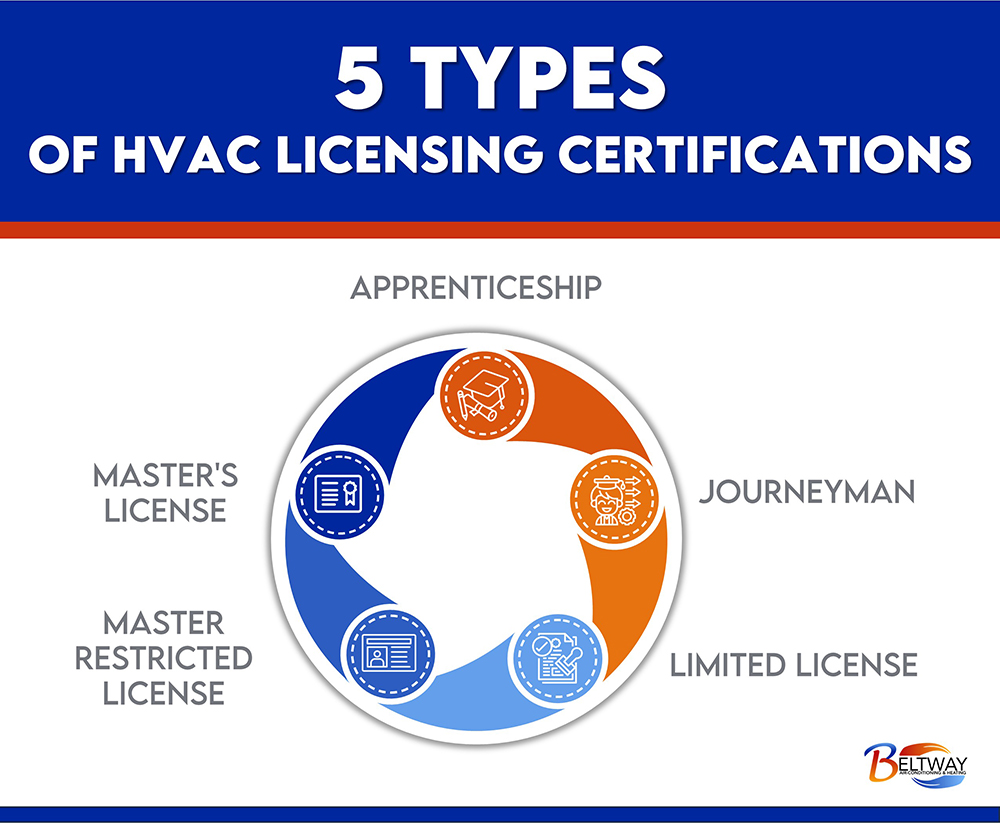
Currently, Maryland offers five types of HVAC licensing certifications. These are apprentice, journeyman, limited, master restricted, and master. Before reaching each level, HVAC contractors must meet certain qualifications.

Apprenticeship

This is the starting point for all professionals in the HVAC industry. This license allows them to work under a licensed HVAC contractor.

Journeyman

With a journeyman’s license, a technician is proving that they have three years of experience as an apprentice and have at least 1,875 hours of working and training under an HVAC contractor.

Limited License

To qualify for this license, a technician needs to work as an HVAC journeyman for at least two years under the supervision of a master HVAC contractor. They need 1,000 hours of supervised work for at least one year before applying for the license.

5 types licensing

Master Restricted License

In order to obtain this license, an HVAC tech will need to be a journeyman for three years working under a licensed master contractor. They will need 1,875 hours working like this before applying.

Master’s License

A master’s license requires an applicant to be a three-year journeyman working under an HVAC master contractor. They will need to complete 1,875 hours of work the year before applying. A master’s license means a person has a more in-depth understanding of HVAC principles than one with a master-restricted license.

EPA 608 Certification

This certification is required for HVAC technicians in harmony with the Clean Air Act. It is for individuals who repair, maintain, service or dispose of equipment that has the potential to release refrigerants into the atmosphere.

To obtain this certification, technicians need to pass an EPA-approved test. The test is specific to the equipment the HVAC tech will work on. They are administered by EPA-approved organizations. Thankfully, the Section 608 Technician Certification credentials do not expire.

The EPA has four types of 608 certifications. Type I is for technicians who work on small appliances. Type II is for technicians working on or disposing of high or very high-pressure appliances. Type III is for disposing of or servicing low-pressure appliances. Universal certification is for servicing equipment of all types.

NATE Certification

NATE, or North American Technician Excellence, represents a nonprofit certification group that centers on HVAC and refrigeration technicians. The HVAC industry develops, operates, supports, and endorses NATE.

The late 90s saw the founding of NATE, with a sharp focus on aiding technicians in elevating their knowledge and skills beyond the competition. NATE certification serves as proof of a technician’s proficiency in various facets of the HVAC industry. Pursuing NATE certification is a voluntary choice that allows technicians to showcase their industry expertise.

To acquire NATE certification, technicians must successfully pass a comprehensive written exam. These exams don’t simply test textbook memorization. They are designed to evaluate a technician’s real-world comprehension of air conditioners, oil furnaces, heat pumps, and more. The exam delves into intricate issues, ensuring that certified technicians possess in-depth knowledge.

In contrast to EPA 608 certifications, which have indefinite validity, NATE certifications are valid for five years. This finite duration reflects the ever-evolving nature of HVAC technology. Thus, NATE certification attests to a person’s up-to-date industry knowledge.

When you hire a NATE-certified technician for your property, you can rest assured knowing that you’re working with someone dedicated to correctly completing the job on the first try. You know that the technician possesses the training and expertise to effectively address any HVAC system issues, providing you with the peace of mind that the job will meet or surpass safety requirements.

HVAC Excellent Certification

HVAC Excellent Certification, widely recognized in the HVAC industry, applies to educators, technicians, and education programs, demonstrating the competence of certificate holders in HVAC and HVACR.

The ESCO group responsible for creating this certification aims to enhance technical competence within the HVAC industry. Established in the early 1990s, the Excellence Certification ensures a consistent education process that validates technicians’ competence in various HVAC areas.

HVAC Excellence Certification offers a series of discipline-specific written exams for professional technicians, each comprising 100 questions. These exams assess a technician’s competence in various areas, such as combustion analysis, heat pump installation, gas heat, residential air conditioning, electric heat, and more. Professional-level exams require technicians to have at least two years of verifiable work experience and pass the core exam before taking these exams.

Technicians can choose the disciplines they want to be certified in. Once a discipline is successfully completed and they receive their certificate, they can progress to the next level, aiming to become a master specialist in that particular discipline.

Hiring a Certified HVAC Technician: The Benefits

Hiring a certified HVAC technician offers several advantages, including working with a professional who comprehends the significance of delivering top-tier work and is committed to ensuring your HVAC system operates at its best.

Cost Savings

When you hire a certified HVAC technician, you save money. The job is completed correctly the first time, eliminating the need to pay someone else to re-do a subpar job.

Access to Professional Expertise

When you work with an HVAC professional who continually undergoes specialized training, their certificates demonstrate their adherence to local regulations and ability to address your inquiries regarding HVAC system issues while offering expert solutions to meet your needs effectively.

Safety Awareness

Working on an HVAC system can be hazardous for those lacking the necessary training and experience. When you partner with a certified professional HVAC technician, you can rest assured that they employ the latest industry methods to maximize safety while working on your system.

Bringing Comfort Straight to Your Maryland Door

At Beltway Air Conditioning and Heating, we understand that we need to do it right when it comes to home comfort. For this reason, we are committed to keeping our customers comfortable all year round with well-maintained furnaces and air conditioners. We are proud to employ licensed, trained technicians, and we are a locally owned and operated company. We have an A+ Better Business Bureau rating and work hard to maintain it.

Our services include HVAC installation, maintenance, and repair. We also offer indoor air quality testing, air purifiers, carbon monoxide detectors, and humidifiers. In addition, we do duct cleaning and install new ductwork. Contact Beltway Air Conditioning and Heating today and experience the satisfaction of working with qualified professionals using quality HVAC products in your home or business.

Heat Pumps vs. Furnaces

Heat Pumps vs. Furnaces: What to Know

Choosing between a furnace-based heating system or a heat pump for your Columbia home can be challenging. Both a heat pump and a furnace have the same purpose, which is to keep your home warm during the winter. However, they have drastically different approaches to providing heat. In certain situations, the heat provided by a furnace is best. In others, the heat from a heat pump is superior.

What Is a Heat Pump?

A heat pump is a system that can both heat and cool your home. Unlike a furnace that uses combustion to heat your home, a heat pump transfers the heat from the outside into your home. The heat is pulled from the outdoors and is transferred to a liquid refrigerant. This refrigerant is transferred to a heat exchanger, and air is blown across the heat exchanger, pushing the heat into the home.

Many people are surprised to learn that it does not need to be hot outside for a heat pump to be able to pull heat energy from the ambient temperature. A heat pump can work in temperatures that are below freezing. However, the colder it is outside, the less efficient a heat pump is to produce heat.

What Is a Furnace?

A furnace uses forced air to heat a home or office. Unlike a heat pump that transfers heat from one place to another, a furnace uses combustion or electric heating to generate heat. The heat produced in the burner is transferred to a heat exchanger. Then, a large fan pushes air across the heat exchanger, heating it and dispersing it through the home’s ductwork to individual rooms.

Primary Differences Between Heat Pumps and Furnaces

The purpose of a heat pump and a furnace is the same. They use some of the same components, such as the blower system. However, they have significant differences.

Heat Pumps vs. Furnaces

There are differences between heat pumps and furnaces that homeowners should consider before making a selection.

Heat Pump Cost

A heat pump will run you somewhere between $3,500 and $5,000 to install. However, other factors will determine the cost, including whether your home already has ductwork, the size of the home, the complexity, and the quality of the heat pump system you purchase.

The simplest, least expensive, and most commonly used heat pumps are air-to-air heat pumps. These will pull heat from the ambient air. Unfortunately, as the temperatures drop, these less expensive models start to experience problems.

Geothermal heat pumps pull heat from the ground. These take advantage of the fact that there is a constant 50-degree Fahrenheit temperature difference between the surface temperature and the temperature under the ground. Geothermal heat pumps are a lot more expensive than air-to-air models.

Furnace Cost

On average, you should expect to pay between $4,000 and $6,000 for a gas or electric furnace. Natural gas is more efficient than electricity. However, if your home does not already have a natural gas line, there is an expense in having one installed.

Heat Pump Efficiency

A heat pump is unbelievably efficient. They require a small amount of electricity to function, allowing them to transfer up to four times as much heat energy as the electric energy used to run the unit. The colder the temperatures are outside, the less efficient a heat pump becomes because it has to work harder to transfer enough heat to warm a room. Heat pumps become less energy efficient than a furnace at a certain temperature point, usually around -10 degrees Fahrenheit.

Furnace Efficiency

Furnaces use combustion to generate heat. Natural gas is a very effective heating option. However, it is way less efficient than a heat pump under normal conditions. A gas furnace is between 90% and 96% efficient. That’s the amount of heat produced through combustion that will be transferred into the home. An electric furnace, on the other hand, is 100% efficient. All of the heat created in the electric coils will be used to heat the home. The fact that a furnace creates its heat makes it a superior option in areas where temperatures during the winter are consistently below zero.

Furnace Durability

A gas furnace, as long as it’s properly maintained, will have a longer lifespan than a heat pump. Furnaces with proper maintenance can last for over 20 years. The heat elements of a gas furnace are only going to be used during the late fall, winter, and early spring months. This means that a furnace’s maintenance requirements are much lower than those of a heat pump.

Heat Pump Durability

A heat pump, similar to an air conditioner, should last around 15 years, having a shorter lifespan than a furnace. Since heat pumps can be used to both heat and cool the house, they will likely run all year round. Heat pumps may require more maintenance.

Heat Pump Appearance

Heat pumps are efficient and versatile, but they are not aesthetically pleasing. With a heat pump, you usually have a bulky standalone unit outside of your house. In the case of mini-splits, there is a large unit hanging on the side of the home on top of the home. These can detract from the aesthetics of the home.

Furnace Appearance

Unlike a heat pump, a furnace is unobtrusive. They are installed in the attic or basement, so they are out of sight and out of mind. This can be a factor to consider, especially if you live in a smaller home or have a smaller yard where you do not want to use up valuable real estate.

Heat Pump and Furnace Maintenance

A heat pump and furnace will require annual professional inspections and maintenance if you want them to work their best. Both systems also require homeowners to change filters and keep the area around the unit clean.

Heat Pump Versus Furnace: Which Is Right for Your Home?

Choosing between a heat pump and a furnace must be done on a case-by-case basis. In Columbia, Maryland temperatures can drop to around 25 degrees Fahrenheit during the winter. While this is still well within the range of a heat pump, it will take a heat pump a lot longer to heat the home at these temperatures than it will a furnace. On the flip side, a heat pump can provide an energy-efficient way to maintain comfortable temperatures in the home and can be used to keep the home cool during the summer.

Bringing Comfort Straight to Your Door

At Beltway Air Conditioning and Heating, we proudly carry the industry’s most dependable and energy-efficient HVAC products. We are an A+ Better Business Bureau-accredited HVAC company that offers customer satisfaction. We are locally owned and operated with licensed and trained technicians.

Our services include HVAC installation, repair, and maintenance. We offer oil-to-gas furnace conversion, ductless mini-split installation, indoor air quality, duct cleaning, and ductwork installation. Contact Beltway Air Conditioning and Heating today for more information.

Reasons to Replace Your Ductwork

Reasons to Replace Your Ductwork

A home’s ductwork usually lasts for 10 to 15 years. After that, the quality may start to suffer, and it might be time to replace the ducts. Of course, your ductwork is mostly tucked out of sight. Since you may not see problems with your own eyes, you may wonder if duct replacement is really necessary. Even still, there are multiple benefits to putting in new ducts. Once you learn all of the good things that updated ductwork can do for your home, you may be eager to schedule an appointment for ductwork replacement.

Improved Air Quality

Ductwork tends to harbor dust. Pollen, pet dander, and other particles may gather there too. The longer your ductwork goes without cleaning, the more buildup there may be.

As air flows through the ducts, it may pick up dust and carry it throughout your home. You are then likely to breathe in those particles. Dusty air can lead to respiratory symptoms, such as a cough and a runny nose. This can be especially problematic for people with allergies or asthma.

Dusty air doesn’t just affect your health. It can also cause dust to settle on surfaces. You may find that you need to clean your shelves and furniture more often than before.

When you install replacement ductwork, you’ll be starting fresh and new. There won’t be nearly as much dust picked up as air flows through your ductwork. Then, to keep your new ducts and your air as dust-free as possible, make professional duct cleaning a priority. You may want to schedule a cleaning appointment once every three years.

Consistent Temperatures Throughout Your Home

If you have a duct with a problem, your home may start to show it. Air doesn’t flow well through bent or kinked ducts. When there are leaks in your ducts, climate-controlled air escapes before reaching its destination.

Then, your rooms end up without the full delivery of air that they are supposed to have. If your room is hot, it may stay hot. If it’s chilly, it may stay chilly. Your comfort could be compromised. Other rooms in your house, though, could be perfectly fine. That’s a key sign that you have a ductwork problem at play, rather than a broken furnace or air conditioner.

Replacing your ductwork should eliminate the uneven heating and cooling in your home. Each room will, once again, receive a strong supply of air from the HVAC system.

Savings on Power Bills

Leaky ducts waste money. You’re paying for the energy to warm or cool your air, but much of that air isn’t reaching its destination. Instead, it’s escaping before it arrives.

Your furnace or air conditioner must keep running to hit the temperature setting on your thermostat. Yes, your rooms will reach that temperature eventually, but it will take longer than it would have with non-leaky ducts. Your power bill will reflect the excess energy that was spent in pursuit of the perfect temperature.

Instead of wasting money throughout the year, consider the one-time expense of replacing your ductwork. You may be glad to see the difference in your electricity or natural gas bills.

Quieter HVAC Operation

Old ducts can be loud. It goes beyond the quiet hum of a running furnace or the noticeable (yet manageable) sound of the system kicking on; noisy old ductwork can be downright annoying. Loose or broken joints cause loud rattling sounds as air flows through the ducts. Banging and clanging are other common sounds produced by broken duct joints.

Some duct leaks are silent. Not all of them are, though. As air escapes through a hole in a duct, you may detect a whistling sound. There doesn’t even have to be actual damage for old ductwork to make loud noises. Dirt buildup can be another culprit. As the flowing air pushes the debris, it may cause buzzes or rattles inside the ducts.

Don’t let loud ductwork rob you of your peace. If you’re ready to have a quieter house, look into replacing your ductwork.

Fresher Smells

Dust isn’t the only foreign substance that may be hiding in your ductwork. There could be mold or mildew growing there as well. It is rather common for condensation to develop inside the ducts. This happens when there is a significant temperature difference between the air inside a duct and the air surrounding it.

Ducts that run through the attic can be particularly prone to this issue. Attics may be short on insulation, and the temperatures there can be extreme compared to elsewhere in the house.

Condensation creates a damp environment. That makes ductwork an ideal habitat for fungi. Like dust, mold and mildew can trigger respiratory symptoms. They don’t smell great either. You may notice that a musty odor has settled over your house. Even if you don’t detect it, visitors to your home may pick up on the scent right away. Putting in new ductwork could make your home a more pleasant and inviting place to be.

Fewer Critters

The thought of mold and mildew living in your ducts can be unpleasant, but the thought of creepy-crawlies in there may be even worse. Unfortunately, old ductwork could be home to all sorts of critters. They can enter through gaps and holes, settle in, and start to breed. There could be bugs or rodents or both living in your ducts.

Living creatures in your ductwork can cause all sorts of problems. Rodents may spread germs throughout your house. Droppings and insect remains can compromise your air quality. Animals are unlikely to respect your quiet hours and might make noise at any time of day or night. Their nests can even block the flow of air, which will reduce the efficiency of your heating and cooling system.

When the old ductwork comes out, so will the critters. The new ductwork will have strong joints and no holes, so a new round of bugs and mice won’t make their way back inside.

Reduced Chance of a Major Problem

Old ductwork is prone to issues. Plastic and fiberglass are common ductwork materials, and they can break down over time. An older ductwork system may easily become tangled or develop a kink. It could spring a leak or end up with a substantial hole. Whatever the issue, you could end up with restricted airflow and wasted energy output.

Instead of waiting for a big problem to arise, be proactive about replacing your ductwork. You might be able to avoid an issue that leaves you with weak or inefficient heating and cooling in one or more areas of your house.

For your residential and commercial HVAC projects, contact Beltway Air Conditioning and Heating. We perform repairs, installations, and tune-ups for furnaces and air conditioners. In addition, we work with air purifiers, ductwork, heat pumps, and ductless mini-splits. We can even convert your heating system from oil to gas. If you’re looking for a reliable, BBB-accredited heating and cooling company in the Hanover area, look no further than Beltway Air Conditioning and Heating.

Call Beltway Air Conditioning and Heating today to schedule your appointment for ductwork installation or other services in Hanover.

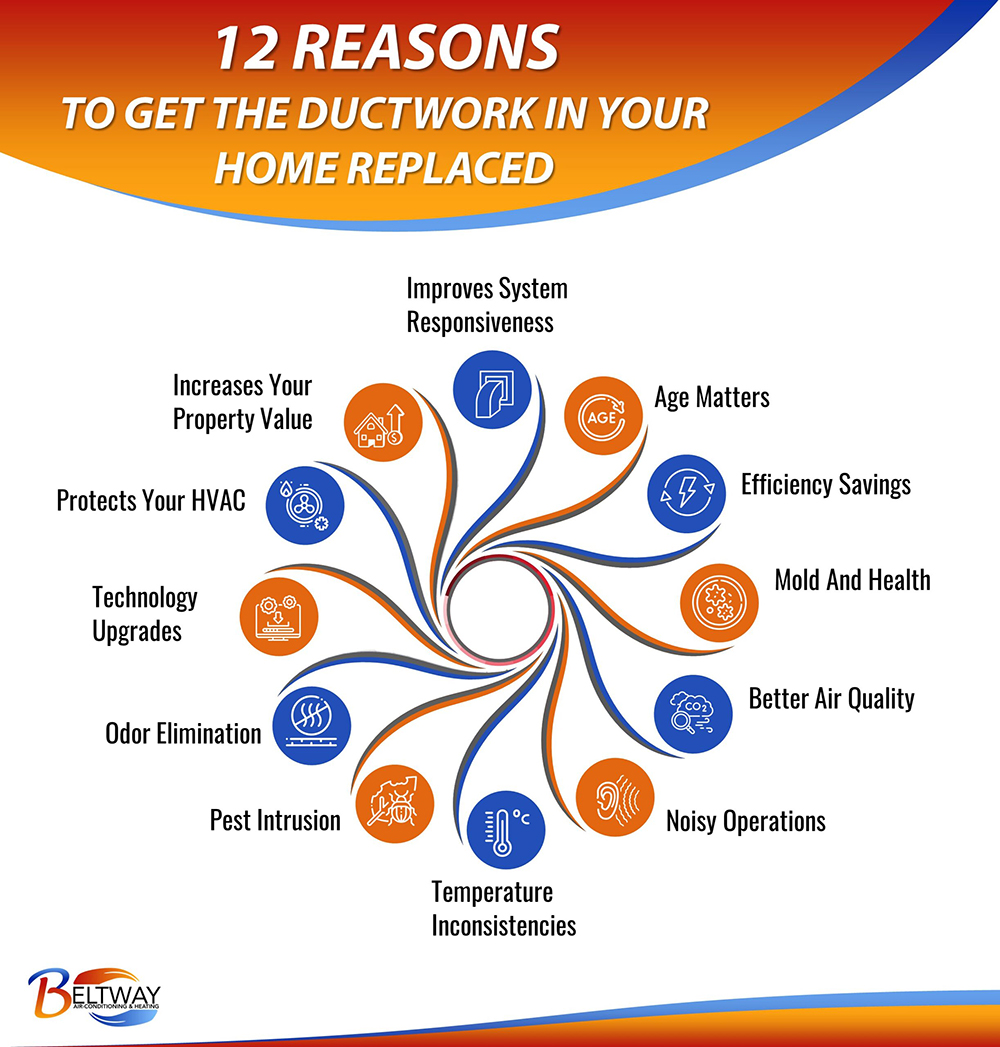
12 Reasons to Get the Ductwork in Your Home Replaced

Ductwork is often the unsung hero of your home’s heating and cooling system. Yet, there comes a time when even these durable pathways need replacement. Here are a few reasons why our professional team should replace the ductwork in your home.

1. Age Matters

Ducts, though resilient, don’t last forever. Over the years, even the most robust ducts start losing their edge, and their decline can be subtle or glaring. Around the time they hit the 15-year milestone, it’s common to notice efficiency isn’t what it used to be. Worn-out ducts can hamper the optimal performance of your HVAC system. Replacing them enhances your HVAC capability and ensures your home benefits from the freshest, cleanest air possible.

2. Efficiency Savings

Everyone appreciates savings on energy bills. Aging or compromised ductwork often results in air leaks, placing unnecessary strain on your HVAC system. This inefficiency increases energy consumption, leading to steeper monthly bills. Replacing your outdated ductwork with contemporary alternatives gives the HVAC system in your home enhanced performance. This upfront investment can lead to substantial long-term savings. By acting promptly, you optimize efficiency, positioning yourself for consistent financial benefits. Embracing this change means a smarter, eco-friendly home that recognizes the balance between performance and cost.

12 reasons get ductwork replaced

3. Mold and Health

Ducts, while instrumental in circulating air, are not impervious to the adverse effects of moisture accumulation. As moisture lingers, it becomes a breeding ground for mold. This sneaky invader grows silently, releasing spores into the air. Inhaling these mold spores poses serious health risks: from respiratory issues to triggering allergic reactions. For those already susceptible to allergies, it can exacerbate their condition. While it’s easy to overlook the hidden dangers lurking in your ducts, taking proactive measures is vital. Replacing compromised ductwork isn’t merely a maintenance task; it’s an assertion of your commitment to ensuring a healthy living environment for everyone under your roof.

4. Better Air Quality

The quality of the air we breathe indoors is directly influenced by the condition of our ducts. As ducts age or deteriorate, they become repositories for dust, allergens, and various pollutants. These accumulated particles then circulate through our homes, often leading to stuffy environments and potential health concerns. An uptick in household dust or intensified allergy symptoms can be telltale signs of deteriorating ductwork. Addressing the problem at its root and opting for duct replacement gives you the option to pave the way for a cleaner, fresher indoor atmosphere. In essence, rejuvenated ducts play a pivotal role in ensuring a healthier living space, elevating the overall well-being of inhabitants. Learn more about our indoor air quality services.

5. Noisy Operations

Occasionally, ducts may emit faint creaks or groans, which are typically harmless. Yet, when these sounds become more persistent and unusual, it’s a signal to pay attention. Ducts, when dislodged, misaligned, or presenting gaps, can be the source of these auditory disruptions. Such irregularities not only compromise efficiency but disturb our peace. Continual noise disturbances hint at deeper underlying problems within the ductwork system and should be addressed.

6. Temperature Inconsistencies

Have you ever transitioned between rooms and noticed a sudden temperature shift? Such disparities can be jarring and are often linked to malfunctioning ductwork. When ducts aren’t in prime condition, they fail to distribute air uniformly across spaces. This inconsistency manifests as rooms that are either too cold or excessively warm. It’s a clear indication of an imbalance in the system, leading to discomfort for inhabitants. Introducing new, efficient ductwork can remedy this. Making sure there is a consistent airflow means temperatures stabilize and equilibrium is restored. Through duct replacement, you’re essentially reestablishing a comfortable and consistent thermal environment in your living spaces.

7. Pest Intrusion

Ducts, especially when old or compromised, can become an inviting gateway for unwanted visitors. Rodents and insects, when finding a breach, eagerly take residence. Once settled, they wreak havoc, not only damaging the ducts further but they can also potentially introduce health hazards. Their droppings and remnants can pollute your air. Swiftly replacing vulnerable ducts can act as a robust barrier, ensuring these pesky invaders remain outside.

8. Odor Elimination

A mysterious and persistent odor often has an inconspicuous source: the ducts. As air circulates, it carries with it scents from daily life like cooking odors and pet dander. Old ducts trap and recycle these odors, leading to a less-than-pleasant ambient aroma. This encapsulation of stale scents diminishes the freshness of your living spaces. A thorough duct replacement offers a tangible solution. New ducts provide an unsullied pathway for air, effectively eliminating trapped odors and reintroducing a fresher indoor atmosphere.

9. Technology Upgrades

As with all facets of our modern world, technological advancements continuously redefine standards. The realm of ductwork is no exception. Contemporary duct systems, designed with cutting-edge materials and innovative configurations, promise superior efficiency and extended durability. Embracing an upgrade not only replaces the old but introduces enhanced capabilities. It’s a step into the present, harnessing technology’s best offerings to optimize your home’s air circulation system.

10. Protects Your HVAC

An HVAC system stands as a pivotal component of your home’s comfort. However, its performance is intertwined with the state of your ductwork. Aged or malfunctioning ducts exert undue pressure on the HVAC, accelerating its wear and possibly leading to malfunctions. This potential chain reaction compromises both comfort and system longevity. Replacing deteriorating ducts means you are setting the stage for your HVAC system to function at its peak potential, ensuring both its efficiency and longevity are preserved.

11. Increases Your Property Value

Ductwork, though often out of sight, plays a significant role in determining a property’s appeal. When the time comes to sell or lease, potential buyers and tenants value the assurance of a well-functioning HVAC system. A freshly replaced duct system serves as an implicit guarantee of optimal air quality and energy efficiency. In a real estate market where every advantage counts, updated ductwork can enhance your property’s allure, potentially driving up its market value and positioning it as an attractive proposition.

12. Improves System Responsiveness

Over time, worn-out ductwork can lead to a sluggish response from your HVAC system. You might find it takes longer for rooms to reach the desired temperature, or the system struggles to maintain consistent conditions. This lag not only compromises comfort but can lead to excessive energy consumption as the system works overtime, trying to compensate. Replacing old ducts can rejuvenate the system’s responsiveness, ensuring that when you adjust your thermostat, the changes take effect promptly. This heightened agility not only leads to quicker comfort adjustments but also promotes efficient energy use, ensuring that your HVAC system reacts swiftly to your commands.

Our Services

At Beltway Air Conditioning and Heating, we provide ductwork services in Hanover, as well as indoor air quality and duct cleaning services for your home. Our skilled team also provides heating, air conditioning, and humidifier services. Contact Beltway Air Conditioning and Heating for more information today!

humidifiers and dehumidifiers in Hanover

Humidifiers vs. Dehumidifiers: What’s the Difference?

At Beltway Air Conditioning and Heating, we understand that maintaining a comfortable indoor environment is essential for your overall well-being in Hanover, MD. One of the critical factors in achieving this comfort is controlling the humidity levels in your home. Humidifiers and dehumidifiers play pivotal roles, ensuring that your living spaces are neither too dry nor too damp.

What Are Humidifiers and Dehumidifiers?

Humidifiers release water vapor into the air, which helps alleviate problems caused by overly dry air. In dry climates or during the winter season, indoor humidity levels can plummet, leading to dry skin, irritated respiratory passages, and even an increased susceptibility to infections. Humidifiers counteract these effects by introducing moisture into the air, creating a more comfortable and healthier environment for you and your family.

Conversely, dehumidifiers operate by extracting excess moisture from the air, making them indispensable in humid regions. High humidity levels can foster mold growth, degrade indoor air quality, and trigger allergic reactions. By reducing humidity, dehumidifiers prevent these issues and create a more pleasant living space. It is especially crucial for areas such as basements and bathrooms, which are prone to dampness and can quickly become breeding grounds for mold and mildew.

difference between humidifiers and dehumidifers

How Do Humidifiers and Dehumidifiers Work?

Humidifiers come in different forms. Ultrasonic humidifiers employ ultrasonic vibrations to break water into fine mist particles released into the air, effectively increasing humidity levels. Steam vaporizers are another type that heats water to create steam before dispersing.

On the other hand, dehumidifiers first draw in moist air, then cool it to cause condensation of the moisture. This condensed moisture is collected and removed. The subsequently reheated air is then released back into the room.

When to Use a Humidifier

Utilize a humidifier when the air in your home becomes too dry, often leading to issues like dry skin, irritated eyes, and respiratory discomfort. Humidifiers can provide significant relief during colder months or in regions with low humidity.

By adding moisture to the air, these devices not only make breathing more comfortable but also contribute to the prevention of skin dryness and other discomforts that can arise due to parched indoor air.

When to Use a Dehumidifier

Consider employing a dehumidifier when your indoor spaces feel excessively damp and humid. High humidity levels can create a conducive environment for mold growth, mildew, and musty odors, which affect indoor air quality and pose potential health risks.

Dehumidifiers are particularly indispensable in areas more susceptible to moisture accumulation, such as basements and bathrooms. By effectively reducing humidity, these devices mitigate the risks associated with excessive moisture, ensuring a healthier living environment while safeguarding your home from the damaging effects of prolonged dampness.

Types of Humidifiers

When choosing the right humidifier for your indoor needs, considering the various types available is essential. Each type employs distinct mechanisms to achieve the common goal of enhancing indoor humidity levels.

Evaporative Humidifiers

Using a fan to blow air through a wet wick or filter, these humidifiers facilitate water evaporation, effectively humidifying the air. They are particularly effective in dry climates or during the winter months.

Ultrasonic Humidifiers

These devices harness ultrasonic vibrations to break water into fine mist particles released into the air. This mist increases humidity levels, making them ideal for maintaining a comfortable environment.

Steam Vaporizers

These humidifiers ensure consistent humidity levels by heating water to generate steam, which is subsequently cooled slightly before release. They are efficient in areas where maintaining precise humidity control is essential.

Types of Dehumidifiers

When it comes to controlling indoor humidity levels, understanding the various types of dehumidifiers available can significantly assist in making an informed choice. Dehumidifiers come in different forms, each designed to address specific needs and conditions.

Refrigerative Dehumidifiers

This widely used type employs a cooling mechanism akin to an air conditioner to condense moisture from the air. Reducing humidity levels helps prevent mold growth and maintain a more comfortable living space.

Desiccant Dehumidifiers

These dehumidifiers absorb moisture from the air, making them suitable for colder conditions. Desiccant dehumidifiers are used in spaces like closets and smaller areas where excess moisture can be an issue.

Benefits of Using a Humidifier

Maintaining balanced indoor humidity levels goes beyond comfort. It also has tangible benefits for your well-being and surroundings. Adequate humidity can significantly affect your overall health and the longevity of your possessions.

Advantages of maintaining optimal humidity include:
  • Improved respiratory health
  • Healthy skin
  • Energy efficiency
  • Reduced static electricity

Benefits of Using a Dehumidifier

Utilizing a dehumidifier can positively affect your indoor environment, from health and comfort to preserving the integrity of your living spaces.

You might notice such benefits of using a dehumidifier as:
  • Mold prevention
  • Improved comfort
  • Odor control
  • Allergen reduction

Humidifier vs. Dehumidifier: Which One Is Right for You?

If you find yourself contending with dry air that leads to discomfort, such as dry skin and respiratory issues, a humidifier can relieve you. Conversely, if you’re grappling with challenges like mold growth, constant dampness, or lingering musty odors, a dehumidifier could be the remedy to restore a healthier indoor atmosphere. Considering your space’s unique conditions and your comfort preferences will enable you to make a well-informed choice that optimizes your indoor living experience.

Humidifier Safety Tips

Ensuring the safety of your humidifier usage is crucial for maintaining a healthy indoor environment. By following these safety tips, you can enjoy the benefits of humidity control without any unwanted side effects.

Clean Regularly

Mold and bacteria can thrive in a humidifier’s damp environment. Regularly cleaning and disinfecting your humidifier according to the manufacturer’s instructions helps prevent the growth of these harmful microorganisms.

Use Distilled Water

Tap water contains minerals that can accumulate in your humidifier and disperse into the air, potentially causing respiratory issues. Using distilled water minimizes mineral buildup, ensuring the quality of the mist released into your living spaces.

Monitor Humidity Levels

Over-humidification can lead to issues like mold growth and excessive moisture, which can be detrimental to your health and home. Investing in a hygrometer allows you to accurately measure indoor humidity levels, enabling you to adjust your humidifier settings accordingly and maintain a comfortable, healthy environment.

Dehumidifier Safety Tips

Using a dehumidifier can significantly enhance your indoor comfort and air quality, but ensuring its safe operation is essential for optimal results.

Ensure Proper Placement

Position your dehumidifier in areas susceptible to moisture accumulation, such as basements or bathrooms. However, make sure there’s enough space around the unit to facilitate proper airflow.

Perform Regular Maintenance

To maintain peak performance, clean or replace filters as the manufacturer recommends. Clean filters ensure efficient operation and prevent airborne particles from recirculating in your space.

Empty the Tank

Regularly check and empty the water collection tank. Preventing tank overflow is essential to avoid water damage to your dehumidifier and the surrounding area. Regular maintenance prevents potential leaks or spills and ensures continuous dehumidification without interruption.

FAQs About Humidifiers and Dehumidifiers

Q: Can I use a humidifier and a dehumidifier in my home?

A: You can strategically use both devices to create a balanced indoor environment. Placing a humidifier in dry areas and a dehumidifier in damp regions helps address different humidity needs across your home.

Q: How do I know if my home’s humidity levels are balanced?

A: An effective way to gauge indoor humidity levels is by using a hygrometer. This device accurately measures the air’s moisture, helping you adjust your humidifier or dehumidifier settings as needed to maintain optimal humidity levels.

Q: Can incorrect humidity levels affect my health?

A: Indeed, extreme humidity levels can adversely affect your health. High humidity can exacerbate respiratory conditions and allergies, while low humidity can lead to dry skin and irritated airways. Maintaining balanced humidity is essential for creating a comfortable and healthy living environment.

Elevate Your Indoor Comfort With Expert HVAC Services

At Beltway Air Conditioning and Heating, our dedication to your indoor comfort is unwavering. Our comprehensive range of HVAC services encompasses installation, maintenance, and repair, effectively addressing all your heating and cooling needs. Proudly serving the Hanover area, our mission revolves around elevating your home’s comfort and efficiency.

Contact Beltway Air Conditioning and Heating in Hanover, MD, today for further details or to arrange a service. Your contentment is our ultimate focus!

HVAC services in Severn, MD

8 Factors to Consider When Choosing HVAC System for Your Home

Having a properly sized HVAC system is key to enjoying maximum comfort in your home. Poorly sized systems can be too small or too large, leading to inefficient operation that significantly increases energy use and may cause damage over time. To help you get the most efficient heating and cooling solution for your home, here’s a helpful guide outlining what size of HVAC system is right for you. Whether you’re looking to replace an existing system or equip a new space with temperature control solutions, the following will provide the information needed to make an informed decision about your HVAC purchase.

1. British Thermal Unit Load Calculation

BTU load measures the heating or cooling capacity required to maintain a comfortable temperature inside your home. The size of your HVAC system will depend largely on the BTU load of your home, which takes into account factors such as the square footage, ceiling height, insulation, and number of windows. It’s important to accurately measure your BTU load to ensure you choose the right size of HVAC system.

When calculating your BTU load, consider some factors. The first factor is the total square footage of the space being heated or cooled. This includes all areas of the home, such as garages and attics. The size of your windows will also affect BTU load calculation because sunlight exposure can increase or decrease efficiency.

Another factor to consider is the home’s insulation quality, which will help determine how much power is needed to maintain a certain temperature. While it may seem complicated, determining the right BTU load can save you a lot of money in the long run by ensuring that you’re not overpaying for a system that’s too large or struggling with a system that’s too small.

2. Energy Efficiency Ratings

When buying an HVAC system, it’s important to consider the energy efficiency ratings. The higher the unit’s rating, the less energy used and more savings on monthly utility bills. ENERGY STAR equipment is rated by the Environmental Protection Agency and meets their strict criteria for improved energy efficiency. To determine which size of HVAC system is right for you, divide your BTU load by the SEER (Seasonal Energy Efficiency Ratio) rating of the unit you’re considering. This will tell you how much cooling or heating capacity you’ll get from that model.

3. Consider Professional Advice

When determining which HVAC system size is best for your home, seeking professional advice may be the best option. While various online calculators and general guidelines are available, a professional can take into account specific factors unique to your home, such as the layout, insulation, and windows. They can also assess your heating and cooling needs and recommend a system that is efficient and appropriate for the size of your home.

Additionally, a professional can recommend other features you may want to consider, such as variable speed fans, zoning, and air filtration systems. For residents of Hanover, MD and the surrounding areas, Beltway Air Conditioning and Heating is a reliable provider of HVAC system services.

4. The Number of People in Your Household

Another factor to consider when choosing HVAC system size is the number of people in your household. Generally, more people will require more BTUs. This is important to consider as insufficient capacity can lead to discomfort and inefficient operation. Conversely, an oversized system will run inefficiently and cost more on monthly energy bills.

Therefore, it’s important to calculate an appropriate BTU load based on how many people live in your home. It’s also useful to consider if you frequently entertain guests or host family gatherings. Knowing this will allow you to choose an HVAC system that can meet the needs of your lifestyle without wasting money on excess capacity.

5. Your Ductwork System

It may not be one of the most obvious factors, but factors like size, quality, and layout of your ductwork system can have a significant impact on the size of HVAC system you should choose. If you have an existing system, it’s important to consider if any repairs or upgrades are needed before selecting a new one. This is because an inefficient or inadequate ductwork system can limit the performance of a unit regardless of its size.

If you’re replacing an existing unit, make sure that the ducts in your home are still sufficient for the new model and don’t need repair or replacement. Additionally, it’s important to consider whether you need to install additional ducts or expand current ones as larger systems require more airflow than smaller units.

6. Your Budget and Future Plans

How much you plan on spending for a new HVAC system will also determine the size of your chosen unit. It’s important to understand that investing in a larger system doesn’t always mean better performance or more savings in the long run. Therefore, selecting a model that meets your needs and budget is important.

Additionally, consider any plans you may have, such as purchasing equipment requiring more power or expanding your home. This will help ensure that you don’t end up with an undersized HVAC system down the line when you need more capacity.

7. The Types of Appliances You Have

The types of appliances you have in your home can also affect the size of HVAC system you should choose. Appliances such as clothes washers, dryers, and dishwashers require additional venting to remove excess humidity from the air. Select a unit with enough capacity to handle the extra moisture they generate to ensure that these appliances don’t place an unnecessary load on your system.

Another appliance to consider is your water heater. If you choose a tankless system, make sure that it’s connected to the same ductwork as your HVAC system so that its exhaust can be properly vented and not affect the performance of your unit. A professional can help ensure that all this is considered and that you have a safe and efficient system.

8. Consider Ratings and Reviews of the Size You Want

While calculating the size of the system based on the square footage of your home is critical, it’s also important to consider the ratings and reviews of the size you want. When researching potential HVAC options, take the time to read through customer feedback and ratings to determine the level of satisfaction that others have experienced with systems of a similar size. By doing this research, you’ll gain valuable insight into the performance and reliability of the HVAC system you’re considering, helping you make an informed decision and ensure that you get the best possible results from your investment.

Choosing the right size of HVAC system for your home is essential to ensure comfort and efficiency. While there are numerous factors to consider, the most important ones are your home’s size, current ductwork system, number of people in your household, budget and plans, and type of appliances you have. Additionally, seeking professional advice may be beneficial as they can assess your situation and recommend an appropriate unit with the necessary features for optimal performance.

At Beltway Air Conditioning and Heating, we provide heating, cooling, indoor air quality, and ductwork services. We pride ourselves in quality service and customer satisfaction and are always happy to help. Reach out to us now to learn more.

Book Online

"*" indicates required fields

This field is for validation purposes and should be left unchanged.
Phone confirm*