Everything You Need to Know About the Frequency of Duct Cleaning

When it comes to maintaining clean and healthy indoor air quality, you should consider the cleanliness of your air ducts. Air ducts are crucial in delivering clean air to your home or commercial building. Over time, however, these ducts can become filled with dirt, dust, debris, and other contaminants, impacting the air you breathe and potentially leading to health issues. This article will explore how often you should clean your air ducts to ensure optimal indoor air quality.

Why Is Air Duct Cleaning Important?

Your home’s HVAC ductwork plays a vital role in circulating air throughout your home. However, these ducts can become a breeding ground for dust, allergens, and other pollutants. Regular air duct cleaning is essential to maintain the cleanliness and efficiency of your HVAC system. Here are a few reasons why air duct cleaning should not be overlooked.

Improved Indoor Air Quality

The air circulating through your ducts can carry dust, pollen, pet dander, and mold spores. When these contaminants accumulate in your ducts, they can be released into your home, contributing to poor indoor air quality. This can lead to respiratory issues, allergies, and other health problems. Cleaning your air ducts regularly can significantly improve your home’s indoor air quality.

Enhanced Energy Efficiency

When your air ducts are clogged with dust and debris, airflow can be obstructed, making your HVAC system work harder to maintain the desired temperature. This can result in increased energy consumption and higher utility bills. Keeping your air ducts clean ensures that your HVAC system operates at maximum efficiency, saving you money on energy costs.

Prolonged HVAC System Life Span

A clean and well-maintained HVAC system can last longer than a neglected one. When dust and debris accumulate in your air ducts, they can find their way into the HVAC system components such as the blower fan, motor, and coils. This can cause unnecessary wear and tear, leading to premature failure of these parts.

Factors Affecting the Frequency of Duct Cleaning

The frequency at which you should clean your air ducts depends on several factors. While the general recommendation is to clean them every three to five years, certain circumstances may warrant more frequent cleaning. Below are some of the factors.

Number of Residents and Pets

The number of people and pets in your household can impact the cleanliness of your air ducts. More residents and pets mean more dust, hair, and dander circulating through your HVAC system. If you have a large family or multiple pets, consider more frequent air duct cleaning every two to three years to maintain optimal indoor air quality.

Allergy Season and Environmental Factors

If you or your family members suffer from allergies or live in an area with high pollen or allergen counts, you may need to increase the frequency of air duct cleaning. Allergens can accumulate in your air ducts and circulate throughout your home, triggering allergic reactions and compromising indoor air quality. Cleaning your air ducts more frequently during allergy seasons can help alleviate these issues.

Visible Mold or Mildew

Mold and mildew thrive in damp and humid environments, making your air ducts an ideal breeding ground. If you notice any sign of mold or mildew in your air ducts, such as discoloration or musty odors, it is crucial to address the issue promptly. Mold and mildew can cause respiratory problems and other health concerns. In such cases, professional air duct cleaning is necessary.

Pest Infestation

Rodents, insects, and other pests can find their way into your air ducts, contaminating the air circulating throughout your space. If you notice signs of pests, such as droppings or unusual odors, it is essential to have your air ducts cleaned immediately. Professional duct cleaning can remove pests and their debris, ensuring clean and pest-free air in your home.

Excessive Dust or Debris

If you notice excessive dust, debris, or visible particles blowing out of your vents, it may be a sign that your air ducts need cleaning. Over time, dust, pet dander, and other particles can accumulate in your ductwork, hindering the airflow and diminishing the efficiency of your HVAC system. Regular air duct cleaning every three to five years can prevent excessive dust buildup and maintain optimal airflow and performance.

Professional Air Duct Cleaning Process

When cleaning your air ducts, hiring a professional HVAC technician specializing in air duct cleaning is essential. Professional duct cleaning companies have the expertise and equipment to thoroughly clean your ductwork, removing all contaminants and ensuring optimal air quality. The process involves the following steps.

Inspection

A professional technician will first inspect your air ducts to assess the level of contamination and identify any issues such as mold growth or pest infestation.

Cleaning Preparation

The technician will then prepare the area for cleaning, ensuring that furniture and other belongings are protected.

Duct Cleaning

Using specialized equipment, the technician will remove the dust, dirt, debris, and contaminants from your air ducts. They may use brushing, vacuuming, or air pressure techniques to ensure a thorough cleaning.

Sanitization

If mold or mildew is present, the technician will sanitize the ducts to eliminate any remaining spores and prevent future growth.

Final Inspection

Once the cleaning process is complete, the technician will conduct a final inspection to ensure all contaminants have been removed and the ducts are clean and ready for use.

Signs Your Air Ducts Need Cleaning

You need to know the signs that indicate your air ducts need cleaning. Recognizing these signs early on can prevent further damage to your HVAC system and improve indoor air quality. Here are some common signs that it’s time to clean your air ducts.

Visible Dust and Debris

If you notice dust buildup on your vent covers or pet hair trapped in your vents, your air ducts are due for cleaning. Additionally, if you observe a thick layer of dust on the grill of your return air registers, it’s time to schedule a professional air duct cleaning service.

Clogged Air Filters

The condition of your air filters can provide valuable insight into the state of your air ducts. Your ductwork is likely contaminated if your air filter is clogged with dust and debris. Cleaning or replacing the air filter is a temporary solution, but professional air duct cleaning is necessary to remove the accumulated dirt from your system.

Dust in the Furnace Compartment

Inspecting the furnace compartment is another way to determine if your air ducts need cleaning. If you notice a significant amount of dust on the blower fan, motor, or furnace controls, it indicates dirty air ducts. Dust in these areas can hinder the performance of your HVAC system and lead to various issues.

Dusty Air Conditioning Coil

The air conditioning coil is responsible for cooling the air that passes through your system. If the coil is dusty or has dust clinging to the housing walls, it indicates that your air ducts are not clean. A dirty air conditioning coil can reduce the efficiency of your HVAC system and impact its ability to cool your home effectively.

You should not ignore these signs, as they indicate a buildup of dust, dirt, and contaminants in your air ducts. Scheduling a professional air duct cleaning between one to three years will help restore the cleanliness and efficiency of your HVAC system.

Regular air duct cleaning is essential for maintaining a healthy indoor environment and ensuring the optimal performance of your HVAC system. While the general recommendation is to clean your air ducts every three to five years, you should consider factors affecting the frequency of duct cleaning. Our team is always ready to assist you with air conditioning and heating services in Hanover and the surrounding areas. From fixing broken AC units to furnace maintenance, we can quickly get you back to your comfort zone. We perform installations as well. Contact us at Beltway Air Conditioning and Heating today for more information.

Commercial HVAC Services in Hanover, MD

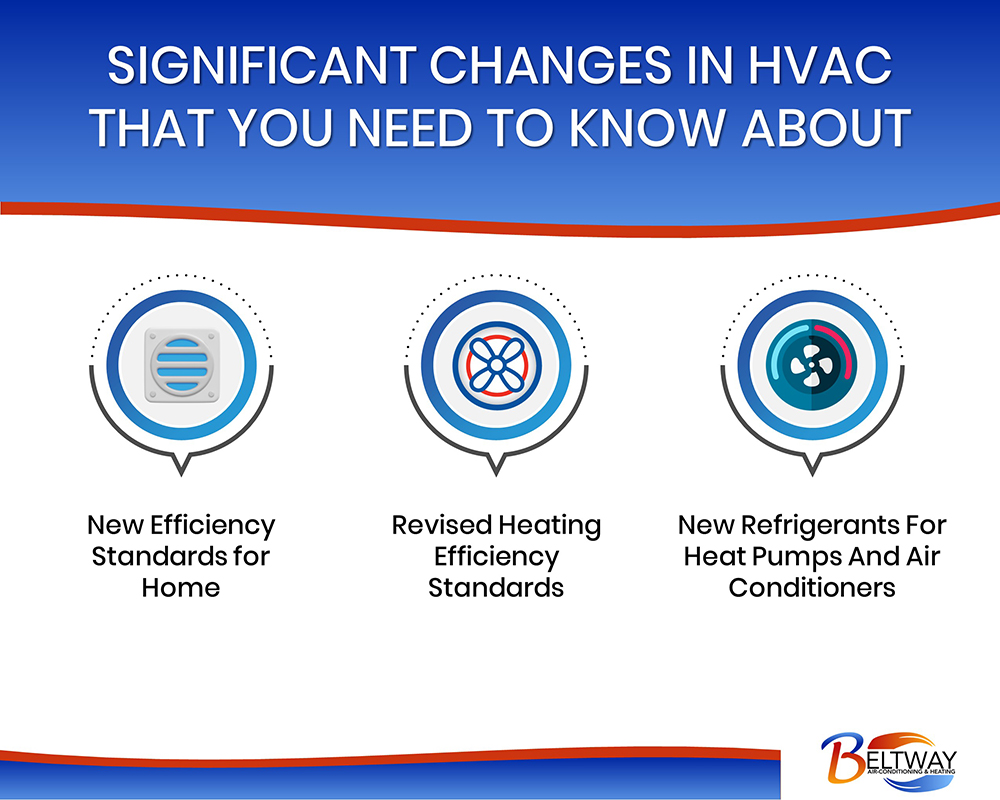
3 Significant Changes in HVAC That You Need to Know About

Energy efficiency remains a high priority in the heating, ventilation, and air conditioning (HVAC) industry to slow climate change and protect the environment. The US Department of Energy (DOE) oversees regulations that manufacturers must follow, and they have recently implemented three significant changes. Servicing Columbia, MD, and the surrounding areas, Beltway Air Conditioning and Heating offers expert advice to navigate these changes and decide if now is the best time for a new HVAC system.

Here are three changes introduced by DOE and how they may affect your decision to invest in a furnace replacement.

1. New Efficiency Standards for Residential Systems

Residential cooling and heat pump systems are labeled with seasonal energy efficiency ratio (SEER) ratings. The ratings indicate how efficiently a unit operates within a specific region. Manufacturers are required to clearly label HVAC equipment to help you choose the most energy-efficient unit for your budget. DOE increased the required SEER ratings for residential heat pumps, air conditioning systems, and ductless mini-split systems. The new rating system is referred to as SEER2. SEER2 ratings represent an 8% to 10% increase in efficiency regulations. Most HVAC systems do not meet the new requirements. Units that do meet the SEER2 requirements are likely to be more expensive for the average homeowner. Finding replacement parts may be difficult initially.
Changes in HVAC that need to know about


The good news is that you don’t need to replace your current system if it’s working properly. If you need a new HVAC system, you can expect to have lower energy costs each month.

2. Revised Heating Efficiency Standards

Because heat pumps are used for cooling and heating, the units are labeled with SEER and heating seasonal performance factor (HSPF) ratings. DOE has increased HSPF requirements for heat pumps. The minimum rating requirements for heat pumps are 14 for SEER and 8.8 for HSPF. Changes to these ratings may mean spending more upfront for your new heat pump, but DOE believes that the savings in monthly energy costs will help you recoup the cost over the lifetime of the unit. If you need to replace your heat pump, we can help you find a unit that meets the new DOE requirements and fits comfortably into your budget.

3. New Refrigerants for Heat Pumps and Air Conditioners

Heat pumps and air conditioners use refrigerants to cool the air during the summer. The first refrigerants were developed in the 1920s and contained chlorofluorocarbon, which has been linked to climate change. Known as R22, the refrigerant was phased out and replaced with R-410A refrigerant. Unfortunately, the hydrofluorocarbon in R-410A has been linked to climate change and environmental damage. New DOE regulations require that R-410A be replaced with R-454b, and many manufacturers have already begun this transition. As with the changes to SEER and HSPF ratings, manufacturing HVAC equipment to accommodate the new refrigerant may take some time. The refrigerant will not work with systems that are designed to use R-410A or R22 refrigerant. If you are looking for a new HVAC system for your home, now is the best time to make the purchase. You benefit from the advantages of the new SEER 2 and HSPF ratings, and many systems on the market use R-410A.

How Much Will the New HVAC Regulations Affect Your Budget?

Because the changes in HVAC regulations are relatively new, it is hard to say how much more the average consumer will spend on new HVAC equipment. Some sources indicate that you could see a 30% increase compared to new units that don’t meet all the requirements. A reduction in energy use offsets the upfront cost. The US Energy Information Administration estimates that the new regulations will result in savings of $2 to $12 billion over the first 30 years. At Beltway Air Conditioning and Heating, we understand that staying within your budget is important, and we also want to ensure that you maximize your monthly energy savings. We help you find a good balance between the cost of your new system and the average monthly savings.

Going Beyond Ratings and Refrigerants

Although ratings and refrigerants are essential factors when you are choosing a new HVAC system, there are other considerations. You may be tempted to purchase the system that fits well within your budget. The downside is that your new system may be too small for your home. In this situation, the HVAC system works harder, and you may need frequent, expensive repairs, or the system may not last for its expected lifetime. It is best to purchase a unit that is sized for your home with SEER and HSFP ratings that will maximize your savings each month. We also recommend other updates to your heating and cooling equipment, such as air purifiers, zone systems, whole-home humidifiers, and programmable thermostats.

Navigating the New HVAC Regulations – Don’t Do It Alone

Choosing an HVAC system for your home is overwhelming, and the process is even more complex with the new DOE requirements. At Beltway Air Conditioning and Heating, we recommend that homeowners focus on maintaining their equipment if it is in good working order and less than 15 years old. We provide routine maintenance HVAC services and repair services. As manufacturers normalize their production operations for the updated DOE requirements, the cost of new systems may decrease. Additionally, the inventory of replacement parts will increase and reduce the cost of repairs. If your system needs to be replaced sooner rather than later, schedule an appointment with one of our expert technicians. We perform in-house evaluations to help you find a heating and cooling system that fits your needs and budget. Expect the new unit to have a larger footprint than your current unit.

Are There Other Changes to HVAC Regulations?

The recent updates to SEER, HSPF, and refrigerants are the only changes being introduced this year. There are changes planned for the next two years. Next year, a 40% phase-down is expected for hydrofluorocarbon refrigerants, such as R-410A. As these products are phased out, supply will become limited, and you may pay more for repair issues that involve the refrigerant. In 2024 and 2025, A2L refrigerants, such as R-454B and R-32, are expected to become the standard for heat pumps and air conditioning systems. A2L refrigerants need to be handled with special precautions, and you may need to add some auxiliary equipment to your HVAC system, such as larger recovery hoses, gauges to monitor the refrigerant, and components to effectively recover refrigerant.

Rely on the Beltway Air Conditioning and Heating Technicians

Updates to DOE HVAC requirements help protect the environment and maximize efficiency, yet these changes may overwhelm you. The heating and cooling experts at Beltway Air Conditioning and Heating in Columbia, Hanover, Severn, and Arbutus, MD are always here to help. We offer both heating repair and furnace maintenance services for your current HVAC system as well as indoor air quality solutions, custom ductwork, and duct cleaning. When you are ready to replace your heating and cooling system, we help you find the best equipment, and our expert technicians perform the installation. Call us today to learn more.

Furnace Maintenance in Arbutus, MD

6 Reasons to Never Use Your Furnace Without a Filter

There’s a lot that goes into maintaining your Hanover, Maryland home. So much so, in fact, that it’s easy to overlook the seemingly minor tasks. Although changing out a furnace filter takes just minutes, it’s a job that some homeowners regularly neglect. Furnaces should never be used without clean, functional filters. The following are six reasons why.

1. Your Furnace Filter Isn’t for Protecting Your Indoor Air Quality

Regularly changing out HVAC air filters is often the first recommendation you may hear for improving indoor air quality (IAQ). Although this is certainly an effective way to limit the amount of airborne allergens floating throughout your home, it’s often misleading. HVAC air filters aren’t actually meant to improve the quality of your indoor air. Instead, these components are primarily designed to protect your HVAC equipment.

A clean furnace filter will prevent large-sized debris from entering your actual heating system. A filter will catch things like pet hair, lint, dirt, dander, and more. Without it, all of these particulates could find their way onto and even into your furnace’s most sensitive interior components. Massive build-ups of debris will pose a serious fire hazard. They’ll also have a significant impact on how your home smells when your furnace is in operation. For instance, if you turn your heater on and your living environment is filled with a burning, dusty aroma, you likely have a dirty or missing furnace filter.

2. You Could Lose Essential Protections

Sadly, some homeowners wind up spending hundreds and even thousands of dollars to repair furnace problems that are both preventable and filter-related. Dirty HVAC air filters are consistently ranked among the most common causes of a furnace malfunction. This is why home insurance companies, furnace manufacturers, and home warranty companies have clearly outlined requirements in their policy documents, contracts, and agreements concerning filter maintenance.

If you purchased a home warranty covering your furnace, this agreement likely requires you to change its filter once every one to three months. The same is true if your furnace has an existing manufacturer warranty. Whenever companies cover heating systems, they want to know that homeowners are doing all they can to prevent and mitigate potential problems. In addition to requiring regular filter changes, these entities will definitely require you to keep a filter in. If you use your furnace without a filter, the HVAC company that handles your covered repairs will know it. HVAC technicians will invariably find dirt and other debris covering the unit’s components. Thus, to avoid losing essential protections, always keep a clean filter in your heating system.

3. Airflow Problems Will Arise

Coatings of dust and other build-ups will eventually cause your furnace to overheat. If your home is dusty or your heating system is already ill-maintained, this might not take long. However, there’s another problem that can arise from having unfiltered air enter your HVAC system. This is the gradual decrease in airflow. As air movement becomes increasingly restricted by accumulations of debris on air registers, air grilles, or even on various surfaces throughout your HVAC air ducts, you’ll notice less warm air making it into the rooms of your house.

Restricted air movement places extraordinary stress on furnaces by forcing them to work both harder and longer. The end result is that your furnace will overheat, and it may shut down.

4. Your HVAC Air Ducts Will Be Inundated By Dirt and Other Debris

Air ducts are naturally dirty environments. After all, there are a lot of contaminants that regularly bypass standard HVAC air filters. HVAC air ducts are also known for harboring high levels of humidity. Together, these two things are a recipe for disaster. Taking the filter out of your furnace and then continuing to run it will only make the situation worse. Larger particulates will lead to larger build-ups and a greater likelihood of mold and mildew development. Although HVAC air ducts only require professional cleaning about once every three to five years, if you’ve ever run your furnace without a filter in, you should schedule duct cleaning right away.

5. Your Indoor Air Quality Will Plummet

Although furnace filters are largely intended to protect furnaces, they do offer a fair amount of protection for household members as well. When your furnace is on and lacks a filter, the concentrations of airborne dust particulates, pet hair, dander, and other allergens will rapidly increase. This can lead to:

  • Coughing
  • Sneezing
  • Wheezing
  • Itchy, watery eyes
  • Irritated nasal passages
  • Skin irritation
  • Headaches
  • Fatigue

Running a furnace without a filter can be particularly harmful to any building residents with chronic respiratory ailments. For added protection, ask us about our indoor air quality solutions.

6. Your Furnace Could Fail

The costs of resolving filter-related furnace problems are often far greater than simply swapping a dirty filter out or making sure that one is in. The most devastating consequence of using your home heating equipment without this essential component is replacing your furnace entirely. Although this is unlikely to be the case after just several minutes of filter-free operation, for some furnaces, even short-term use could prove to be the last straw.

Standard furnace filters aren’t expensive. Moreover, if you’ve been using a higher-rated and more costly filter type, you can always revert back to a more affordable option in a pinch. With some households requiring filter changes every thirty days, keeping a few extra in stock is always a good idea.

Why People Sometimes Operate Their Furnaces Without Filters

Although many homeowners have run furnaces with dirty filters at some point in their lives, you may find it difficult to believe that there are also people who’ve turned their furnaces on with absolutely no filters at all. Surprisingly, this isn’t an uncommon mistake, and it’s actually very easy to do.

If you’ve ever started to change your furnace filter and been distracted by an unexpected guest or phone call, there’s a possibility that you left the job unfinished. Sometimes people put new furnace filters in but fail to put them in correctly. There are also homeowners who’ve installed filters in the wrong place or purchased filters that were the wrong size. Using a filter with any of these issues is akin to using a furnace without a filter.

If you recently purchased a home, take a minute to make sure that your furnace has a filter. The former owner may have taken this component out and forgotten to replace it. With a new home, it’s always best to give your heating system a quick inspection before attempting to use it. Small oversights like this can have expensive consequences if they aren’t caught and corrected early on.

What to Do If You’ve Been Using Your Furnace Without a Filter

Whether you’ve been intentionally running your furnace without a filter or have just discovered that your furnace filter is missing, hope is not lost. We can remove build-ups of dirt and grime on your furnace’s interior components. We can also clean your HVAC air ducts and share some of the latest and most effective indoor air quality solutions.

Contact the Professionals

At Beltway Air Conditioning and Heating, located in Hanover, MD we offer heating and cooling system replacement, maintenance, and repair services. We also provide air duct cleaning, custom ductwork, and indoor air quality services. If you’ve been running your furnace without a filter or have questions about what type of filter to purchase, we can help. Call Beltway Air Conditioning and Heating today to schedule an appointment.

Beltway HVAC Technician in Hanover, MD.

Some Helpful Tips on Finding the Best HVAC Contractor

At Beltway Air Conditioning and Heating, in Ellicott City, MD, we understand that you need to find the best contractors for your needs to perform much-needed HVAC work on and around your home. That’s why we have compiled a list of qualities of top HVAC contractors that we ourselves strive to be every day in our work.

First, we will dive into why you might want to hire a top contractor rather than attempt HVAC work yourself. Then, we’ll look at those tips for your research in finding a contractor to perform work for you.

Why Would I Want a Top HVAC Contractor to Perform Work?

You may be wondering why you need a top contractor to perform work on your home. That’s a fair question, as you probably want to save money getting HVAC work done. However, the work that you start out to do could be botched if a professional isn’t handling it.

First, you will need to spend lots of time doing exhaustive research to ensure that you understand the nature and type of work that needs to be done. After you perform the diagnostics yourself, you could be working off of a faulty premise. For example, if you misdiagnose a heater problem and attempt to fix the wrong components, you may actually just be adding to the list of HVAC issues you’re experiencing.

A common issue that homeowners run into when doing their own HVAC work is warranty coverage. When you buy a new HVAC appliance, it will come with its own factory warranty. Typically, it will last a number of years, and the sponsoring company will pay for certain types of repairs needed before the termination of the warranty. If you set out to do work on your own HVAC appliances, you may be putting yourself out of a warranty. Speaking of that, you could also be making unnecessary work for yourself; some of the work that will need to be done on your HVAC appliances will likely be covered by the warranties already on them. However, the money to perform the repairs and maintenance will only be payable to professionals to ensure that the work is done properly.

All of the risk of doing HVAC work yourself simply isn’t worth the worry. Go with your gut, and trust the professionals at Beltway Air Conditioning and Heating to do the work right the first time!

Tips on Finding Top HVAC Contractors in Your Area

Finding the top HVAC contractors in the beltway region doesn’t need to be a hassle! Looking for these characteristics in any company you end up hiring can help you weed out the best people for the job.

First, you should look for a company that’s local to you. HVAC professionals familiar with the beltway region will be able to accurately take into account various factors like the climate and other location-specific items that top contractors will take into account when they do the job.

Second, you should look for a company that is well-reviewed online. A bad Internet presence often means that there are limited resources spent on ensuring easy customer access. This is often a bad sign, as it may reflect that a contractor isn’t willing to work with people.

Third, you should always review the licensure of the HVAC contractors you’re hiring for any job. If a company isn’t licensed and insured, you run many risks. Hiring someone without these items could actually make you legally liable in court later on if there is an issue with the work being done. If a company isn’t willing to take the time and make the effort to get the appropriate licensure and insurance, then how would you be able to have faith in that company’s ability to do the work well and within budget?

Also, you need to make sure that the HVAC company you choose can do the work you need done. If you have a company that doesn’t advertise that they perform a service, they may not do it often or be able to do it. At Beltway Air Conditioning and Heating, we strive to provide quality service in a number of domains, but certain companies may not be able to do this as well. You should beware if there isn’t any online documentation of the HVAC work you got done. Documentation is key to proving the company worked on your unit.

The Ideal Process to Follow When Choosing an HVAC Company

We will now go over the steps to take when you’re looking at companies, all the way from initial inquiry to finishing up the work. The difference between choosing your Maryland experts in HVAC and a company that simply employs workers who act more as technicians than craftsmen can have an immense effect on your home’s well-being.

First, you should consult Maryland’s state license board to ensure that you’re looking at a contractor who has a license, like us. The company should be current and not have any pending licensure complaints. Once you’ve verified that you’re looking at a licensed company, you can move to the next step.

Second, you need to ensure that your chosen contractor offers home visits. In these visits, the contractor will need to do an evaluation to ensure that they can do the work safely. Picking a company that is known to be honest during these evaluations can prove critical to your home.

Third, you need to look up reviews of the company online. Make sure that they are as scrupulous as they claim. As was discussed earlier, a great online presence with plenty of articles and media about the company is the way to go in this respect. While you’re at it, feel free to ask the contractor for references and previous jobs done. Getting to see the great work of a quality company can help you to set expectations for the work you’re looking to have done in your own home.

Fourth, you’ll need to book an appointment with the company you’ve chosen. That means you can use an online form or call the company, whatever is easiest. Having a scheduled time that works for you is one of the reasons to schedule the appointment, but it will also ensure that the contractor is able to do the work at that date and time.

Fifth, you will need to be available at the time of the appointment. Being physically present is crucial since as the homeowner, you are best qualified to point out important factors you may know about your own home that can be crucial for the work being done.

Contact the Profesionals at Beltway Air Conditioning and Heating

By using us, you guarantee quality work done in a variety of domains in HVAC. We do plenty of work on heating and air conditioning units, but we also offer other services in our family umbrella of services. We can work on everything, from boilers to heaters to air conditioning units to keep everything in your home running smoothly. Don’t delay, and call us or use our online form to make your online appointment today!

Happy Couple Looking Over Finances in Hanover, MD

What’s the Cost of Having Heat Installed in Your Home?

Any Hanover, Maryland home without heat is hardly a home at all. If you’ve recently purchased a property that lacks a functional heating system, or if your existing heating system has just gone down, paying to have new equipment installed is your first priority. However, you may be worried about the cost. Following are several things to know as you prepare your budget.

The Cost of Heating Installation Can Vary Significantly

In general, homeowners should be prepared to pay several thousand dollars to have new heating equipment put in. However, the actual cost of these projects can vary greatly from home to home based on several factors such as:

  • The removal of existing equipment
  • The preferred heating system type
  • The addition of smart technologies and integrated accessories
  • System efficiency ratings

Building layouts, building sizes, and the structural integrity of existing air distributions systems matter as well. Thus, the only way to get an accurate estimate of how much your project will cost is by requesting a quote.

The Removal of Old Equipment and the Refinement of Storage Areas

If your home already has a furnace or boiler, you might think that this project is as simple as pulling the old unit out and putting a new one in. However, home heating needs have changed significantly over time. Home heating equipment has evolved as well. If you have an older property with an older furnace that’s housed in a relatively small-sized storage area, it may be necessary to make several structural modifications to accommodate a significantly larger heater. When assessing your home and calculating your needs for heating power, we’ll take note of how accessible your old heating equipment is, and of how much we’ll have to streamline the current furnace storage area to suit.

Your Home’s Air Distribution System

HVAC ductwork is a critical consideration when installing new central heating equipment. Older ductwork may not have the capacity to support the design and demands of a new heater. Moreover, if you haven’t replaced your home’s HVAC ductwork in a while, ragged, torn ducting will quickly render a brand-new heater inoperable.

In a best-case scenario, your new heater will work seamlessly with the well-maintained ductwork you already have. However, it is often necessary for homeowners to pay for ductwork modifications, repairs, or replacement, in addition to the costs of having new heaters installed.

Multi-Functional Heating Solutions

Having your old heater replaced is an opportunity to consider options in new and highly efficient heating equipment. Some people choose to upgrade their properties with radiant floor heating, others opt to have heat pumps installed instead. Heat pumps provide more energy than they use via their highly efficient heat transfer process. By some estimates, many of these units can transfer 300% more the energy than they consume. Comparatively, even high-efficiency boilers and furnaces are only capable of converting 98% of the energy they use into heat.

There’s also the fact that heat pumps are capable of both providing heat in the winter and cooling in the summer. They eliminate the need to have a separate air conditioner installed. Moreover, given that heat pumps have a single, outdoor condenser, they free up considerable amounts of space indoors. When cutting project costs isn’t your primary concern, you’ll have a lot of options in innovative heating to explore.

Economy vs. Efficiency

System efficiency ratings and cost go hand in hand. A high-efficiency boiler or furnace will cost less to use from year to year, but it will also cost more upfront and more to install. High-efficiency heaters additionally tend to be a bit larger than medium-efficiency heaters. If you have spatial concerns, paying less for a medium-efficiency heater can also mean paying less for building modifications during the install process.

Advanced HVAC Technologies

Home heating systems have come a very long way in recent years. Not only are they more efficient, but they’re also far more technologically advanced. This has made things a lot easier for consumers by introducing features that allow for remote system monitoring, energy use tracking, and smart home integration. Even smart and programmable thermostats are no longer exclusive to high to mid-range and luxury homes. If you’re looking to add value and marketability to your property, and if you want to keep your home on par with current market standards, it’s important to consider some of the latest options in efficiency and convenience-related HVAC technologies.

Having a new heater installed, especially if you’ll be having your HVAC ductwork replaced or modified at the same time, is also a great time to have integrated HVAC accessories put in. If you have major indoor air quality concerns due to building residents with chronic respiratory ailments, you might want to add:

  • An air purifier
  • An air scrubber
  • A media filter
  • A whole-house dehumidifier or humidifier

In some households, integrated humidification/dehumidification equipment is absolutely necessary for resident comfort, resident health, and the preservation of building materials. If you’re able, it’s a good idea to build your heater installation budget with room for integrated accessories that may prove essential.

Requesting a Quote

Requesting a quote for your heating system is about far more than calling in and asking for a general cost estimate. In-person assessment of your property is vital for ensuring correct heater sizing. This is how HVAC companies avoid installing heaters that are too large or too small for the intended service area. These visits are a great opportunity to talk about your goals and about any cost-related concerns that you might have.

Preparing for This Expense

The best way to stave off the need for heater replacement is by taking good care of the heating you equipment you currently own. Your furnace, boiler, or heat pump should be professionally serviced at least once each year. Your HVAC ductwork should be professionally inspected and cleaned at least once every three to five years. When ductwork rips or tears are identified or when your heating equipment stops performing reliably, having timely repairs performed can extend the lifespan of your heater as well. When repairing damaged equipment is a feasible, short-term solution, it may be possible to put an untimely heater replacement off. However, old and failing heating equipment often proves more troublesome to retain than it is to replace.

If your heating system has already failed and you aren’t quite ready to replace it, exploring your options in financing is far preferable to relying on inefficient space heaters. When you work with us, we can help you find a feasible, affordable plan for restoring heat to your Maryland home. We offer multiple heating system types, and we have high-performing options at different price points. We also have a Family Plan that’s designed to help our clients cut their HVAC-related spending, and affordably access the services and equipment they need.

At Beltway Air Conditioning and Heating, we offer an expansive range of home comfort services and solutions. Residents of Hanover, MD and the surrounding area can turn to us for furnaces, heat pumps, air purifiers, and more. We also provide cooling, indoor air quality, and duct cleaning service. If you need help finding the right heating system for your home, give us a call today.

8 Benefits of a Heat Pump

A heat pump is an air conditioning and heating system that provides a more efficient, cheaper alternative for homeowners. It moves air between the inside and outside of a home. The components include an encased outdoor unit with coils and a fan and an inside air handler that also has coils and a fan. A refrigerant that absorbs heat circulates through the system. The system runs on electricity and doesn’t use fossil fuels. Under most circumstances, this results in greater efficiency and lower energy bills for homeowners.

In cool weather, the heat pump warms a home. As long as it’s not freezing, the outside coils cause the refrigerant to evaporate, and the fan transfers the vapor to the inside air handler where coils condense the vapor that releases heat. The internal fan then blows the released energy through vents.

It can also work as an AC to cool a room. The warming process is reversed for cooling. In this case, the refrigerant extracts heat from the indoor air and transfers it to the outside air. The coils inside the air handler evaporate the refrigerant, the fans push the vapor outside where the coils condense it into a liquid, thereby releasing the heat.

1. They Are Energy Efficient

Heat pumps are the most efficient air-source heating and cooling systems available, with an energy efficiency up to 300% more than a standard electric furnace. A heat pump will use a fraction of the electricity needed by an electric furnace and gas furnace, offering significant operating cost savings.

2. They Are Environmentally Friendly

Heat pumps are considered a green technology because they are more energy efficient and environmentally friendly than conventional heaters and air conditioners. They transfer the heat directly into a home from the outside environment, which reduces the energy required to heat up or cool down a building.

They use a renewable energy source to decrease your energy consumption and your dependence on fossil fuels. No fossil fuels are used in the heating or cooling process. Heat pumps do not release carbon dioxide and other greenhouse gases into the air.

It uses less electricity when it operates and doesn’t waste the energy it uses by radiating heat into the environment. Heat pumps can reduce your carbon footprint by using renewable energy sources such as geothermal or solar to provide heating and cooling. These alternate energy forms are environmentally friendly and protect our ozone layer while reducing pollution.

3. They Require Minimal Maintenance

Heat pumps are very efficient in the way they use energy, but they do require maintenance. The filters and refrigerant need regular cleaning to keep them functioning optimally. Also, there will be changes in performance and efficiency over time. A full-service call will help maintain the best efficiency possible.

The compressor is a vital part of a heat pump and needs to be checked regularly to ensure it’s working correctly. There could be a leak, worn bearing, or fan on the compressor. If this happens, there will be a loss in efficiency, and your unit may need to be repaired or replaced by a professional technician at Beltway Air Conditioning and Heating.

However, in comparison to conventional heating systems, there are fewer components. This means fewer repairs are needed, which means lower maintenance costs than traditional heaters. With proper maintenance, they require little upkeep and are an affordable option for many homeowners looking to upgrade their home’s heating system. Heat pumps are less likely to break down because they don’t require combustion.

4. They Are Quiet

A heat pump is quiet, which makes it an excellent option for those with small children or pets. They are generally quieter than standard furnaces and tend to be less disruptive to sleep patterns due to their low-noise levels. This can contribute to a healthier environment by eliminating the furnace’s noise.

5. Heat Pumps Can Be Ducted or Ductless

A traditional heat pump system uses ducts to regulate the airflow throughout a home. A mini-split system is ductless, and the outside unit connects directly with an inside air handler that will regulate the temperature within a relatively small area.

Larger heat pump models allow multiple air handler connections to one outside unit. In that way, multiple rooms can benefit from the same external unit. It’s best to have a professional technician install the system to ensure the optimal placement of the inside air handlers and the external component. Most likely, the technician will need to drill a hole in an external wall to connect each air handler to the outside unit.

6. Beneficial to Air Quality

They improve your air quality by filtering and dehumidifying it. This helps to make your indoor air healthier and more comfortable. Excess moisture could lead to mold and mildew, which can cause health issues. The dehumidifying process helps reduce mold and mildew growth in your home, as well as allergens like dust mites.

Bad air quality may also be a contributing factor to allergies and asthma. Heat pumps help filter your air, reducing the dust, pollen, mold spores, and other airborne pollutants that can trigger allergies or asthma attacks. The result is better overall home comfort and improved health for you and your family.

7. They Have a Long Lifespan

Depending on the model and the homeowner’s use, heat pumps are designed to last up to 15 years or more. This is especially true if they are maintained regularly and operate in areas with mild winters.

During maintenance, an HVAC service technician will check the system to ensure there are no leaks and that the system is working correctly. If something needs to be repaired, it can be taken care of immediately rather than letting it progress.

This is to avoid issues such as refrigerant leaks. They are dangerous as they are toxic and potentially flammable. A leak will not only damage your unit but is also hazardous to the environment. It causes global warming and ozone depletion.

8. They Are Multi-functional

A heat pump can be used for both heating and cooling. Depending on the system’s needs, the compressor or the fan can be reversed. They provide cool air for the summer months and warm air for the winter months. Only one system would be needed throughout the year, saving you money on purchasing and maintaining an extra system.

Regular maintenance and inspections are essential to ensure that your heat pump is operating efficiently. Check your heating and cooling systems before each heating season to make sure it’s in good working condition. A certified professional will be able to provide inspection and maintenance suggestions that you can follow to extend the life of your heat pump and lower energy consumption. In Hanover, MD, you can rely on the services of Beltway Air Conditioning and Heating.

In conclusion, heat pumps are a great option for homeowners who want a more energy-efficient system that is environmentally friendly. They have low maintenance costs and can be used for heating and cooling your home. We offer cooling and heating services. Contact the experts at Beltway Air Conditioning and Heating today for more information.

Factors to Consider When Cooling Office Building Spaces

Businesses need to save money on their operating costs in order to thrive. When your air conditioning system is the right size for your office space, is on a regular maintenance schedule, and is a modern unit that is sufficiently energy efficient, you will save money on this important operating cost. When cooling units go down, it becomes very hard for your employees to focus on the task at hand. Also, clients that enter the building will not want to stay for long. Clearly, when air conditioning systems are not working properly, your business is put at risk.

Problems Due to Improper Sizing and Lack of Maintenance

Sadly, some office buildings have cooling systems that are either improperly sized, have not been properly maintained, or are at the end of their service life. When units are sized too small for your area, they will strain at high for the entire warm period of the day, wasting energy and leading to shorter service life. Units that are too large for your office space will cycle on briefly and then be cycled off for long periods of time, leaving your office with zones that are too cold and zones that are too warm.

When air conditioning units are not maintained properly, they can be straining and possibly make unusual sounds. This also wastes energy and leads to excessive wear and tear for the unit. Obviously, this ends up wasting precious business capital.

Potential Warning Signs

Even units that have been properly maintained and are properly sized will eventually need repairs or reach their end of service. A unit that has a bad odor may have mold growing in the system. If the smell is more like something is burnt, it is possible that the motor is overheating or that there is a wire that has burned out.

Units that are no longer pumping cool air into your office may have a thermostat that is malfunctioning, or they may have a refrigerant leak. Refrigerant leaks can create pools of water, discoloration, ice buildup on the coils, or hissing sounds as other tell-tale signs. If your air conditioning unit is suffering from a reduction in airflow, the air filter may simply be too dirty to function properly, the air ducts may not have been sufficiently sealed, the ducts may be obstructed, or the compressor may be on its way out.

If your air conditioning unit is making unusual noises, the sound may be an indication of the problem. For example, squealing noises can be fan belts or blowers that are going out. Also, air conditioners naturally have a bit of a hum and develop more of a hum as they age, but a hum with a bit of a buzz could indicate a problem in the electrical portion of the system. If you hear banging or clunking, it could be that the fan, blower, motor, or compressor is loose.

If your unit begins to cycle on and off quite a bit more than in the past, that is also a sign that something is wrong with the system. This also could signify a thermostat that is going out. The only way to know for sure is to have a professional inspect the unit.

Weighing the Cost/Benefit of a New AC Unit

The government is regularly increasing the energy efficiency ratings required for new air conditioning units sold in the country. If you have an older unit or one that needs major repairs, you may want to consider the costs versus the benefits financially of purchasing a newer, more energy-efficient unit.

Larger commercial and residential air conditioning units are rated with a system labeled SEER. It stands for Seasonal Energy Efficiency Ratio. The SEER rating is designed to measure cooling capacity versus energy cost for units cooling in conditions from 65 to 105 degrees.

Units that are over 15 years old tend to have a SEER rating that is around 8. The new units being sold on the market in the southern states, like Maryland, start at a SEER rating of 14 and up because that level of energy efficiency is mandated by the federal government for all new installations in the country. You can run your monthly energy costs through a SEER calculator online to see how soon you can recoup the cost of buying a new, more energy-efficient unit.

Which New Unit Should I Get?

If it makes the most sense to replace the existing unit, you will still have an important factor to consider. New units can begin at a SEER rating of 14, but they can go up to a rating of 23 and above. Which makes the most sense to purchase, a more economical unit or a unit with better overall energy efficiency? Why are some units so much more efficient?

Looking at the latter question first, units that have two stages or variable speeds are more energy efficient. They have SEER ratings of 16 and above. Units with lower SEER ratings are one-stage units. What that means is that the air conditioner is either on at a high speed or off. A two-stage unit has a low and a high setting. Thus, the unit is either off, on low, or on high. Two-stage units are more efficient because they quickly get the rooms to the desired temperature on high and then operate at low to keep the rooms cool. This keeps their energy costs lower and saves on wear and tear on the unit over time.

A unit with a SEER rating of 16 is 14% more efficient than a unit with a SEER rating of 14. The jump between a unit with a lower rating of 14 SEER compared to a two-stage unit with a 20 SEER rating is 43% more energy efficient. To make a judicious decision between units, you can plug numbers into an online SEER calculator to see if the initial cost of the unit will be offset enough by the reduced energy costs to justify the purchase of a unit with a higher SEER. The higher the SEER, the more expensive the unit, and the cost differential can be dramatic.

We Can Help!

Here at Beltway Air Conditioning and Heating in Hanover, Maryland, we will take care of your office building’s comfort needs whether it is snowing in the winter or in the 90s in the summer. We know that breakdowns in your comfort units can slow or stop the pace of work. Our services are quick and dependable, and we are here to keep indoor areas comfortable year-round. Our technicians are fully licensed and trained. We are experienced in commercial units as well as residential. Besides the design of commercial HVAC systems and HVAC repair, installation and maintenance, we provide the following commercial office services:

  • Heat pump and furnace installation, repair, and maintenance
  • Boiler service
  • Duct cleaning
  • Indoor air quality products, like air filtration systems
  • Ductwork installation

Beltway Air Conditioning and Heating serves Hanover, Columbia, Ellicott City, and the surrounding area here in Maryland, and we are very proud of our BBB-accredited A+ rating. Contact us today to schedule your appointment!

Finding the Best HVAC Contractor

Deciding on the best HVAC company in your area can be difficult. The HVAC industry is booming, and countless small businesses have popped up in cities around the country. How do you find the right one for your HVAC needs? The contractor you choose will be responsible for your entire HVAC system. By not doing enough research or by deciding arbitrarily, you may find yourself without reliable temperature control when you need it most.

It’s important to recognize the trademarks of a quality HVAC company to ensure you get the best service possible. Here’s what you need to know to find the best HVAC contractor in your city.

Research Local Companies

Start your search by researching local HVAC companies. It’s important to find a company that serves your community and isn’t several cities away. The closer you are to your company of choice, the less time you’ll have to wait during an emergency. Create a list of at least 10 to 20 companies that you can then cut down.

Feel free to ask your family members, friends, and neighbors for recommendations. You’ll likely also find flyers and business cards available at local stores in the area. The best way to determine the quality of a company’s service is by talking to people who have already worked with them.

Check Reviews

After you have a list, it’s time to look for their reviews. Check on Google, Yelp, and Angie’s List to find reviews of previous customers. Don’t just rely on the company’s website because they’ll likely only showcase positive reviews that don’t adequately represent their reputation. Learning what people think about the company will help you determine if they’re a good fit for you.

Focus on reviews that have been published in the past few years. Many companies have been in the business for decades and may have changed their policies or technicians. You want an up-to-date evaluation of their customer service and craftsmanship.

Find Licensing Info

The highest quality HVAC companies are professionally licensed. Qualified contractors will have their license numbers on their vans and business cards. A licensed contractor is qualified to handle any HVAC issue from repairing gas lines to installing new appliances. They’re also insured, which protects you in case of injury or damage.

Once you have a license number, you can check the State Licensing Board for any outstanding disputes or issues. You’ll also be able to confirm that the license is up to date and active. Avoid working with unlicensed contractors who may charge less initially but can’t guarantee high-quality work.

Consult Better Business Bureau

Check the Better Business Bureau website to find any outstanding issues or complaints with local HVAC businesses. A BBB-accredited company has a reputation for integrity and excellence. These companies are trustworthy and provide exceptional work to every customer every time they’re called. You can fully trust HVAC companies with A+ reputations to offer superior work and lasting results.

The website also allows you to find previous customer complaints that may steer you toward another business. Fully researching an HVAC business before scheduling an appointment will minimize your chances of having an unsatisfactory service experience.

Interview Process

Once you’ve narrowed down your list, it’s time to start directly contacting local HVAC companies. Many businesses offer free consultations or quotes to new customers. Learn more about the company by taking advantage of any free services. Reputable HVAC technicians should make you feel comfortable and understood. The best contractors will listen to your comfort concerns and determine a helpful plan. They’re also trained to find faults in your current HVAC system and home.

Quality contractors know how to lower your home’s energy usage and carbon footprint. They’re dedicated to improving your day-to-day life with tips and advice. You should never feel like an HVAC contractor is pressuring you to buy or upgrade something you don’t need. The best contractors are dedicated to maintaining and improving your indoor comfort while providing excellent customer service that puts you first.

Ask for Prices

It can be difficult to find a reputable HVAC company with low prices. While you may want to find the best deal possible, it’s important to realize that quality work often costs a little more. Don’t let a company’s low prices be the only reason you request their services.

Trusting any HVAC company with your indoor comfort issues can result in more costly damage and repairs in the future. Superior work has a higher price point but will ultimately save you money in the future. You won’t have to worry about HVAC emergencies or sudden repair issues.

Search for Benefits

High-quality HVAC contractors often provide free cost estimates so you’re never surprised by the final bill. Scheduling an estimate or consultation is a great way to learn more about a company without committing yourself financially. You’ll be able to evaluate the technicians’ professionalism and skills and see how they compare to other companies.

Some HVAC contractors even offer second opinions so you know you’re getting the best deal possible. Try to find a quality company with benefits that match your unique needs so you can save money without risking the safety of your home.

Making Your Decision

Finding the best HVAC company for your home can take a lot of time and energy. You need to be willing to research local contractors in your area and ensure they’re licensed and well-reviewed. You also have to confirm their prices are reasonable, competitive, and within your budget. Don’t underestimate the value of talking with an HVAC contractor face to face. Meeting technicians in person can show you they care about your household’s comfort more than making a sale.

Taking the time to find the best contractor will have lasting results on your comfort and budget. Your HVAC system will always be in peak condition, and your family will be comfortable and safe no matter the season. You’ll also save money on future service needs. Keep these easy tips in mind, and you’ll have no issue finding your ideal HVAC contractor.

Exceptional Local HVAC Contractor

Beltway Air Conditioning and Heating is a top HVAC company in Hanover, MD. We’ve provided quality residential and commercial services in the area for years. Our locally owned business has a wide service area and is dedicated to satisfying all of our customers. We also maintain an excellent rating with the Better Business Bureau. You can trust our licensed and certified technicians to expertly manage all of your indoor comfort needs. When you rely on Beltway Air Conditioning and Heating, you become an essential part of our family.

We offer comprehensive heating and cooling services in Hanover. From repairing your furnace to installing a new air filtration system, we’re the best HVAC company for the job. Trust our team to regularly maintain your HVAC system during the year. We can also check your indoor air quality, clean your ductwork, and provide state-of-the-art humidifiers. Our team provides commercial services for apartment buildings, retail stores, office buildings and more. We’re ready to be your comfort solutions provider in Hanover. Call today to schedule your appointment.

Signs That Your Home’s Ductwork Is Due for Replacement

Your ductwork is your HVAC’s circulatory system. It’s responsible for transporting air from one part of your home to the next. Its value in your HVAC is indispensable as it aids in improving indoor air quality and home comfort. However, it’s often the last thing you think of when scheduling HVAC repairs and maintenance. Watch out for the following signs of defective ductwork that may be due for replacement.

Old Age

When your ductwork hits approximately 10 years old, its efficiency will decrease. Even with thorough care, the ductwork won’t be as effective once it has served you for over a decade. You’ll notice that the seams, seals, and joints have deteriorated, which affects the capacity of the ductwork to transport heated or cooled air into the designated rooms. This will result in poor system performance, higher energy bills, and discomfort. If you’re noticing these issues in your Hanover, MD home, it may be time to contact the professionals at Beltway Air Conditioning and Heating.

Dusty Home

Dust is almost everywhere in your home. But when you notice that the dust levels have become unbearable even though you’re still cleaning the same amount, it’s time for you to seek HVAC services. When the ductwork has defects, it allows dust from the outside to flow into your rooms. The ductwork distributes the dust to your home vents and lets it flow throughout the house.

If you notice that you or your family are exhibiting more allergy symptoms like sneezing, runny nose, and coughing, it could be because of excess dust in your home from dirty or damaged ductwork. For quality ductwork cleaning in Hanover, MD, talk with our talented duct cleaning experts at Beltway Air Conditioning and Heating. Our HVAC experts have experience cleaning dirt, dust, and other types of debris. We promise to leave your HVAC system functioning more effectively while keeping your bills low.

We offer fast and professional ductwork cleaning services to protect against dusty homes. If your ductwork is due for replacement, we will custom design and install ductwork suiting your needs.

Increasing Issues With Pest Infestation

Damaged ductwork also increases the risk of pest infestation. Ductwork with holes and leaks offers room for rodents and bugs to enter your home. Once pests find their way into your house, they can build colonies inside the ductwork.

Pest infestations must be addressed immediately because it’s a hygiene issue. If there is a pest colony living in your ductwork, you’re breathing in air that’s been filtered through their living space, which will introduce all kinds of bacteria into your home. Additionally, when rodents and bugs infest your ductwork, they can also clog the ducts, affecting indoor air quality. Clogged ductwork won’t distribute the needed air amount, upsetting your HVAC system’s performance.

Larger pests are extremely noisy and can damage the ducts, so it’s best to contact a professional right away. There’s a good chance that you’ll have to replace at least some of the ductwork, and it definitely will need a thorough cleaning.

Obstructed Ductwork

Another common sign of ductwork due for replacement is kinking or obstruction. A kinked duct system affects airflow throughout your home. The causes of this damage will vary. Your ductwork may become obstructed when heavy items like a tree branch or rock fall on it. If you’ve recently done any home renovations, a wood or insulation could have come dislodged and blocked the vent. Such objects falling on your ductwork can also leave it with leaks and holes. Ducts in the attic, basement, or garage tend to have such issues because they are exposed.

Mold and Odors

Foul odors and mold growth are also issues common with damaged ducts. Mold growth occurs in the ductwork when moisture and condensation proliferate inside. Leaky ductwork will allow water and dust in, creating a breeding ground for mold. Whenever the HVAC system powers on, it will spread the foul odors and mold spores to all rooms in your house, which can lead to respiratory issues and serious allergies. If your HVAC system has mold-like or foul smells, you have to get it checked. One of our HVAC technicians may need to replace the damaged and old ductwork to curb such issues.

Uneven Cooling and Heating

Defective ductwork that’s due for replacement also affects your HVAC system’s heating and cooling capacity. Once the ductwork has issues, you’ll note that some rooms receive more heat than others. You might note that some areas aren’t evenly conditioned. That happens because the ductwork does not distribute enough air to these parts of your home.

The easy way to tell if the HVAC is heating your home unevenly is by testing the temperatures in different rooms with an indoor thermometer, available at any home improvement store. Uneven heating and cooling issues need to be addressed promptly, and getting new ductwork is one of the best solutions. That’s especially true if the ductwork has leaks and holes that cause air loss or if the ductwork is obstructed.

Increased Energy Bills

Defects in the air duct create dozens of other problems. When the ductwork cannot supply enough air because of clogs or old age, your HVAC system has to overwork. When the ductwork loses heated air, the HVAC unit has to run longer to boost your indoor comfort.

Ductworks losing over 20% of air often affect the unit’s efficiency. Even when the thermostat setting is higher, it will take longer to achieve desired indoor temperatures. The inefficiency of the HVAC system translates to an increase in energy bills. That said, if your bills are high and you’re sure your HVAC system is okay, you should get the ductwork checked and replaced.

Noisy Operation

It is normal for the HVAC unit to make some noises when operating. Yet when it makes louder rattling noises that disturb your household or if there are new noises, it indicates a problem. The problem could be in your HVAC unit. But if you’re sure the HVAC has no issues, you should get the ductwork inspected. Rattling noises are often caused by ductwork that has come loose and is vibrating within the walls.

Recent Renovations

If you have recently had work done on your home, there’s a good chance that your ductwork will need to be updated to accommodate your new space. Bringing in an HVAC professional after a home renovation for a system inspection will ensure that your ducts haven’t been damaged or obstructed by the construction. It’s best to hire an HVAC contractor like the professionals at Beltway Air Conditioning and Heating to work along with the construction company. Your new space will need to be climate-controlled, and depending on the size of the addition, you may need to install a new system. Some people prefer to use a heat pump or mini-split system in a renovation rather than run ductwork, and we can help you weigh your options.

We maintain, install, and repair whole-house humidifiers, air purifiers, and ductwork in Hanover, Ellicott City, Columbia, and the surrounding area. Our HVAC experts know providing award-winning indoor air quality and duct cleaning services. We even offer financing on approved credit. For premium-quality duct cleaning and replacement services, call our experienced techs at Beltway Air Conditioning and Heating.

AC Installation in Hanover, MD

Cool Your Home with a Heat Pump

When looking for the best options to heat and cool your house, you will encounter heat pump systems. Heat pumps are reliable, and they’re capable of providing comfort control for your home. They help cool your home in the summer and supply heat in the winter. In some cases, they can heat water in your home. Heat pumps are the best solutions in most applications for both retrofits and new homes. They are viable options for replacing AC systems as the cost to move to a heat pump is low. Given the varieties of heat pumps in the market, finding the right solution for your home can be hard.

What Is a Heat Pump?

Heat pumps work on a simple principle of removing heat inside your house to cool it and reversing the process to heat your home. Most heat pumps are made of two parts: an outdoor unit and an indoor air handler.

Types of Heat Pumps

Heat pumps are energy-efficient options compared to AC systems and furnaces. They work in all climates, and they use electricity to make your house cooler or warmer, depending on the season. Since they transfer heat instead of generating heat, they can efficiently provide optimum temperatures for your home. Here are the different types of heat pumps to consider for your home.

Ductless Air Source Heat Pumps

Also known as mini-split heat pumps, they are ideal solutions for homes without ducts. Besides, there are unique versions of these heat pumps known as reverse cycle chillers. They generate cold and hot water instead of air, thus providing a feasible solution for floor heating systems.

Ducted Air Source Heat Pumps

These heat pumps are ideal for homes with ducts. Both air source solutions are inexpensive to install, and they are the most preferred options in most homes. They also function well in most climates by utilizing outside air as a heat exchange medium.

Absorption Heat Pumps

These heat pumps are relatively new in homes since they use thermal energy as their primary energy source. They are also called gas-fired heat pumps, and they can be driven by a myriad of heat sources, including geothermal heated water, steam solar-heated water, or natural gas. Absorption heat pumps are more complex and necessitate larger units than air source heat pumps. They also have lower electricity demand since they only use power when pumping liquid.

Geothermal Heat Pumps

They are also known as water source or ground source heat pumps. They are more efficient since they transfer heat between your house using the nearby water source or the ground. These heat pumps also cost more to install, but they have low operating costs since they take advantage of constant water or ground temperatures. The heat pumps can also control humidity, reduce energy use by 30 to 60%, and fit in many homes. To determine whether this is the heat pump for you, you need to consider your landscape, subsoil, and the size of your lot. Besides, you can use these heat pumps in more extreme climates, unlike air source heat pumps.

Features to Look for in a Heat Pump

If it’s your first time buying a heat pump for your home, there are some pleasant features to consider for efficiency and greater comfort. Below are the best features to consider when looking for a heat pump.

Backup Heating

Heat pumps lose their efficiency once the outside temperatures are below 30 degrees. The standard backup heating system in heat pumps is electric resistance heating, and it takes over in sub-freezing temperatures. You can also opt for a hybrid heat pump with a gas furnace as its backup heating method. The hybrid option is preferred since it can change energy sources, thus boosting its efficiency.

Blower Motor Speeds

You should consider variable-speed or two-speed blower motors since they offer great cooling and heating. They also provide better efficiency since they have variable speeds to condition your home more comfortably, quietly, and smoothly.

Compressor Technologies

Some heat pumps use a fixed compressor that only runs at full capacity. Variable stage and two-stage compressors can meet your home’s load more accurately, thus providing better efficiency. Furthermore, these compressors are amongst the quietest and deliver refrigerant in error-free 1% increments for optimal heating and cooling.

Water, Spa and Pool Heating

Another advantage of using heat pumps is their inexpensive water heating capabilities. Therefore, you can use the heat pump to heat your spa, pool, or even floors. Adding a desuperheater to the heat pump can let you enjoy hot water for the water heating system in your home. The heat pump does this at a fraction of the cost of electric water heating.

Choosing the Ideal Heat Pump

Now that you’ve known that heat pumps are more efficient than AC systems and furnaces, the next step is to purchase one. However, there are a few considerations to ensure that you end up with the ideal heat pump for your home.

Efficiency Rating

One easy way of finding the best heat pump for your home is to check the heating seasonal performance factor and seasonal energy efficiency ratio. These ratings help measure the heat pump’s cooling performance. You can choose a heat pump with a rating of between 14 to 20. The higher the number, the better the efficiency.

Sizing

Sizing is a crucial aspect when shopping for the best heat pump. It will affect the heat pump’s efficiency, cost, and overall comfort in your home. The ratio will differ significantly if you have a well-insulated home. It’s advisable to have professionals use precise equipment sizing standards and load calculations to help you find the best heat pump for your home.

Benefits of Heat Pumps

Investing in a heat pump can change your home’s comfort and overall feeling. Below are some of the benefits that make heat pumps better than AC systems and furnaces.

Energy Efficient

Heat pumps work more efficiently by moving air from one place to another. Therefore, they take warmth from the outside air and pump it inside during the winter and reverse the process during summer. The process saves energy use, thus lowering your monthly energy bills.

Improve Indoor Air Quality

Heat pumps mix and circulate inside air with outside air. This results in improved air quality in your home. By conducting regular maintenance and using effective filters, the heat pump will offer better smelling and cleaner air.

Quiet

Heat pumps are quieter compared to AC systems. This makes them a preferred choice in most homes since they are comfortable to use. Besides, the compressor system tends to produce less noise since it’s placed outside.

Schedule Professional Installation Now

At Beltway Air Conditioning and Heating, we serve our Hanover, MD, clients with top-notch heating and cooling services. We also provide exceptional products, and we’re proud to offer the most energy-efficient products, including heat pumps. We aim to keep you comfortable all year long, be it in your home or your business. We also offer a wide array of services and impeccable customer service.

Book Online

"*" indicates required fields

This field is for validation purposes and should be left unchanged.
Phone confirm*