Common AC Problems in Maryland

What Are the Major Parts of an Air Conditioner?

When it’s sweltering hot in summer, your air conditioner keeps your home cool and cozy. For your AC to be reliable and efficient, several components have to work together in harmony. In this article, we will look at the critical parts of an AC and how they function.

1. The Refrigerant Fluid

One of the most critical parts of your air conditioner is the refrigerant. The fluid is compressible, meaning you can pressurize it to increase its temperature. It also moves from the indoor and the outdoor unit to dispense heat outside.

The refrigerant cycle depends on two stages of the fluid. When it is in the form of vapor, it absorbs heat from the evaporator coils. In the liquid form, it transfers its energy to the condenser.

There are many types of fluids that manufacturers may utilize in a cooling system. Regulators have banned some coolants due to their toxic or flammable properties. That means when you have a refrigerant leak; a technician may not be in a position to refill it.

The two most popular refrigerants are R-12 (Freon) and R22. Several countries have banned R-12 versions, including the U.S., since 1996. Modern cooling systems use R22 refrigerants, which are safer than their predecessors.

2. The Evaporator Coils

The evaporator coil primarily consists of copper tubes with a liquid coolant. When indoor air passes over the tubing, they absorb heat. The amount of heat it can absorb depends on the pressure of the coolant. When it’s hot, the pressure is low. On the other hand, when it’s cold, the pressure is relatively high.

A fan inside the AC’s air handler facilitates the continuous movement of air through the coil. When the refrigerant absorbs heat, it turns into vapor under low pressure. In its vapor state, the fluid will use energy to return to its liquid form. The last stage of the process cools the interior further.

The evaporator coil can also capture some of the humidity inside the interior of your home. When vapor heats the coil, condensation takes place, and it then turns into water. The water flows into the condensate pan and then dispenses it away from your home.

3. The Condenser Coil

The condenser coil is responsible for the second half of the cooling cycle. When warm air leaves the evaporator coils, it is pressurized in the compressor. The compressor has a fan that blows air onto the condenser coil to absorb energy from the refrigerant.

The condenser’s tube material is copper to facilitate the absorption of heat energy. The assembly also includes multiple coils to increase the surface area in contact with the moving air. Once the refrigerant cools down, it turns into liquid and returns to the indoor unit.

For the evaporator and condenser coils to work effectively, they need to be clear of debris and dust. Otherwise, the dust will act as an insulation that hampers the transfer of energy to the refrigerant. The best way to avoid such issues is to organize for cleaning during routine maintenance. Cleaner components enhance efficiency and reduce the energy consumption of your system.

4. The Expansion Valve

When the refrigerant returns from the condenser, it first goes into the expansion valve of your indoor air handler. The expansion valve can optimize the system’s cooling effect by limiting its pressure before it enters the evaporator coils.

As a result, the liquid refrigerant getting into the evaporator coils is at low pressure and cool enough to absorb heat. The expansion valve is, in turn, controlled by a sensing mechanism that adjusts the pressure according to indoor temperatures. That way, the air conditioner can regulate temperatures more effectively.

5. The Compressor

Compressors perform two critical functions: pressurizing the refrigerant and moving it through the system. It can pressurize gas coming from the evaporator coils as it goes into the condenser. The higher pressure increases the energy of the molecules, and it gains heat. The high pressure is cooled in the condenser coil before it can absorb heat in the interior.

There are different types of compressors with varying features. But most will include a motor that requires routine lubrication. The motor bearings can succumb to friction, which may cause technical problems within your AC unit.

It is worth noting that ACs use a special kind of lubricant that does not react with the refrigerant. Other types of oil can be hazardous when it comes into contact with the coolant. That is why you should leave tasks such as troubleshooting intricate parts of ACs to professionals.

Some compressors are hermetically sealed, which means you cannot repair their internal components. In such instances, you may have to replace it to restore the efficiency of your air conditioner. If you suspect your AC has an issue, you can talk to Beltway Air Conditioning and Heating’s certified technicians in Annapolis.

6. Thermostat Devices

A thermostat is an essential device for efficient air conditioning systems. It takes the temperature of the room and sends that information to the cooling system. An inaccurate thermostat can overwork your AC and negatively impact the comfort of your home.

Your system may not regulate temperature properly if the device is in an inappropriate location. Areas with lots of ambient heat can change the temperature reading on your device. As such, the system can record incorrect temperatures and cool temperatures more than is necessary.

In the past, most devices were manual or electric but with a few features. Today, thermostats have many features such as wi-fi and programmable capabilities. A smart device can adjust your AC depending on your schedule or daily habits.

For example, you can turn down your AC when your leave home. You can then program it to turn on just before you get home. Wi-fi capabilities allow you to make adjustments on your smartphone or portable devices. That way, you can check on your AC when in your room or when you are away from home.

Heat Pumps and Variations in Cooling Systems

The parts of a cooling system may vary considerably depending on its working principle. One type of system that is becoming popular with homeowners is the heat pump.

A heat pump can heat and cool your home within the same unit. It has an indoor and outdoor air handler and a refrigerant that transfers heat from the indoors to the outdoors. In the cold season, it can reverse the cycle to heat the interior.

The heat pump can cool primarily by changing the pressure of the refrigerant in the indoor unit. That means heat pumps do not use resistance heating present in most conventional air conditioners. As such, it is a good option for low-cost cooling.

A heat pump efficiency can be up to four times higher than a regular AC. They can also provide warm water with temperatures of up to 176 degrees Fahrenheit. Even in the chilly winters in Annapolis, a heat pump can provide adequate and efficient heating.

Whenever you suspect there is an issue with your air conditioner, it is always wise to seek prompt repairs. Our BBB accredited team is always ready to inspect and fix your system. We can install heat pumps, furnaces, ductwork, and indoor air quality solutions. Consult Beltway Air Conditioning and Heating’s staff today and discover our A+ rated AC solutions.

Ductless Mini-Split

How Does A Ductless Mini-Split System Work?

If you are looking for flexible heating and cooling options for your home, ductless mini-splits can be an ideal choice. They are very efficient, especially for controlling temperatures in hard-to-reach areas. Ductless mini-splits are popular in regions where many buildings don’t have HVAC systems. Before installing mini-splits, you need to understand how they work, their benefits, and their disadvantages.

What Are Ductless Mini-Split Systems?

Unlike a conventional HVAC system that distributes air throughout the house from one unit, a ductless mini-split system serves an area of the home or a single room. Every system has a separate evaporator coil and fan. They are known as split because they have different outdoor and indoor systems. “Mini” refers to the fact that the system consists of individual units that are smaller than standard HVAC equipment.

Many homes in Hanover, Columbia, Ellicott City, and the surrounding areas without existing ductwork could benefit from the ductless mini-split system. Most commercial and residential property owners don’t want to cut through walls and floors to install new ducts. Since mini-splits circulate air directly through the indoor units, you can use them in situations where HVAC systems cannot fit.

How Do Ductless Mini-Split Units Work?

The heating/cooling combination system works like a heat pump in that it functions using electrical power. That is why the units are very efficient. Mini-splits have two parts; the outdoor condenser and the indoor handling unit. The indoor equipment is mounted on a high wall and transfers air directly into the room. It connects to an outdoor compressor through a refrigerant instead of a complicated duct system.

Besides the refrigerant tubing, the indoor system links to an outdoor unit with a condensate drain line, a power cable, and suction tubing. You can connect several indoor units to the outdoor unit and control them independently, even though they share an outdoor heat pump for dispensing or absorbing heat. The operation is far from a traditional central air system that sends air from the indoor element through the ducts.

Air from the indoor unit goes through a series of pipes to the condenser, where it comes into contact with the coils containing the coolant. The hot air transfers the heat to the coolant, turning the liquid into gas—the gas transfers to the compressor, where it is recycled and converts into a liquid again. The newly cooled air gets into the air handler, from where it goes back to the room. The cycle repeats itself to attain the desired temperature.

It’s easy to control a ductless mini-split system because most models have remote controls for setting the desired temperature.

5 Benefits of Ductless Systems

Here’s why you should consider using mini-splits in your home or commercial property.

1. Quick and Easy to Install

Installing a conventional HVAC unit is a large operation that might interfere with your regular activities. The ducting must pass along the walls or sometimes inside them to connect to other parts of the unit. It takes days or weeks, depending on the size and complexity of the project.

Ductless systems are easier to install. Since the work can be divided on a room-by-room basis, the installation can be completed in a day. The units have small holes, so you don’t have to repair plasterwork or rebuild walls. Most holes have a diameter of 3 inches at most, which has an insignificant impact on the building’s structure.

2. Highly Flexible

Ductless systems are flexible, unlike traditional heating/cooling systems. With a mini-split unit in your home, you can change one room’s temperature without affecting other parts. For instance, you may want to cool your living area during the day while maintaining your bedrooms’ temperature. Also, different family members have varying heating and cooling preferences. With mini-splits, you can adjust the temperature of any room independently.

Ductless systems are also flexible because you can install them in many places as opposed to regular HVAC units. They are ideal for condos, garages, period properties, home additions, basements, small apartments, and old office buildings.

3. Better Air Quality

Traditional HVAC systems require intensive clean-up and don’t prevent pollution from coming into the house. They blow in bacteria, allergens, vehicle exhaust fumes, and pollen without discrimination. Some traces of these contaminants remain even after cleaning.

Ductless mini-splits feature problematic filtration cartridges that are easy to clean and replace. The multi-stage filtration systems help to get rid of most airborne particles from contaminating your office or home.

4. “Green” Solution

The ducts used in regular HVAC systems risk air leakage, which can be very inefficient. When the temperatures are high, warm air might seep into the room, thus forcing your AC to work harder than it should. The same applies to cold temperatures. Since the ductwork stays in unconditioned places, it is exposed to summer heat or freezing winter temperatures. The HVAC equipment works extra hard to counteract the exposure.

Ductless systems are efficient because they don’t use ductwork. Therefore, your HVAC unit doesn’t have to work extra hard, and you pay fewer energy bills. Mini-splits also use inverter technology, which is more efficient than conventional HVAC units. The technology eliminates sharp fluctuations and extends the life of the unit’s parts.

5. Affordable Solutions

Ductless mini-split units use less power than conventional alternatives. They are smaller than forced-air systems, and air doesn’t have to travel along with lengthy distances. Since mini-splits don’t use ducts, heat loss reduces significantly. You can also use them to target specific areas or rooms within a building. It helps to develop temperature-controlled zones. When you go green, you might enjoy tax credits and utility rebates from local governments and federal administration.

Disadvantages of Mini-Split Systems

While mini-splits have a host of benefits, they may not be an ideal solution because of these disadvantages:

  • Higher upfront costs than traditional systems
  • You may not like the aesthetic of the indoor units
  • Requires professional installation

Who Should Consider a Mini-Split System?

If you have an older building or a slab home with no ductwork, the cost of installing pipes might exceed that of the furnace and AC. Therefore, a ductless option might be ideal in this case. People who have already installed conventional HVAC units but have “nuisance” spots in their homes might be better off installing mini-splits in those rooms.

Homeowners who want to downsize without relocating can resort to ductless mini-split units to help reduce the running costs. If you run a commercial property, and every tenant has differing needs, you may consider installing mini-splits to keep everyone comfortable. Ductless systems are also perfect for those looking to extend their homes and don’t want to redo the ductwork.

If you are considering installing a ductless AC unit in your home, our experts in Hanover, Columbia, Ellicott City, or the surrounding areas will be happy to help. At Beltway Air Conditioning and Heating, we are invested in ensuring that our clients are comfortable. We will survey your home or commercial property and advise you on the best air conditioning or heating unit to install.

How Often Should You Get HVAC Maintenance?

You know your HVAC system requires regular maintenance, whether it’s because you installed a new system or have seen the ads. How often should you have your system maintained, and what does it include? Understanding the why and how behind these tasks makes it easier to make this a priority every year.

How Your System Works

To start understanding why your system needs regular maintenance, it’s important to first understand the basics of how it works. In a single state, it operates on the simple premise of circulating air through your home and your system.

When your system is operating at peak efficiency, it easily draws air into your system through the return vents. It then moves this air through the system, heats or cools it, and then pushes it back out into your home. The process of drawing air in and pushing air out helps the air in your home circulate.

The first major issue you can have with your system, regardless of whether you are heating or cooling, is an airflow restriction. These restrictions can happen in a number of places in the system.

The goal is to keep your system working as close to peak efficiency as possible. This both keeps your heating and cooling bills low. It also reduces the overall repair costs and helps extend the service life of your furnace.

Why Your System Needs Maintenance

Your system works itself into needing maintenance just by operating regularly. First, as it circulates air, contaminants that make their way past your filter will settle on your evaporator coil, heat exchanger and circulating fan. As these contaminants collect, they restrict proper airflow through your system.

Further, your system works with a number of motors, which create a lot of vibration as they spin. This vibration eventually loosens some mounting bolts and screws in the system.

When you have airflow restrictions or loose parts, the result is ultimately the same: increased electrical resistance. This increased resistance creates additional heat in sensitive areas of your furnace.

When you have electrical components that experience additional heat, it makes connections brittle and causes wires to wear. If the resistance is enough, some components may burn out or create shorts.

The goal of regular maintenance is to reduce the extra resistance in your system by catching the causes early. By completing a series of preventive maintenance tasks and cleaning, your technician helps your system run smoothly and efficiently.

Ideally, you should have your system maintained twice annually. During each visit, your technician will perform some common preventative, inspection and cleaning tasks. However, each visit will also have some tasks specific to the season.

Preventative Tasks

Preventative tasks are a bulk of what a properly trained technician will focus on during a regular maintenance visit.

One of our technicians will check the mounting bolts and screws on your circulating and induction motors. These will loosen over time from the vibration of normal operation.

A technician will also lubricate the bearings in the circulating fan motor. If these are not properly lubricated, they will eventually wear and cause the motor to seize.

The fan is also a wheel, and like the wheel on your car, it needs to be balanced. If it is off-balance, it causes extra wear on the motor and increases the resistance in the electrical components. All of this leads to premature motor failure.

System Inspection

While technicians are working on your system, they will be inspecting the unit as well. Mechanical and electrical parts will eventually fail, and they usually give early warning signs when they do. When you can detect them early, you reduce the strain on your system and the broader impacts of a failing component.

Our technicians will inspect the wiring and electrical components, including the control board. During this inspection, they will be looking for melted insulation and singe marks. These indicate a problem with either arcing or a short.

They will also test components like capacitors to ensure they’re working properly. If a capacitor is failing, you may experience issues with your circulating fan starting consistently.

The circulating fan wheel is also something to pay attention to in order to replace it if it becomes damaged. There are additional components specific to the two maintenance visits our technicians will also inspect, detailed below.

System Cleaning

In order to keep air moving through your system freely, you have to continue areas that collect airborne contaminants. Our technicians will clean these areas during their visit.

During both visits, our technicians will also clean the circulating fan wheel. This ensures it will move the maximum amount of air while it spins.

Additionally, they will clean your heat exchanger, which allows the air to be heated correctly. When contaminants collect on the exchanger, it will produce a slight burning smell when it first lights up.

Another common area to collect airborne contaminants is the evaporator coil. This is what cools your air in the summer. The evaporator coil does not warm up like the heat exchanger; it will not naturally resolve itself.

Lastly, our technicians will check your condensate drain. As your system runs, it will produce condensation, whether it is the heat or air conditioning. This condensation drips down and collects in a drip pan. That pan then has a pipe to allow the condensation to drain off.

While the condensation collects, it will also pick up small metal particles and dirt. This will cause your system to trip and stop running to prevent damage.

Spring Maintenance

During spring maintenance, our technicians will want to ensure your system is ready to run for the summer. They will inspect your compressor, condenser and the area around your outside unit. They will also clean the outside of your unit and ensure it is clear of debris that may restrict airflow.

In addition, they will check your refrigerant level and offer to recharge your system if needed. A system with too little refrigerant is prone to freezing, which damages the compressor.

Fall Maintenance

During your fall maintenance, the focus is primarily on your heating system. A major part of this visit is the inspection of your furnace burners and heat exchanger. If your exchanger is cracked, you’re more prone to having a carbon monoxide issue. So, ensure it is solid before you light it off for the year.

Another important area to check for your furnace is the gas flow to your system. Your regulator, igniter and heat sensor can all malfunction. When they do, they cut the fuel flow to your system. You want to find these issues before the winter season arrives.

Beltway Air Conditioning and Heating offers trusted HVAC services to Hanover, MD, residents and residents in the surrounding area. Our team provides heating and air conditioning installation, maintenance and repair services. We also have expertise in indoor air quality to help you breathe more easily and keep your system clean of contaminants.

How to keep snow out of a furnace vent

Updated: September 18, 2023

Routine maintenance is essential in upholding your heating system’s efficiency. Keeping the snow out of the furnace vent is one of the critical maintenance tasks you can’t afford to ignore. The buildup of condensation can wreak havoc on your HVAC system. In this article, we’ll explore steps on how you can keep snow from out of your furnace vent.

Condensation in High Efficiency Furnaces

A modern condensing furnace utilizes two combustion stages to attain up to 90% AFUE fuel efficiency. Unlike conventional heating systems, condensing furnaces have a second heat exchanger. When the exhaust gas passes through the element, it absorbs much of the remaining heat.

Because they can absorb most of the heat from the exhaust, it prevents waste and is much more efficient. However, condensing furnaces have one drawback: the discharge of exhaust gases is hardly ever warm. The cooler fumes allow faster condensation. For that reason, high-efficiency units should have a specialized venting system in place during installation.

how to keep snow out of furnace vent

In a conventional system, the flue can be metal since the gases are still hot when they exit the exhaust. On the other hand, modern condensing furnaces have a plastic vent pipe in place of metal. The fact that the vent is plastic is an indication of the low temperature coming from the exhaust.

Typically, mid-efficiency furnaces are not as prone to condensation. However, if the flue’s placing or sizing is incorrect, it will trap vapor, and moisture will accumulate.

Give Your Furnace Space

A clogged vent pipe can cause problems within your furnace and may pose a health risk in your home. That’s why it’s important to clear the area around your outdoor unit of snow and debris. Homes with the vent pipe going through the exterior walls rather than the chimney are more vulnerable to condensation.

When the vent pipe is blocked by snow, it will shut down your system as a safety measure. You may have to call a furnace emergency service in the middle of a cold winter. Furthermore, when the blockage is around the exhaust pipe, it may introduce harmful gases into your home.

At Beltway Air Conditioning and Heating, we recommend checking your carbon dioxide and carbon monoxide detectors before winter. During the cold season, your furnace will be running most of the time. You want to ensure that the safety alarm will alert you if there is a risk of a hazard.

Debris and Ice Formation

When the system expels exhaust fumes from the furnace, it meets the cooler air outside and condenses. The process is much faster for higher-efficiency heating systems because of the cooler fumes. However, other factors, such as debris obstructions, can accelerate the process of condensation.

Remember, once the twigs and leaves sticking from the vent pipe come into contact with vapor, condensation happens to form water vapor. For that reason, you should clear the area around the exterior unit of any debris. Children like to push sticks into the pipes, so it is advisable to ensure there is a barrier around it.

Improper Vent Pipe Installation

Clearing the area around the outdoor unit will minimize snow accumulation and prevent blockages. However, a substandard installation process can create chronic issues that could eventually damage your furnace. High-efficiency furnaces can be prone to condensate buildup unless the installation is thorough.

During furnace installation, the system must discharge exhaust fumes efficiently. Otherwise, the intake vent can draw the gases into it, which can cause ignition problems. The warm air will melt the snow and pull in vapor, which will end up freezing inside the pipe.

Excess moisture may also cause the condensate drain to clog. This will trip the pressure switch. The pressure switch ensures the right amount of air gets into the unit for combustion. If there is a blockage, your furnace will produce an unstable flame.

During installation, components that produce condensate should be on a slope to allow the moisture to drain. Such components include hoses connected to the furnace, the condensate drain and vent pipes. Your central air conditioning system can also generate moisture that may travel to the furnace.

In high-efficiency furnaces, the trick is to ensure the discharge of exhaust is as fast as possible. The plastic vent pipes must be of the right size to minimize the amount of condensation. Therefore, it is essential to have a terminating hub to direct the flow of exhaust fumes.

A hub at the end of a vent pipe should point downwards to ensure there is no risk of exhaust intake. Snow buildup will trigger a lockdown mechanism. Routine maintenance of your furnace before winter should unearth potential installation issues or equipment faults.

Inconsistencies on the venting material may develop due to poor installation. An opening in the PVC piping will impact the exhaust’s discharge, which may allow toxic gases to accumulate. Beltway Air Conditioning and Heating ‘s staff in Hanover will perform thorough tune-ups and repairs to keep your home safe.

Steps to Prevent Snow Buildup

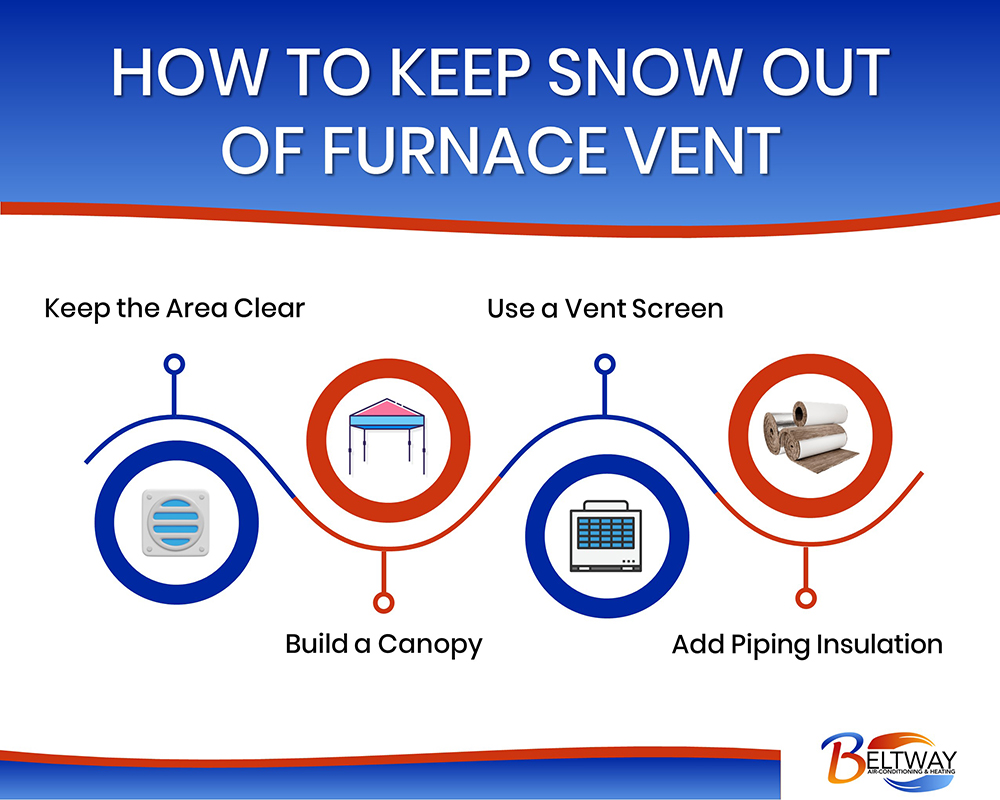
There are several steps you can take to minimize the accumulation of condensation in your heating system. Besides clearing the area around your outdoor unit, you can install a canopy to protect it from the snow.

You can also use a vent screen to keep snow away from the unit. But the screen should be of the right size and grade. If you happen to use one with thick material, it could have the opposite effect. The spacing of the mesh openings needs to be at least half-an-inch wide. Our factory-trained technicians can offer reliable solutions based on the manufacturer’s specifications.

However, you shouldn’t place a cover right on top of the condenser. Always keep the clearance at least two feet from the unit by removing obstructions like shrubs or branches. Also, to maintain airflow within the system, change or clean the filter at least once a month.

It is also advisable to ensure that any exposed piping has insulation. When the water freezes, it can burst your pipes, causing leaks that release moisture. Inspect the insulation on outdoor plumbing or in areas such as the attic, and ensure it is not worn out.

When clearing snow, do not use boiling water to melt the ice. When the temperatures are in the extreme, the hot water will freeze faster than warm water. You could end up increasing the amount of snow around the outdoor unit. You may use warm water as long as it is not cold outside.

Professional Furnace Vent Installation and Maintenance in Hanover

You need to schedule a routine checkup of your furnace to ensure its drainage system is working. Your heating system generates condensation that should be drained away to prevent faults within the system. Our technicians will clean components and check for any anomalies that may promote moisture buildup.

We offer quality custom ductwork in Hanover, MD. The ductwork has a huge impact on the airflow and efficiency of your furance. Our certified technicians can troubleshoot air quality concerns, energy losses, leaks, and moisture accumulation. Our HVAC company also offers comprehensive heating services and cooling services.

You can depend on the furnace service from Beltway Air Conditioning and Heating for fair pricing and quality craftsmanship in Hanover. Call us today to schedule an appointment with our top-rated team.

How Does a Heat Pump Work in the Winter?

If the upcoming Hanover winter has got your wallet bracing for the worst, the good news is there’s a more efficient option for keeping your home warm this winter. That better option is the heat pump. Although they’ve been widely available since the 1970s, heat pumps continue to rise in popularity as more and more people realize the exceptional efficiency gains that can be had when using a heat pump from Beltway Air Conditioning and Heating. To help remove the shroud of mystery that sometimes surrounds heat pumps here is some basic information about how they operate.

Creating Heat

In a typical heating unit, the air is warmed using heat created by the furnace. Most furnaces utilize either electricity or natural gas to create this heat. Although this process is time-tested, it lacks efficiency, both due to energy being wasted and energy being lost as light instead of being converted to heat.

Even in newer gas furnaces that reclaim some of the heat in the exhaust gases, there is still some energy that’s wasted. When it comes to electric furnaces, they tend to be less efficient because the heating coils can’t get as hot as the flame from a gas furnace, meaning that the system has to run longer to produce the same amount of warm air.

Moving Heat

Rather than creating heat from a fuel source, a heat pump’s sole purpose is to move or “pump” heat from the outside to your home’s interior. A heat pump does this by lowering the temperature of a refrigerant until the refrigerant is colder than the ambient air. Then, thanks to the second law of thermodynamics, the heat in the ambient air moves naturally from the air to the refrigerant.

The system then pumps the refrigerant into your home. There, the indoor unit, serving as a condenser, sends the refrigerant through a long series of tubes that allow the refrigerant to begin to cool. At the same time, the blower fan in your indoor unit is blowing cool air over the warm condenser, warming the air in the process. After that, the warm air is sent through your ducts to the rest of your home to provide comfort throughout the winter.

An Efficient Process

While the mechanics of heat pump operation sound complicated and inefficient, the heat transfer process is surprisingly efficient. In fact, most of the process happens without any energy input, thanks to the refrigerant’s thermodynamic properties. The few components that do require energy, mainly the compressor and the blower fan, use far less energy to do their work than is required to create heat in a furnace.

This increased efficiency has numerous benefits. One of the most obvious benefits is a lower utility bill. In addition to using far less energy, a heat pump uses the energy it does need far more efficiently. Therefore, you get a much greater volume of heated air for your home for every dollar that you spend on utility costs.

Another benefit of increased efficiency is less wear and tear on your system. Creating heat in an enclosed system puts a lot of stress on a heating system’s components. Therefore, most furnaces have shorter life expectancies than heat pumps from Beltway Air Conditioning and Heating.

Different Backups

One problem with extracting heat from the outside air is that sometimes the outside air is quite cold. This means that the refrigerant has to get even colder in order for thermodynamics to take over. Given that the refrigerant tubes are made from metal, these sustained cold temperatures can cause ice to form on the tubes, which can greatly reduce your heat pump’s efficiency.

To overcome this problem, most heat pumps have something called a defrost cycle. This cycle pulls heat from inside your home into the refrigerant so that the warm refrigerant can defrost the outdoor refrigerant lines. As you can imagine, though, this will quickly cause your home to become cold. Therefore, heat pumps have a backup heating system to ensure that your home never dips below your desired temperature.

The type of backup heating system that’s used is one of the main differences between the various heat pumps that we sell at Beltway Air Conditioning and Heating. Some heat pumps use a basic electric heater, while others use a gas heater. The efficiency of the backup heater you choose will ultimately determine the overall efficiency of your heat pump.

An Underground Option

Thus far, the discussion has been focused largely on air-source heat pumps. Although these heat pumps make an excellent option, they are not the most efficient type of heat pump available from Beltway Air Conditioning and Heating. That honor belongs to the ground-source, or geothermal, heat pump.

Similar to an air-source heat pump, a geothermal heat pump uses electricity to move the refrigerant through long tubes to pump heat from outside your home to its interior. Instead of coming from the air, though, the heat that a geothermal heat pump sends to your home comes from the ground. This is accomplished by burying long refrigerant tubes in the ground and attaching them to an indoor pumping unit.

The best part about using a geothermal heat pump is that the ground stays at a fairly constant temperature year-round. Therefore, even if it’s bitterly cold outside, you’ll be able to easily extract heat from the ground without having to worry about a defrost cycle. Plus, a geothermal heat pump operates during the summer, as well, to provide cooling to your home in a much more efficient manner than a typical air conditioner.

Impressive Operation

When thinking about installing a heat pump from Beltway Air Conditioning and Heating, one of the biggest concerns of homeowners is that their heat pump won’t work when the temperature gets really cold. The good news, though, is that heat pumps can operate in a wide variety of conditions. As mentioned, geothermal heat pumps can operate in just about any weather because of the consistent underground temperatures.

Even air-source heat pumps, though, can operate in frigid conditions because the refrigerant’s ability to extract heat isn’t dependent on the ambient air temperature. Instead, the temperature of the refrigerant can be controlled by changing its pressure, which is the sole purpose of the compressor in the outdoor unit.

We Have What It Takes

Installing a complex mechanical system, such as a heat pump, really separates the HVAC amateurs from the pros. An incorrect installation will result in inefficient operation and sudden breakdowns. Luckily, at Beltway Air Conditioning and Heating, we’ve got the experience necessary to install any type of heating system, whether it’s a heat pump or a more conventional option.

Plus, we can take care of all of your air conditioning needs, such as repair, maintenance, and installation. We can also take care of custom ductwork installations, commercial projects, and more. Our five-star customer reviews and our A+ Better Business Bureau rating serve as a testimony to our customer-first focus. For more information about various heating options for your home, contact us at Beltway Air Conditioning and Heating today.

Reasons Your Furnace Blows Cold Air

When those chilly nights arrive, you want to know you can rely on your heating system. However, there are times when the heater blows out cold air from the vents. This situation may be annoying, but the solution is often a simple fix, so don’t panic. In most cases, you can correct the problem by yourself. However, if these quick fixes don’t remedy the issue, you may have to call a professional HVAC technician to handle the job. If you’re experiencing cold air problems with your heating system, here are a couple of tips.

Thermostat Settings Need Adjustment

It may seem like a silly problem, but many homeowners forget to set their thermostats back to heat after the summer. If there is cold air blowing from the vents in the summer, you don’t think twice about the settings. Before you call a repair company, you want to check that the thermostat is set to blow warm air into your home.

Wrong Fan Settings

Wrong fan settings can cause problems with the furnace. Furnaces use a fan to push warm air throughout your ducts. For those homes with cold air blowing into the house, you need to check the fan button for your system. If the button is positioned to the “on” setting, you need to switch it over to “auto.” When it is set to “on,” the fan will continuously operate throughout the day. With this setting, the furnace burners will shut off as the heating cycle ends. However, your fan will continue to operate. Since the furnace is no longer producing heat, the air will feel cold.

These settings are very important for your system. The thermostat should be switched to the heat setting, and you will want to set the fan to “auto.” The “auto” setting allows the fan to operate when the heating system is producing heat. If this step has not fixed your problem, it may be time to call a professional to inspect the system. You might have another issue causing the furnace to produce cold air.

Leaky Air Ducts

If your system’s settings are correct, there might be other issues causing your furnace to produce cold air. You may want to check your ductwork. For most systems, there are ducts traveling throughout your home. They take the hot air from the furnace and distribute it around your home. A leak in your ductwork means that cold air can get sucked into your house. As the cold air mixes with the warm air, the air will be cooler than normal.

Leaking ductwork can cause other problems around your home. You’ll probably notice your cooling and heating system struggles to reach the desired temperature in your rooms. There might even be individual rooms that can never cool down or warm up. These spaces might feel stuffy or have an excess of dust in the air. Finally, leaky ductwork can cause your energy bills to spike. If you’re noticing these issues around your home, it could be the result of leaky ductwork.

While you may want to tackle this problem by yourself, a home’s ductwork needs to be inspected by a professional. A trained technician will examine your ducts for any signs of leakage. For those small leaks, the technician can usually repair a single leak in the same visit. However, any excessive leaks will require a complete resealing of your ductwork system.

Limit Switch Problems

Limit switches can cause problems with your furnace. There are a few symptoms associated with this problem. When the system starts, the air coming from the vents will feel very chilly. The air may eventually warm up, but then the furnace could produce cold air again. Your fan will operate, but it gets cut off between the heating cycles. If this is the case with your home, the limit switch might be the cause of the problem.

The fan’s limit switch is located under the hood of the furnace. It is responsible for turning the fan on and off. When it stops working, the fan and furnace will have an irregular heating cycle. Under normal circumstances, the switch allows the burners to warm up before the fan is activated. The fan will continue to operate until the burners have cooled down. With this process, the system can avoid overheating. You will want to check that the limit switch is set to the correct position. If there is cold air coming from your vents, you might have to replace this component.

Overheating Furnace

Finally, your furnace might be overheating. There are a couple of ways to know if this is your issue. A furnace that blows out hot and cold air might be the result of overheating. If your furnace randomly shuts off, then it could have overheating issues. For those homes that have quick heating cycles, it is often an issue with an overheating furnace.

If the furnace starts to overheat, the heat exchanger is getting too hot in your system. When that happens, the fan limit switch will shut down those burners. However, the fan continues to operate until the heat exchanger cools down. Once the exchanger cools down, the furnace may turn on to warm your home. You will notice that your heater might be operating in quick on/off cycles. The air vents blow out cold air from the fan since the furnace is no longer producing heat.

There are a few ways to fix this issue. You’ll want to check the air filters in your home. Filters with excessive dust and debris must be replaced. A clogged filter will restrict the amount of air that flows through your furnace. When the airflow is blocked, then the furnace can overheat.

You should also check all those supply vents around your home. If the vents are blocked, then excess pressure builds up in the duct system. All that extra pressure can put a strain on the furnace blower. In turn, the system will start to slow down, and it will not push out air over the heat exchanger. When the heat exchanger cannot cool down, it will overheat. An air filter replacement and open vents should resolve these issues, but you may continue to have problems with your system. In those cases, you need to schedule a service call with a trained HVAC technician.

We Can Help With Your Furnace Issues

Located in Hanover, MD, Beltway Air Conditioning and Heating is a locally owned business. We specialize in residential and commercial heating, cooling, and ventilation services. If you’re having cold air issues with your furnace, our technicians are ready to help. With our extensive experience, we’ll find a solution to your heating, cooling, and ventilation problems. If you would like to schedule a service call for your Hanover home or business, give Beltway Air Conditioning and Heating a call today! We’d be happy to serve you!

Beltway Air Conditioning, Heating, & Plumbing – Identifying & Avoiding AC Repair Scams

How to Identify and Avoid AC Repair Scams

An air conditioner is essential between April and August in Maryland. It keeps the indoors of our homes and businesses cool during the searing heat of summertime. However, an AC that stops working can be devastating. When faced with a non-working air conditioner, you will immediately delve into a desperate search for someone to fix the problem. There are plenty of genuine AC maintenance and repair services in Maryland, but these businesses may not be able to immediately come out and solve your problem. If the luxury of time is unavailable at such a moment, you are more likely to make rushed and unwise decisions.

Like in any other trade, deceitful technicians do exist in the industry. It is advisable to be watchful about them. You do not want your AC handled by someone who could cause more havoc instead of improving the situation. However, it is not an easy task to find out who’s genuine and who’s not. This article will help you recognize some ways to identify and avoid AC repair scams.

1. Shallow Company Details

A bad AC contractor will provide very little or no information about their company. For instance, they might have a one-page website that doesn’t give sufficient details on what the company offers. Some will lack a website all together since they are not versed with vital information to display on the site. Besides that, they do not have registration and certification documents to prove their legitimacy. Unlike legitimate service providers, false contractors will not have a license to show you. You should quickly sense a scam if an AC repair technician cannot produce a permit upon your request. Keep in mind that a license is proof that the technician has the necessary qualifications for the job. It also shows they are complying with the set-out rules and regulations in conducting business.

Ask a few questions before signing a contract, and request that your AC service provider show you their license. You also want to check their certification to know their areas of expertise. You should avoid service providers who won’t issue these documents right away.

2. Asking for Upfront Payments

Be suspicious of anyone who asks for full payment before the service is completed. Unscrupulous AC repair service companies will ask for full payment and will not accept a down payment. Genuine companies will ask you for a small amount of money at the start of the project, while the rest of the payment is made upon its completion. Others will have an after-the-service payment policy where you settle the whole amount when the work is finished. This is never the case with shady contractors. They will demand full payments before they start the project. Their mission is usually to pocket the money and vanish into thin air.

Avoid being ripped-off by checking the payment policy of your prospective AC repair company. Make sure that the company doesn’t include hidden charges or demand upfront payment.

3. Unrealistic Estimates

While low prices can be rather enticing, they could be another scam. An illegitimate company is likely to cut corners by providing low-priced services while compromising on quality. Why would a company that’s in business to make money offer huge discounts or free services? Simply, it is because they have under-qualified technicians who perform sub-standard work. Similarly, outrageously high prices are a red flag to watch out for. These prices are inclusive of hidden charges, which allow the company to make big profits at your expense.

To avoid this scam, ask for estimates from several AC repair companies. With a list of quotes, you will have an idea of the price to expect when you hire an AC technician. Essentially, the prices of different professional AC repair services will not differ much. Choose the company whose price is not only within your budget, but also looks realistically true. Also, make sure the estimate is done in writing to avoid surprises in the future if additional expenses begin to pop up.

4. High-Pressure Sales Tactics

Scammers will do whatever it takes to sell their services. They will persuade their customers to make unwise decisions using their high-pressure sales tactics. For instance, they will get you to believe that your AC will break down completely if you fail to have it repaired now. Of course, this is to scare you and get you to hire them immediately. You also need to be wary of companies that always have limited time offers such as huge discounts and free services. It is often a tactic used by false AC repair companies to lure unsuspecting customers.

Avoid these scammers by simply following your instincts. A broken AC isn’t a matter of life and death. You should take your time to find reliable and professional services if you want quality in return. Remember, when the deal is too sweet, you need to think twice.

5. No Reviews, No References

An obvious clue you are dealing with a scammer is when you fail to locate even a single review about the air conditioning company. Worse yet, is when they become reluctant to provide you with a list of references whom you can contact before bringing the contractor on board. Essentially, a professional AC repair company will pride itself on having as many online reviews as possible. This is meant to give you a chance to ascertain the quality of their work by reading past clients’ experiences.

To make sure an AC repair company can make good on its claims, check out their online reviews. These could be on their social media platforms such as Facebook or on the Better Business Bureau website. Ask for a list of genuine references as well. Make sure you call them and verify everything you want to know about the AC repair company you plan to hire.

6. A Long List of Unnecessary Parts

Replacing one or two parts in the AC is common. However, replacing almost all the parts, all at once, is uncommon. If your AC repair technician does such a thing, you may be dealing with a fraudster. This stunt is intended to spiral up your repair costs as the technician benefits from added profits. They could also be attempting to convince you to replace your entire AC unit, which implies increased service charges. Another red flag to watch out for is when the technician keeps insisting on recharging the refrigerant. They use this trick to keep coming back for recharging services instead of repairing the leak in the refrigerant.

You can avoid being the victim of a scam by contacting Beltway Air Conditioning and Heating in Hanover. We have qualified technicians who can correctly diagnose and provide permanent solutions. Furthermore, our crew can provide same-day services in many instances. We offer fair prices with no hidden charges, and we encourage you to visit our website to learn about the products we offer from Lennox, Trane, and more. In addition to air conditioners, we work with heat pumps, furnaces, and boilers. Please contact Beltway Air Conditioning and Heating for more information.

A Guide to Attic Insulation

In many homes, the attic is just a storage spot that is rarely entered. However, even if you never use your attic, it is still important to pay attention to its insulation. The right attic insulation can make your home more comfortable and reduce energy costs. At Beltway Heating and Air Conditioning, we want you to make informed decisions about your attic insulation. You can learn about the different types of insulation and get some helpful installation tips right here in this guide.

Benefits of Attic Insulation

Your attic plays a very important role in balancing temperatures inside your home. It is very easy for cool and warm air to pass through all the tiny holes and cracks around a roof. When your attic is uninsulated, your HVAC-treated air leaks out of the attic. Insufficient insulation leads to a home that is hot in summer and cold in winter. Attic insulation is especially important in the winter. Since heat rises, you can end up with almost all of your heat heading up to the attic. In fact, 85 percent of the heat lost in a home leaves through the attic.

Adding insulation to your attic does more than just improve overall comfort. It also saves you a lot of money on your heating and cooling bills. Increasing attic insulation can lower your heating costs by roughly 10% to 50%. Furthermore, attic insulation improves air quality since dust and pollen from outside won’t be able to leak in as easily. It also helps to protect your roof by preventing ice dams and moisture buildup that can lead to torn and missing shingles.

How to Tell If Your Attic Needs More Insulation

Of course, the simplest way to tell if your attic needs insulation is just looking at it. If your insulation is so flattened that your floor joists are sticking out over the top of the insulation, you definitely need more. Another easy way of checking to see if you should add more insulation is by looking at your roof in the winter. If you are getting ice dams, you need more insulation. These happen when heat escapes from your attic and melts the snow on your roof.

An uninsulated attic also tends to cause higher energy bills, so try comparing your home’s energy bills to the average bills for a similar-sized home. If they are abnormally high, it can mean your uninsulated attic is causing your HVAC system to run too much. A final way of checking your insulation is by measuring it and calculating the R-value. As long as you can take the time to do some research and measurements, this can tell you exactly how well your attic is being insulated.

Understanding Insulation R Values

When you are assessing your current insulation or shopping for new insulation, R values frequently come up. An R-value is essentially a measurement of how well a material resists heat flows. Generally speaking, the higher the R-value, the better the insulating properties of a material.

For attics, the U.S. Department of Energy recommends an R-value of at least 30, with an R-value of 60 being preferable. Keep in mind that an insulation’s stated R-value only applies to the insulation when it is brand new and uncompressed. Things like moisture and material degradation can reduce R-value with age. Some types of insulation lose R-value when stacked because compression can reduce R-values.

How to Choose the Best Insulation Type for Your Home

Fiberglass batts are one of the most common types of insulation because they are very easy to install. Made up of thin fibers of glass rolled into sheet sand backed with a vapor barrier, fiberglass batts are budget-friendly and moisture resistant. Per inch, they have an R-value of around 3. Due to their bulkiness, installing them in very low clearance attics or attics with small corners can be tricky.

Cellulose is recycled insulation made from a blend of paper. Typically, it is installed by spraying down a layer with a blower, so even small areas are easily coated. It also comes in loose-fill bags that you can dump into small areas as needed. This insulation usually has an R-value of about 3.5 per inch. Cellulose is both cheaper and more insulating than fiberglass. However, it can easily be destroyed by moisture, rodents, and insects.

Loose-fill fiberglass is another type of blown insulation, but it is made out of fiberglass instead of paper. Loose-fill fiberglass tends to have an insulation R-value of 2.5 per inch. Like blown-in cellulose, it easily gets in all the tiny nooks and crannies of an attic. Keep in mind that it has some unique safety concerns due to being loose fiberglass. It may cause lung problems if it is left uncovered and you enter the attic without proper protection.

Spray foam has an extra high R-value of 3.5 to 6.5 per square inch. This insulation is sprayed on as a liquid, and then it expands and hardens rapidly into a foam. Closed-cell foam is more insulating than open-cell foam, but both are very effective. However, the higher effectiveness comes with a higher price tag.

In addition to the four most common types of insulation, there are also some less common options like rigid foam panels, mineral wool, and recycled denim insulation. These can have benefits like extra sustainability or fire resistance. However, you may have to spend more time shopping around to find these options and get someone who can install them.

The Insulation Installation Process

The installation process typically involves spraying insulation or laying down pre-made batts of insulation on the floor of your attic. Whether or not you can do insulation as a DIY project will depend on the type you choose. Common types of insulation for DIY projects include:

  • Fiberglass batts
  • Mineral wool
  • Loose-fill cellulose
  • Cotton/denim batts

When working with spray foam, you will probably want to leave the installation to the professionals. It is hard to apply the foam evenly unless you have proper tools and experience. Blown insulation, like fiberglass or cellulose, is also best left to the professionals. Though technically it is possible to do it yourself, managing to get an even layer with the heavy machinery can be tricky.

Whatever the type of insulation you select, be sure to fix roof leaks and seal around any exhaust fans, chimneys, or flues beforehand. Make sure that all vents are venting to the exterior. If there are any light fixtures on the ceiling below your attic floor, create a safety barrier around them to prevent fire hazards. Most types of insulation can benefit from a vapor barrier near the warmest side of the insulation to keep condensation from damaging your insulation.

When you want to improve energy efficiency, call Beltway Air Conditioning & Heating. Our technicians help residents of Hanover and Annapolis stop air leaks and install energy-efficient HVAC systems. We can also help with any heating or cooling repairs or maintenance checks. Schedule your appointment now.

Pleated Filters: Why They Are So Effective

Lots of things go on behind the scenes of your HVAC system. In particular, air filters remove dust and dirt particles from your home’s air. Without these filters, individuals with underlying health conditions would be at risk. However, there are different types of filters that have different benefits. Pleated filters have become increasingly popular over the last few years. Let’s examine pleated filters and why they are so effective.

Less Porous

First, pleated filters are less porous from the start. The existence of pores means that air can easily pass through. When air passes through, some particles are bound to go undetected by the filter. While pleated filters still have pores, they are much smaller than those of their fiberglass counterparts. You never really know what sort of particles will pass through the filter. Bacteria and contaminants can be so microscopically small that only the least porous filters can catch them. In a nutshell, fiberglass filters are porous and pleated ones are not. This isn’t to say that fiberglass filters are useless at all times. There definitely is a time and place for a fiberglass filter, but if your aim is to purify your air, you’ll want to make the transition to pleated filters.

More Resistance

Pleated filters provide more resistance. This is the other side of the same coin from above. A pleated filter is made of a tightly woven material that doesn’t let many particles through. Aside from air, not much can get through this resistance. If you have traditional fiberglass filters, feel the two in the palm of your hand for comparison. You can easily tell the difference by breathing on the material. It’s hard to stress just how intricate the pleated filter is. At first glance, it nearly looks like a solid surface that won’t let any air through. However, you have to remember that your cooling system is blowing air at a very rapid pace. The air might also be pressurized to a certain degree. This allows for a constant air stream while separating out all the solids.

Handles All Particles

Now, think about all the hairs from your pet and dirt particles that get tracked in from your child’s shoes. You can rest assured that the level of resistance that pleated filters offer will catch these contaminants in your HVAC system. Furthermore, it’s not all about how porous the material is. The actual design of the filter matters as well. Pleated filters come with an array of microfibers that latch on to the particles. When you can’t risk anything getting through, you want your filter to be pleated above anything else. Particles can range from innocent specks of dirt to bacteria that can infect your nose and lungs. On the latter end of the spectrum, for those who have health and breathing conditions, it is absolutely necessary to catch these particles. Just a couple of specks can be enough to send someone to the hospital. Pleated filters are amazing for the safety of your family as well as your guests.

Maximal Surface Area

Pleated filters also maximize the available surface area of the filter. A large surface area is good for stopping particles from passing through. There are more opportunities for the particle to get stuck. For example, this is evident when you take apart the filter for replacement. With a pleated filter, you’ll notice that there is so much dust and debris on all the surfaces. A flat filter has less surface area, and as a result, fewer particles can be caught at one time. Pleated filters take advantage of the most basic geometric principles.

Not Too Large

At the same time, pleated filters don’t take up an excessive volume. It’s quite an engineering feat to get the best of both worlds: The surface area is respectable because of the pleats, yet the filter itself is compact. If you have a modern cooling system, you can take advantage of this design every time you turn the system on. The pleated filter will get the job done without interfering with other components of your HVAC appliance.

Many Types of Pleated Filters

It’s important to note that there are many types of pleated filters. You’ll want to acquire one that is compatible with your system and brings out the best in its filtration capabilities. As a homeowner, you can experiment with these variations. After using a certain pleated filter for a week, try a different one and test the air quality. If you notice a significant improvement, go with the latter filter. This sort of adaption is one of the biggest selling points of pleated filters. Moreover, this is a relatively modern form of technology. Researchers make developments each year, and there are always improvements to be made. If you can stay up to date with the latest news, you’ll always have the best efficiency at your fingertips.

Higher MERV Ratings

The MERV scale measures how many particles can pass through a filter. A higher MERV rating means that fewer contaminants can pass through. In general, pleated filters have some of the highest MERV ratings on the market. While this number isn’t the end of the discussion, it’s definitely important to consider. At the very least, it is a way of quantifying how effective a filter is. When you’re choosing between a pleated filter with an impressive MERV rating and a cheap filter, the decision is almost obvious. The pleated filter is going to do a better job in almost all circumstances.

Equal Safety

Finally, pleated filters provide all of the above benefits without sacrificing safety. Contrary to popular belief, pleated filters don’t make your AC work harder than usual. It’s a common misconception that pleated filters block too much of the air and force your HVAC system to use a stronger air stream. Tests have shown that these filters don’t require extra power. There isn’t an additional risk of overheating, and even on the hottest summer days, you can use pleated filters without worry.

Safety is paramount when it comes to your HVAC system, and pleated filters meet safety standards without sacrificing efficiency. Overall, they don’t have many downsides at all. Moreover, handling these filters can be even easier than before. You’re able to wash these filters and reuse them as long as the manufacturer has given a thumbs up.

Call Professional Services

When all is said and done, pleated filters are effective for a number of reasons. Moving forward, they could very well be the best type of filter for your HVAC system. A professional company such as Beltway Air Conditioning & Heating in Hanover, MD, is a great resource to help you get started with changing to a pleated filter. We’re experts at everything from HVAC installation to repair to replacement. We can also manage heating, air quality and other HVAC concerns. Give us a call right away so that we can bring you the best pleated filters for your home!

Is Super Cooling Bad for your Cooling System?

Updated September 18, 2023

As AC units become more advanced yearly, homeowners look for ways to take advantage of these products. One practice that has become commonplace is supercooling. Supercooling is a variation of regular cooling that seems powerful beyond belief. However, there are questions about whether it can have adverse effects on the system at its core. So, is supercooling bad for your cooling system?

What Is Supercooling?

Supercooling is the act of turning your AC down during off-peak hours, typically at night and in the early morning. Then, you turn your AC back to an average temperature during peak hours. Because many electric companies offer varying rates depending on the time of day, you will be saving money in the process. It is no secret that AC units consume a great deal of energy, and operating them during peak hours hurts your energy bill.

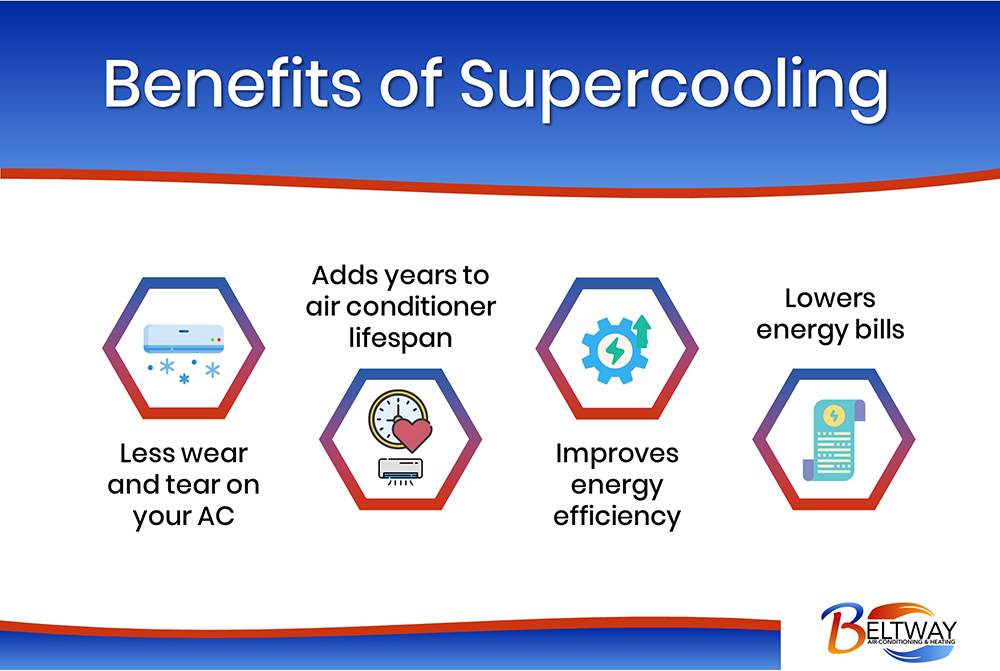
benefits of supercooling

Cool air becomes trapped in the confined space of your home, and your home remains cool throughout the day. As the name suggests, supercooling requires you to turn the thermostat almost as low as possible. If you simply turn it to your preferred climate, things will warm up during the day, and the effect will be lost. When you supercool, you have to go all in on the commitment.

Dangers of Supercooling

What could be bad about supercooling? Not much. The biggest danger is that you will overwork your unit at its maximum setting. It is true that you unit cannot handle a full day of working at maximum capacity. This is why you only use this setting for a couple of hours on end. As long as your AC can handle ultra-cooling at night, you should be good to go.

Supercooling can also have negative effects when done at the wrong time of year. In the summer, go ahead with supercooling for the comfort of you and your family. However, in the winter, there is really no need to supercool. If you proceed with supercooling for whatever reason, you are simply taxing the system for no reason at all.

Benefits of Supercooling

On the other hand, there are many benefits of supercooling. You can save so much money in the process. During the day, electric companies charge their clients much higher rates for using electricity. This makes sense as so many residential and commercial properties are running at full power. This puts additional stress on power plants, and the company needs compensation for all of these demands. However, when you consume electricity at off-hours, rates tend to be much lower. In essence, think of it like putting in a retirement fund or bank account. You bank energy and coolness in the early morning so that you can enjoy it throughout the day.

If you have never done this sort of practice before, you might be surprised just how well your home retains coolness. Make sure to close all windows and doors in the process. While your home certainly is not airtight like a refrigerator or freezer, it does a solid job of creating a barrier between you and the outside world. In particular, air does not seep out as much as you might think.

Caring for Your Cooling System

Overall, supercooling does not harm your cooling system. What are some related ways you can take care of your cooling system? One important approach is to run the AC in cycles. If you put your AC on full blast all the time, it has to work overtime to meet these high demands. If you can alternate your settings and at least provide your unit with some time to recover, you will extend its lifespan by many years. Supercooling helps this approach. You work the AC to an extreme in the early morning and let it recover in the afternoon, perhaps on a fan mode.

Other methods of cooling are also good for the system. Anything besides running the unit all day to exhaustion is essentially a good thing. This can range from supercooling to periodic cooling to lukewarm temperatures that can be complemented by a fan. As a homeowner, there is more to cooling nowadays than just turning the unit on. With so much smart technology at your fingertips, you will want to take advantage of all this with intelligent cooling strategies.

Supercooling in the Evening

One interesting idea is to supercool in the evening. Depending on your county, electricity rates could be low at this time, and you can get in many hours of supercooling before you head to sleep. This could lead to a solid night of rest. It is a slightly unorthodox approach, but it can definitely work if you do not mind staying up late. In general, it results in the same effect on your cooling system. You have simply shifted the cycle to the opposite part of the day. Homeowners who are out at work or in the community all the time can look into this method. After a couple of weeks of supercooling in the evening, you will condition your AC to operate at these hours. It is a net benefit for everyone and all appliances involved.

Supercooling Properly

There are right and wrong ways to supercool. If you supercool improperly, it is possible that you incur damage on your cooling system. However, supercooling the right way is fundamentally harmless. One of the best practices when supercooling is to monitor the system as much as possible. There is no doubt that you do not want to have to keep your eyes on the interface at all times, but you should still oversee your AC as it does its job. You will be able to turn off the unit immediately once your home reaches the correct temperature.

Another good way to supercool is to close as many doors as possible in your home. It is clear that you need to shut all the windows, but doors often get overlooked in the grand scheme of things. If you can create confined spaces, cool air will get trapped in these spaces for the rest of the day. It is well known that cool air settles and warm air rises. This means that the basement or ground floor of your home is an excellent target for supercooling.

Contact Us for Supercooling

The bottom line is supercooling is not bad for your cooling system. In fact, it is one of the most efficient ways to cool your home when done correctly. A professional service like Beltway Air Conditioning and Heating in Columbia, MD, and the surrounding areas, can get you started on the basics of supercooling. We will set up your AC unit and prepare it for a season of supercooling. Moreover, we can handle AC maintenance, furnace repair, and heat pump installation. Get in touch with us right away so you can reap all the benefits of supercooling.

Book Online

"*" indicates required fields

This field is for validation purposes and should be left unchanged.
Phone confirm*