Author: Kevin

Ductless Mini-Split

How Does A Ductless Mini-Split System Work?

If you are looking for flexible heating and cooling options for your home, ductless mini-splits can be an ideal choice. They are very efficient, especially for controlling temperatures in hard-to-reach areas. Ductless mini-splits are popular in regions where many buildings don’t have HVAC systems. Before installing mini-splits, you need to understand how they work, their benefits, and their disadvantages.

What Are Ductless Mini-Split Systems?

Unlike a conventional HVAC system that distributes air throughout the house from one unit, a ductless mini-split system serves an area of the home or a single room. Every system has a separate evaporator coil and fan. They are known as split because they have different outdoor and indoor systems. “Mini” refers to the fact that the system consists of individual units that are smaller than standard HVAC equipment.

Many homes in Hanover, Columbia, Ellicott City, and the surrounding areas without existing ductwork could benefit from the ductless mini-split system. Most commercial and residential property owners don’t want to cut through walls and floors to install new ducts. Since mini-splits circulate air directly through the indoor units, you can use them in situations where HVAC systems cannot fit.

How Do Ductless Mini-Split Units Work?

The heating/cooling combination system works like a heat pump in that it functions using electrical power. That is why the units are very efficient. Mini-splits have two parts; the outdoor condenser and the indoor handling unit. The indoor equipment is mounted on a high wall and transfers air directly into the room. It connects to an outdoor compressor through a refrigerant instead of a complicated duct system.

Besides the refrigerant tubing, the indoor system links to an outdoor unit with a condensate drain line, a power cable, and suction tubing. You can connect several indoor units to the outdoor unit and control them independently, even though they share an outdoor heat pump for dispensing or absorbing heat. The operation is far from a traditional central air system that sends air from the indoor element through the ducts.

Air from the indoor unit goes through a series of pipes to the condenser, where it comes into contact with the coils containing the coolant. The hot air transfers the heat to the coolant, turning the liquid into gas—the gas transfers to the compressor, where it is recycled and converts into a liquid again. The newly cooled air gets into the air handler, from where it goes back to the room. The cycle repeats itself to attain the desired temperature.

It’s easy to control a ductless mini-split system because most models have remote controls for setting the desired temperature.

5 Benefits of Ductless Systems

Here’s why you should consider using mini-splits in your home or commercial property.

1. Quick and Easy to Install

Installing a conventional HVAC unit is a large operation that might interfere with your regular activities. The ducting must pass along the walls or sometimes inside them to connect to other parts of the unit. It takes days or weeks, depending on the size and complexity of the project.

Ductless systems are easier to install. Since the work can be divided on a room-by-room basis, the installation can be completed in a day. The units have small holes, so you don’t have to repair plasterwork or rebuild walls. Most holes have a diameter of 3 inches at most, which has an insignificant impact on the building’s structure.

2. Highly Flexible

Ductless systems are flexible, unlike traditional heating/cooling systems. With a mini-split unit in your home, you can change one room’s temperature without affecting other parts. For instance, you may want to cool your living area during the day while maintaining your bedrooms’ temperature. Also, different family members have varying heating and cooling preferences. With mini-splits, you can adjust the temperature of any room independently.

Ductless systems are also flexible because you can install them in many places as opposed to regular HVAC units. They are ideal for condos, garages, period properties, home additions, basements, small apartments, and old office buildings.

3. Better Air Quality

Traditional HVAC systems require intensive clean-up and don’t prevent pollution from coming into the house. They blow in bacteria, allergens, vehicle exhaust fumes, and pollen without discrimination. Some traces of these contaminants remain even after cleaning.

Ductless mini-splits feature problematic filtration cartridges that are easy to clean and replace. The multi-stage filtration systems help to get rid of most airborne particles from contaminating your office or home.

4. “Green” Solution

The ducts used in regular HVAC systems risk air leakage, which can be very inefficient. When the temperatures are high, warm air might seep into the room, thus forcing your AC to work harder than it should. The same applies to cold temperatures. Since the ductwork stays in unconditioned places, it is exposed to summer heat or freezing winter temperatures. The HVAC equipment works extra hard to counteract the exposure.

Ductless systems are efficient because they don’t use ductwork. Therefore, your HVAC unit doesn’t have to work extra hard, and you pay fewer energy bills. Mini-splits also use inverter technology, which is more efficient than conventional HVAC units. The technology eliminates sharp fluctuations and extends the life of the unit’s parts.

5. Affordable Solutions

Ductless mini-split units use less power than conventional alternatives. They are smaller than forced-air systems, and air doesn’t have to travel along with lengthy distances. Since mini-splits don’t use ducts, heat loss reduces significantly. You can also use them to target specific areas or rooms within a building. It helps to develop temperature-controlled zones. When you go green, you might enjoy tax credits and utility rebates from local governments and federal administration.

Disadvantages of Mini-Split Systems

While mini-splits have a host of benefits, they may not be an ideal solution because of these disadvantages:

  • Higher upfront costs than traditional systems
  • You may not like the aesthetic of the indoor units
  • Requires professional installation

Who Should Consider a Mini-Split System?

If you have an older building or a slab home with no ductwork, the cost of installing pipes might exceed that of the furnace and AC. Therefore, a ductless option might be ideal in this case. People who have already installed conventional HVAC units but have “nuisance” spots in their homes might be better off installing mini-splits in those rooms.

Homeowners who want to downsize without relocating can resort to ductless mini-split units to help reduce the running costs. If you run a commercial property, and every tenant has differing needs, you may consider installing mini-splits to keep everyone comfortable. Ductless systems are also perfect for those looking to extend their homes and don’t want to redo the ductwork.

If you are considering installing a ductless AC unit in your home, our experts in Hanover, Columbia, Ellicott City, or the surrounding areas will be happy to help. At Beltway Air Conditioning and Heating, we are invested in ensuring that our clients are comfortable. We will survey your home or commercial property and advise you on the best air conditioning or heating unit to install.

How To Make An Old Home More Energy Efficient

Old homes don’t get the love they deserve. Although they may present more repair and maintenance needs than newer homes, old homes are often cheaper than their newer counterparts. Whether you rent or own the old home you’re living in, you probably struggle with high utility bills. To improve your home’s energy efficiency, try integrating the tips mentioned below.

Water Heater

Water heaters have been around for more than a hundred years. In fact, the prototype for the modern tank water heater was developed in the late 1800s, more than 130 years ago.

Although tankless water heaters have grown in popularity over the past couple of decades, tank-type water heaters are still the most popular variety.

If you have a tanked water heater, consider increasing the insulation on your water heater. You can find insulating jackets made specifically for water heater insulation. Buying one of these is much simpler than crafting makeshift insulation on your own. It’s also affordable, especially considering how long it’ll insulate your water heater.

After fitting the jacket to your water heater, it’s time to insulate your home’s hot water pipes. You may find a few feet of hot water pipes around the heater itself. However, most hot water pipes will be located in your home’s crawl space. Although nobody likes spending time in crawl spaces, you should bite the bullet and insulate your pipes while you can.

Before visiting the next energy efficiency tip, turn your water heater’s temperature down to 120 degrees Fahrenheit. Keeping your water temperature higher wastes energy and can lead to scalding when washing dishes or showering. On the other hand, dropping the water temperature below 120 degrees can encourage unwanted bacteria growth.

Consider a Geothermal Heat Pump

Although they’ve been around nearly as long as tank-type water heaters, geothermal heating systems aren’t as well-known as furnaces or air conditioners.

These systems can take care of your year-round heating and cooling needs, not to mention substantially reduce your energy consumption. Better yet, you probably won’t need to make major home renovations to make room for a geothermal heat pump.

As long as your home already has a central HVAC system, you can connect the heat pump to the home’s ductwork. If you can afford to install a geothermal heat pump in your home, don’t bother doing it yourself. Getting something wrong could lead to poor system performance or expensive repairs and requires extensive technical knowledge and equipment plus knowledge of the proper zoning and permitting for your region.

Rather, have a professional HVAC contractor like Beltway Air Conditioning and Heating of Hanover, Maryland, install it for you. Our NATE-certified technicians know the ins and outs of modern geothermal heat pumps. Here at Beltway Air Conditioning and Heating, our Marylander HVAC professionals take pride in doing jobs right the first time around.

Invest in an Energy Audit

It’s hard to know whether you’ve improved without a baseline to compare your performance to. You also won’t know whether your home is energy efficient or not. Investing in an energy audit is a great starting point for any energy efficiency project.

Many local and state government agencies offer these home energy assessments. You can also get them from qualified HVAC providers such as us, Beltway Air Conditioning and Heating of Hanover, Maryland.

Home energy audits look at things like your windows, insulation, locations where air is escaping your home, holes in your ducts, the age and efficiency of your appliances and the type of heat source that you’re using. In addition to energy efficiency ratings, you’ll receive personalized recommendations for improving your home’s energy efficiency.

Find and Seal Air Leaks

Although homes do a good job of insulating you from the outdoors, they’re still full of tiny gaps. These gaps allow air leaks to flow into your home, which makes your energy bills higher.

Unlike full-scale heat pump installation or performing a home energy assessment, locating and sealing air leaks is a project you can reasonably take on. Still, it never hurts to get help from a professional HVAC contractor like us for any heating and cooling project.

While air leaks can come from anywhere, common sources of air leaks include:

  • Fireplaces
  • Phone line, internet, and cable line entry points
  • Wall outlets
  • Gaps in foundations or brick walls
  • Outdoor water faucets
  • Attics
  • Window and door frames

The easiest way to close air leaks is by closing fireplace dampers or attic doors, for example. Of course, most leaks won’t be as easy to address.

Weatherstripping is ideal for sealing door and window frames. You can also use draft snakes, or rolled towels in a pinch, below doors to block drafts.

In general, you can use caulk to seal most remaining air leaks. Be careful to apply it carefully because excess caulk can look ugly. For best cosmetic results, find hardware stores with a wide range of caulk tones. Get clay-colored caulk for sealing holes in red brick, for example, and white or eggshell caulk for plugging up air leaks around wall outlets.

Get Some Newer Windows

Assuming they don’t shatter, windows can last many decades. Even if they don’t open well, it’s easy to put off window replacement.

If you’re serious about improving your old home’s energy efficiency, it’s time to buy some newer windows. As long as they have the Energy Star label, you don’t need to search for a specific brand. Make sure your new windows fit snug, too. Although you can temporarily compensate for small windows, they’ll eventually make way for major air leaks that’ll haunt you in the future.

Windows aren’t cheap. Gas-filled, two-ply or three-ply windows are the most efficient but are also the most expensive. High-quality windows can cost several hundred dollars per unit. Large picture windows can cost even more. Despite the cost, windows can save you more money than many other energy efficiency upgrades.

Before finishing your window replacement project, don’t forget to insulate them. This simple step can prevent air leaks from forming in the future, saving you worry and energy in the process.

Change Your Light Bulbs

Revamping your home’s energy efficiency isn’t entirely heating and cooling related. Changing light bulbs is a simple, effective way to reduce your home’s energy usage.

Compact fluorescent bulbs, also called CFLs, are the cheapest energy-efficient bulbs on the market. CFLs use less energy and last many times longer than traditional light bulbs. You can also replace your home’s light bulbs with LEDs. Light-emitting diodes cost much more than CFLs or incandescent bulbs but will save you more money in the long run because a single bulb uses less energy and can last 3-5 times longer than a CFL or incandescent bulb.

Whichever type of bulb you choose is up to you. Either way, you’ll save money on utilities and help the environment in the process.

If you’d like professional heating and cooling help, look no further than Beltway Air Conditioning and Heating of Hanover, Maryland. We also have another location in Annapolis, giving us easy access to clients across the Old Line State. Some of our many HVAC services include AC repair, furnace replacement, and all-around HVAC maintenance. For more information about our services, give us a call today!

How Often Should You Get HVAC Maintenance?

You know your HVAC system requires regular maintenance, whether it’s because you installed a new system or have seen the ads. How often should you have your system maintained, and what does it include? Understanding the why and how behind these tasks makes it easier to make this a priority every year.

How Your System Works

To start understanding why your system needs regular maintenance, it’s important to first understand the basics of how it works. In a single state, it operates on the simple premise of circulating air through your home and your system.

When your system is operating at peak efficiency, it easily draws air into your system through the return vents. It then moves this air through the system, heats or cools it, and then pushes it back out into your home. The process of drawing air in and pushing air out helps the air in your home circulate.

The first major issue you can have with your system, regardless of whether you are heating or cooling, is an airflow restriction. These restrictions can happen in a number of places in the system.

The goal is to keep your system working as close to peak efficiency as possible. This both keeps your heating and cooling bills low. It also reduces the overall repair costs and helps extend the service life of your furnace.

Why Your System Needs Maintenance

Your system works itself into needing maintenance just by operating regularly. First, as it circulates air, contaminants that make their way past your filter will settle on your evaporator coil, heat exchanger and circulating fan. As these contaminants collect, they restrict proper airflow through your system.

Further, your system works with a number of motors, which create a lot of vibration as they spin. This vibration eventually loosens some mounting bolts and screws in the system.

When you have airflow restrictions or loose parts, the result is ultimately the same: increased electrical resistance. This increased resistance creates additional heat in sensitive areas of your furnace.

When you have electrical components that experience additional heat, it makes connections brittle and causes wires to wear. If the resistance is enough, some components may burn out or create shorts.

The goal of regular maintenance is to reduce the extra resistance in your system by catching the causes early. By completing a series of preventive maintenance tasks and cleaning, your technician helps your system run smoothly and efficiently.

Ideally, you should have your system maintained twice annually. During each visit, your technician will perform some common preventative, inspection and cleaning tasks. However, each visit will also have some tasks specific to the season.

Preventative Tasks

Preventative tasks are a bulk of what a properly trained technician will focus on during a regular maintenance visit.

One of our technicians will check the mounting bolts and screws on your circulating and induction motors. These will loosen over time from the vibration of normal operation.

A technician will also lubricate the bearings in the circulating fan motor. If these are not properly lubricated, they will eventually wear and cause the motor to seize.

The fan is also a wheel, and like the wheel on your car, it needs to be balanced. If it is off-balance, it causes extra wear on the motor and increases the resistance in the electrical components. All of this leads to premature motor failure.

System Inspection

While technicians are working on your system, they will be inspecting the unit as well. Mechanical and electrical parts will eventually fail, and they usually give early warning signs when they do. When you can detect them early, you reduce the strain on your system and the broader impacts of a failing component.

Our technicians will inspect the wiring and electrical components, including the control board. During this inspection, they will be looking for melted insulation and singe marks. These indicate a problem with either arcing or a short.

They will also test components like capacitors to ensure they’re working properly. If a capacitor is failing, you may experience issues with your circulating fan starting consistently.

The circulating fan wheel is also something to pay attention to in order to replace it if it becomes damaged. There are additional components specific to the two maintenance visits our technicians will also inspect, detailed below.

System Cleaning

In order to keep air moving through your system freely, you have to continue areas that collect airborne contaminants. Our technicians will clean these areas during their visit.

During both visits, our technicians will also clean the circulating fan wheel. This ensures it will move the maximum amount of air while it spins.

Additionally, they will clean your heat exchanger, which allows the air to be heated correctly. When contaminants collect on the exchanger, it will produce a slight burning smell when it first lights up.

Another common area to collect airborne contaminants is the evaporator coil. This is what cools your air in the summer. The evaporator coil does not warm up like the heat exchanger; it will not naturally resolve itself.

Lastly, our technicians will check your condensate drain. As your system runs, it will produce condensation, whether it is the heat or air conditioning. This condensation drips down and collects in a drip pan. That pan then has a pipe to allow the condensation to drain off.

While the condensation collects, it will also pick up small metal particles and dirt. This will cause your system to trip and stop running to prevent damage.

Spring Maintenance

During spring maintenance, our technicians will want to ensure your system is ready to run for the summer. They will inspect your compressor, condenser and the area around your outside unit. They will also clean the outside of your unit and ensure it is clear of debris that may restrict airflow.

In addition, they will check your refrigerant level and offer to recharge your system if needed. A system with too little refrigerant is prone to freezing, which damages the compressor.

Fall Maintenance

During your fall maintenance, the focus is primarily on your heating system. A major part of this visit is the inspection of your furnace burners and heat exchanger. If your exchanger is cracked, you’re more prone to having a carbon monoxide issue. So, ensure it is solid before you light it off for the year.

Another important area to check for your furnace is the gas flow to your system. Your regulator, igniter and heat sensor can all malfunction. When they do, they cut the fuel flow to your system. You want to find these issues before the winter season arrives.

Beltway Air Conditioning and Heating offers trusted HVAC services to Hanover, MD, residents and residents in the surrounding area. Our team provides heating and air conditioning installation, maintenance and repair services. We also have expertise in indoor air quality to help you breathe more easily and keep your system clean of contaminants.

How to keep snow out of a furnace vent

Updated: September 18, 2023

Routine maintenance is essential in upholding your heating system’s efficiency. Keeping the snow out of the furnace vent is one of the critical maintenance tasks you can’t afford to ignore. The buildup of condensation can wreak havoc on your HVAC system. In this article, we’ll explore steps on how you can keep snow from out of your furnace vent.

Condensation in High Efficiency Furnaces

A modern condensing furnace utilizes two combustion stages to attain up to 90% AFUE fuel efficiency. Unlike conventional heating systems, condensing furnaces have a second heat exchanger. When the exhaust gas passes through the element, it absorbs much of the remaining heat.

Because they can absorb most of the heat from the exhaust, it prevents waste and is much more efficient. However, condensing furnaces have one drawback: the discharge of exhaust gases is hardly ever warm. The cooler fumes allow faster condensation. For that reason, high-efficiency units should have a specialized venting system in place during installation.

how to keep snow out of furnace vent

In a conventional system, the flue can be metal since the gases are still hot when they exit the exhaust. On the other hand, modern condensing furnaces have a plastic vent pipe in place of metal. The fact that the vent is plastic is an indication of the low temperature coming from the exhaust.

Typically, mid-efficiency furnaces are not as prone to condensation. However, if the flue’s placing or sizing is incorrect, it will trap vapor, and moisture will accumulate.

Give Your Furnace Space

A clogged vent pipe can cause problems within your furnace and may pose a health risk in your home. That’s why it’s important to clear the area around your outdoor unit of snow and debris. Homes with the vent pipe going through the exterior walls rather than the chimney are more vulnerable to condensation.

When the vent pipe is blocked by snow, it will shut down your system as a safety measure. You may have to call a furnace emergency service in the middle of a cold winter. Furthermore, when the blockage is around the exhaust pipe, it may introduce harmful gases into your home.

At Beltway Air Conditioning and Heating, we recommend checking your carbon dioxide and carbon monoxide detectors before winter. During the cold season, your furnace will be running most of the time. You want to ensure that the safety alarm will alert you if there is a risk of a hazard.

Debris and Ice Formation

When the system expels exhaust fumes from the furnace, it meets the cooler air outside and condenses. The process is much faster for higher-efficiency heating systems because of the cooler fumes. However, other factors, such as debris obstructions, can accelerate the process of condensation.

Remember, once the twigs and leaves sticking from the vent pipe come into contact with vapor, condensation happens to form water vapor. For that reason, you should clear the area around the exterior unit of any debris. Children like to push sticks into the pipes, so it is advisable to ensure there is a barrier around it.

Improper Vent Pipe Installation

Clearing the area around the outdoor unit will minimize snow accumulation and prevent blockages. However, a substandard installation process can create chronic issues that could eventually damage your furnace. High-efficiency furnaces can be prone to condensate buildup unless the installation is thorough.

During furnace installation, the system must discharge exhaust fumes efficiently. Otherwise, the intake vent can draw the gases into it, which can cause ignition problems. The warm air will melt the snow and pull in vapor, which will end up freezing inside the pipe.

Excess moisture may also cause the condensate drain to clog. This will trip the pressure switch. The pressure switch ensures the right amount of air gets into the unit for combustion. If there is a blockage, your furnace will produce an unstable flame.

During installation, components that produce condensate should be on a slope to allow the moisture to drain. Such components include hoses connected to the furnace, the condensate drain and vent pipes. Your central air conditioning system can also generate moisture that may travel to the furnace.

In high-efficiency furnaces, the trick is to ensure the discharge of exhaust is as fast as possible. The plastic vent pipes must be of the right size to minimize the amount of condensation. Therefore, it is essential to have a terminating hub to direct the flow of exhaust fumes.

A hub at the end of a vent pipe should point downwards to ensure there is no risk of exhaust intake. Snow buildup will trigger a lockdown mechanism. Routine maintenance of your furnace before winter should unearth potential installation issues or equipment faults.

Inconsistencies on the venting material may develop due to poor installation. An opening in the PVC piping will impact the exhaust’s discharge, which may allow toxic gases to accumulate. Beltway Air Conditioning and Heating ‘s staff in Hanover will perform thorough tune-ups and repairs to keep your home safe.

Steps to Prevent Snow Buildup

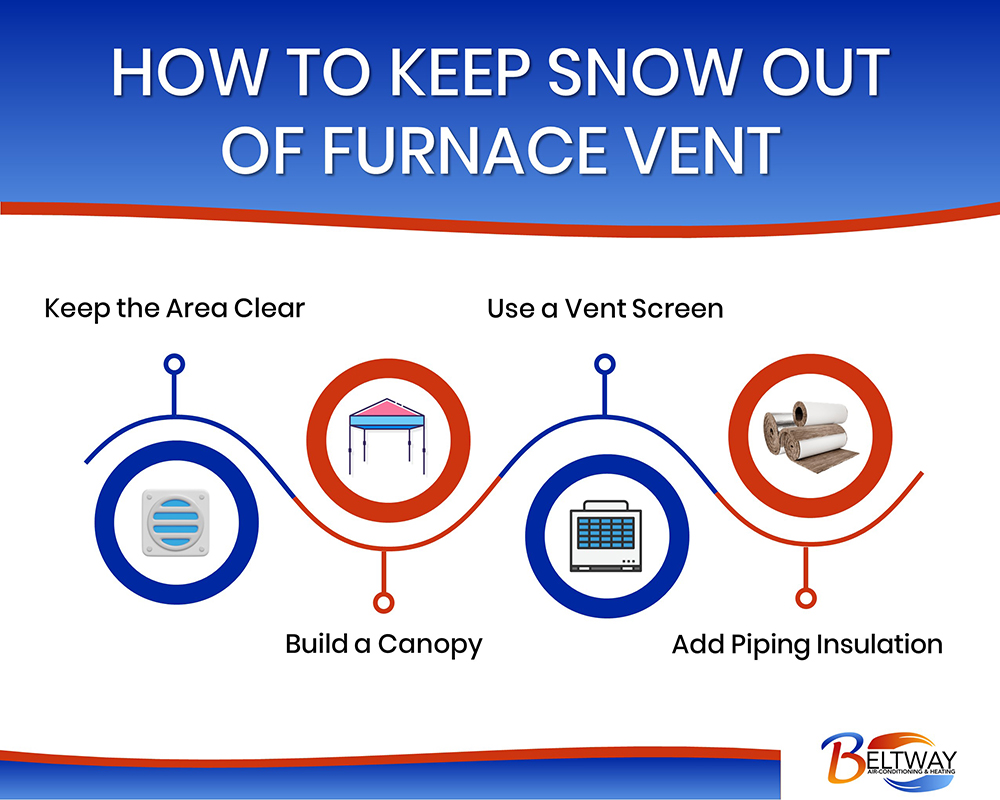
There are several steps you can take to minimize the accumulation of condensation in your heating system. Besides clearing the area around your outdoor unit, you can install a canopy to protect it from the snow.

You can also use a vent screen to keep snow away from the unit. But the screen should be of the right size and grade. If you happen to use one with thick material, it could have the opposite effect. The spacing of the mesh openings needs to be at least half-an-inch wide. Our factory-trained technicians can offer reliable solutions based on the manufacturer’s specifications.

However, you shouldn’t place a cover right on top of the condenser. Always keep the clearance at least two feet from the unit by removing obstructions like shrubs or branches. Also, to maintain airflow within the system, change or clean the filter at least once a month.

It is also advisable to ensure that any exposed piping has insulation. When the water freezes, it can burst your pipes, causing leaks that release moisture. Inspect the insulation on outdoor plumbing or in areas such as the attic, and ensure it is not worn out.

When clearing snow, do not use boiling water to melt the ice. When the temperatures are in the extreme, the hot water will freeze faster than warm water. You could end up increasing the amount of snow around the outdoor unit. You may use warm water as long as it is not cold outside.

Professional Furnace Vent Installation and Maintenance in Hanover

You need to schedule a routine checkup of your furnace to ensure its drainage system is working. Your heating system generates condensation that should be drained away to prevent faults within the system. Our technicians will clean components and check for any anomalies that may promote moisture buildup.

We offer quality custom ductwork in Hanover, MD. The ductwork has a huge impact on the airflow and efficiency of your furance. Our certified technicians can troubleshoot air quality concerns, energy losses, leaks, and moisture accumulation. Our HVAC company also offers comprehensive heating services and cooling services.

You can depend on the furnace service from Beltway Air Conditioning and Heating for fair pricing and quality craftsmanship in Hanover. Call us today to schedule an appointment with our top-rated team.

Air purifiers vs Plants

Indoor air quality is a concern for many homes today. Modern furnishings and materials are responsible for up to 90% of the contaminants. But how can you manage your indoor air quality? In this article, we compare plants and air purification systems.

Can Plants Clean the Air?

In recent years, there has been a resurgence of some of the 1970s trends. One such trend is the use of houseplants to purify the air. Using plants may seem like a great idea since they accentuate your interior design choices. Gardening is also a healthy hobby that can be fulfilling for many homeowners.

Unfortunately, the idea that plants can capture toxins and allergens from the air is hardly true. Several studies have already debunked the myth. When compared to home purification systems, their ability to clean the air is negligible.

Plants can get rid of toxins but at such a low rate that they cannot compete with conventional purification systems. The surface area of a plant’s leaf is too small to take in significant quantities of air. You will need 10 of them for every square foot. That translates to about 5,000 plants for a five by five-foot space.

Why the Confusion?

The reason the myth is so prevalent is that the claims usually rely on old studies. Research by NASA from 30 years ago indicates that plants can indeed remove some pollutants like VOCs.

The level of Volatile Organic Compounds indoors can be up to two to five times the concentration outdoors. VOCs can cause respiratory problems as well as eye and nose irritation after a short duration of exposure. Unfortunately, they cannot be removed by your average electrostatic purifier.

That is why studies showing some plant’s ability to remove VOCs have generated so much interest. However, the NASA study was done in a lab, where the experiment does not match your indoor environment.

Why Plants Are Impractical for Air Purification

Plants may seem like an economical option for addressing indoor air quality concerns in your home. They take in carbon dioxide and release oxygen and humidity. That is in contrast to a home purification system that consumes considerable amounts of energy to remove toxins.

But there are several reasons why plants are impractical. Unlike in a hermetically sealed lab environment, your home allows air to get in from the outdoors. The incoming airflow will introduce new pollutants as soon as the plant completes its purification cycle.

The rate at which the houseplant can remove pollutants in your home is too slow to be useful. Since you’ll need at least 10 plants per square foot, you’ll be effectively turning the room into a garden. Even then, the capacity to purify is marginal in comparison to a purification system.

Additionally, houseplants cannot remove pollutants that a basic air purifier will capture. For example, pet dander, allergens and dust will only settle on the plan’s leaf, unlike the VOCs it can process.

Plants also require a lot of upkeep. You’ll need to water, weed and prune them every now and then. That translates to more resources and time spent on indoor gardening. The amount of care the houseplant will require will depend on the species. Some houseplants require a consistent interior temperature, which may consume the energy you’re trying to save.

The Challenges of Removing Volatile Organic Compounds

VOCs are a group of toxic compounds found in skincare products, paints and adhesives. You could have a significant concentration of VOCs if you’ve done some renovation work recently. The toxin gases could also be coming from vehicle traffic from a road close to your home.

One problem with VOCs is that electrostatic and HEPA filters cannot capture the toxins. Even though HEPA filters can stop particles as small as 0.3 micrometers, they still won’t capture VOCs. Gases are even smaller than that and will require a specialized air purifier.

Another challenge is that the source of VOCs may continue releasing the toxic gases indefinitely. How much they continue to introduce contaminants will depend on the material. Some of the VOCs, such as those from paint, will emit toxins after six months. But other items in your home like the particulate board or MDF can continue releasing the gas for two decades.

Therefore, you must locate the pollutant before you think of installing a filtration system. An indoor air quality monitor can help track hazardous contaminants in your home. Removing the material that releases VOCs is the best first step to take to make your home safe from toxins.

Activated Carbon Filter Versus Plants for VOCs

Although plants can filter VOCs, their capacity is marginal and impractical. Also, a regular filtration system cannot capture the toxic gas due to the small size of the particles. So how can you eliminate volatile organic compounds from your home?

One of the most effective solutions is to use activated carbon filters. Activated carbon has minute pores with a low volume. The structure of its molecules allows for a large surface area that can capture different types of compounds.

The filter works by adsorption, where molecules from a fluid adhere to the surface of activated charcoal. Some studies show that it can capture between 60 and 80% of gaseous toxins. One of its applications is to control hazardous nuclear waste.

Air Purifiers and Managing Indoor Air Quality

Many types of pollutants can pose a risk to your home. They include particulate matter, ozone, radon, Asbestos and biological contaminants. You should understand the type of contaminant you are dealing with before you take any remedial steps.

You should also note that indoor air quality issues can create more complicated problems if not resolved on time. For example, high levels of humidity can cause biological contaminants to thrive in your home. Vapor combined with warmth can encourage a bacterial or mold spore infestation.

Understanding the nature of the pollution will help you determine the best course of action to take. For instance, species like the Jade Plant can humidify the room. But the extra moisture may be destructive if humidity levels are already high in the building.

The EPA suggests improving ventilation in the interior to address indoor air quality concerns. When the air from the outdoors gets into your home, it dilutes harmful toxins. Enclosed spaces allow for particulate matter and VOCs to accumulate.

Unfortunately, plants cannot remove significant amounts of pollutants, especially where there is ventilation. It is also much harder to determine the plants you’ll need to remove pollutants in a given space.

Another approach to indoor air quality is to use monitors to detect contaminants in your home. The process is much more verifiable and scientific. Plants can enhance aesthetics and complement other air purification systems. You can talk to Beltway Air Conditioning and Heating ‘s certified technicians for effective air quality solutions in Hanover.

The condition of your ductwork and AC system can have an impact on your indoor air quality. Beltway Air Conditioning and Heating ‘s BBB-accredited service has a team of experienced professionals who can install whole-home humidifiers. We offer installation services for cooling and heating systems. Our team can also provide dependable custom ductwork and metal fabrication solutions.

If you need dependable indoor air quality solutions you can rely on, consult Beltway Air Conditioning and Heating ‘s team in Hanover today.

How Does a Heat Pump Work in the Winter?

If the upcoming Hanover winter has got your wallet bracing for the worst, the good news is there’s a more efficient option for keeping your home warm this winter. That better option is the heat pump. Although they’ve been widely available since the 1970s, heat pumps continue to rise in popularity as more and more people realize the exceptional efficiency gains that can be had when using a heat pump from Beltway Air Conditioning and Heating. To help remove the shroud of mystery that sometimes surrounds heat pumps here is some basic information about how they operate.

Creating Heat

In a typical heating unit, the air is warmed using heat created by the furnace. Most furnaces utilize either electricity or natural gas to create this heat. Although this process is time-tested, it lacks efficiency, both due to energy being wasted and energy being lost as light instead of being converted to heat.

Even in newer gas furnaces that reclaim some of the heat in the exhaust gases, there is still some energy that’s wasted. When it comes to electric furnaces, they tend to be less efficient because the heating coils can’t get as hot as the flame from a gas furnace, meaning that the system has to run longer to produce the same amount of warm air.

Moving Heat

Rather than creating heat from a fuel source, a heat pump’s sole purpose is to move or “pump” heat from the outside to your home’s interior. A heat pump does this by lowering the temperature of a refrigerant until the refrigerant is colder than the ambient air. Then, thanks to the second law of thermodynamics, the heat in the ambient air moves naturally from the air to the refrigerant.

The system then pumps the refrigerant into your home. There, the indoor unit, serving as a condenser, sends the refrigerant through a long series of tubes that allow the refrigerant to begin to cool. At the same time, the blower fan in your indoor unit is blowing cool air over the warm condenser, warming the air in the process. After that, the warm air is sent through your ducts to the rest of your home to provide comfort throughout the winter.

An Efficient Process

While the mechanics of heat pump operation sound complicated and inefficient, the heat transfer process is surprisingly efficient. In fact, most of the process happens without any energy input, thanks to the refrigerant’s thermodynamic properties. The few components that do require energy, mainly the compressor and the blower fan, use far less energy to do their work than is required to create heat in a furnace.

This increased efficiency has numerous benefits. One of the most obvious benefits is a lower utility bill. In addition to using far less energy, a heat pump uses the energy it does need far more efficiently. Therefore, you get a much greater volume of heated air for your home for every dollar that you spend on utility costs.

Another benefit of increased efficiency is less wear and tear on your system. Creating heat in an enclosed system puts a lot of stress on a heating system’s components. Therefore, most furnaces have shorter life expectancies than heat pumps from Beltway Air Conditioning and Heating.

Different Backups

One problem with extracting heat from the outside air is that sometimes the outside air is quite cold. This means that the refrigerant has to get even colder in order for thermodynamics to take over. Given that the refrigerant tubes are made from metal, these sustained cold temperatures can cause ice to form on the tubes, which can greatly reduce your heat pump’s efficiency.

To overcome this problem, most heat pumps have something called a defrost cycle. This cycle pulls heat from inside your home into the refrigerant so that the warm refrigerant can defrost the outdoor refrigerant lines. As you can imagine, though, this will quickly cause your home to become cold. Therefore, heat pumps have a backup heating system to ensure that your home never dips below your desired temperature.

The type of backup heating system that’s used is one of the main differences between the various heat pumps that we sell at Beltway Air Conditioning and Heating. Some heat pumps use a basic electric heater, while others use a gas heater. The efficiency of the backup heater you choose will ultimately determine the overall efficiency of your heat pump.

An Underground Option

Thus far, the discussion has been focused largely on air-source heat pumps. Although these heat pumps make an excellent option, they are not the most efficient type of heat pump available from Beltway Air Conditioning and Heating. That honor belongs to the ground-source, or geothermal, heat pump.

Similar to an air-source heat pump, a geothermal heat pump uses electricity to move the refrigerant through long tubes to pump heat from outside your home to its interior. Instead of coming from the air, though, the heat that a geothermal heat pump sends to your home comes from the ground. This is accomplished by burying long refrigerant tubes in the ground and attaching them to an indoor pumping unit.

The best part about using a geothermal heat pump is that the ground stays at a fairly constant temperature year-round. Therefore, even if it’s bitterly cold outside, you’ll be able to easily extract heat from the ground without having to worry about a defrost cycle. Plus, a geothermal heat pump operates during the summer, as well, to provide cooling to your home in a much more efficient manner than a typical air conditioner.

Impressive Operation

When thinking about installing a heat pump from Beltway Air Conditioning and Heating, one of the biggest concerns of homeowners is that their heat pump won’t work when the temperature gets really cold. The good news, though, is that heat pumps can operate in a wide variety of conditions. As mentioned, geothermal heat pumps can operate in just about any weather because of the consistent underground temperatures.

Even air-source heat pumps, though, can operate in frigid conditions because the refrigerant’s ability to extract heat isn’t dependent on the ambient air temperature. Instead, the temperature of the refrigerant can be controlled by changing its pressure, which is the sole purpose of the compressor in the outdoor unit.

We Have What It Takes

Installing a complex mechanical system, such as a heat pump, really separates the HVAC amateurs from the pros. An incorrect installation will result in inefficient operation and sudden breakdowns. Luckily, at Beltway Air Conditioning and Heating, we’ve got the experience necessary to install any type of heating system, whether it’s a heat pump or a more conventional option.

Plus, we can take care of all of your air conditioning needs, such as repair, maintenance, and installation. We can also take care of custom ductwork installations, commercial projects, and more. Our five-star customer reviews and our A+ Better Business Bureau rating serve as a testimony to our customer-first focus. For more information about various heating options for your home, contact us at Beltway Air Conditioning and Heating today.

Should I Be Worried About Carbon Monoxide in My Home?

When thinking through common home threats in Hanover, most people tackle the visible threats first. After all, it’s much easier to set up a home security system to protect against potential intruders that you can see than it is to install security measures for a threat that you can’t see. When protecting your home from threats, though, it’s sometimes the threats that you can’t see that pose the biggest risk. That’s why at Beltway Air Conditioning and Heating, we recommend taking these unseen threats seriously, such as the threat of carbon monoxide poisoning.

What Is Carbon Monoxide?

The chemistry behind carbon monoxide is simple. Carbon monoxide is a gas whose molecules are each made from one carbon atom and one oxygen atom. Similar to other carbon-based gases, carbon monoxide is colorless, odorless and tasteless. This means that carbon monoxide is impossible for humans to detect, even in high concentrations. Carbon monoxide occurs naturally but can also be produced through the burning of fossil fuels.

How Is Carbon Monoxide Produced?

As mentioned, carbon monoxide is produced when fossil fuels are burned. Specifically, carbon monoxide is released when incomplete combustion occurs. Since oxygen is a necessary ingredient for combustion to occur, complete combustion results in the production of carbon dioxide, representing the extra oxygen atom that is added to the molecule. However, if combustion occurs in a low-oxygen environment, carbon monoxide will be produced.

How Does a Furnace Produce Carbon Monoxide?

The burner on a gas furnace from Beltway Air Conditioning and Heating produces a large amount of flame in a small area. Thus, although the burner is quite efficient at combustion, there is typically some carbon monoxide that is produced during this combustion process. Fortunately, any carbon monoxide that is produced is typically vented through the furnace’s exhaust vent to allow it to escape into the outside air.

However, if the exhaust vent isn’t properly maintained, some of the carbon monoxide that is produced can escape into your home. Additionally, a furnace can produce carbon monoxide if there is a problem with the burner. If the burner is dirty or damaged, it can result in an incorrect mix of oxygen and gas, resulting in an increase in the amount of carbon monoxide that is produced.

What Are the Effects of Carbon Monoxide Exposure?

In small concentrations, carbon monoxide generally won’t cause any ill effects. However, as the concentration increases, you will begin to experience the effects of carbon monoxide poisoning. Some carbon monoxide poisoning symptoms include headaches, dizziness, nausea, blurred vision and even loss of consciousness.

These symptoms occur because the carbon monoxide replaces the oxygen in your lungs, leading to low blood-oxygen levels that impede your body’s normal functioning. If you aren’t able to escape to fresh air quickly enough, carbon monoxide poisoning can result in death, meaning that carbon monoxide is something that you should take very seriously.

How to Avoid Exposure to Carbon Monoxide

Given the serious side effects of carbon monoxide exposure, it’s important to avoid exposure at all costs. The most important way to do this is to have Beltway Air Conditioning and Heating inspect and maintain your heating system.

A routine inspection will include a check of the burner and exhaust vent, plus a test of the draft inducer. The draft inducer is a component that’s mounted in your system’s exhaust vent and pulls air into the exhaust vent. This helps create negative pressure to ensure that any exhaust gases, including carbon monoxide, are safely vented out of your home.

Early Warning Is Key

While it’s vital to keep your heating system properly maintained, it’s also important to have a way to alert yourself if carbon monoxide finds its way into your home. That’s why carbon monoxide detectors are a must-have item for every home. These devices work similarly to smoke detectors in that they monitor the air in your home 24/7 for any sign of danger.

If a detector senses carbon monoxide, it will beep loudly to alert you to leave your home immediately. This beeping is loud enough to wake you up if a carbon monoxide release happens at night. Since a carbon monoxide release can happen anywhere at any time, it’s important to have detectors on every level of your home. Make sure that the alarm can be heard in every bedroom. If your detector goes off, but you aren’t experiencing symptoms, it’s still important to exit your home, as a carbon monoxide detector is designed to alert you of a problem before you become incapacitated.

What to Look for

Although it’s impossible to detect carbon monoxide by itself, there are some signs you can look for that can indicate a possible carbon monoxide leak. Of course, the pros at Beltway Air Conditioning and Heating do not recommend substituting these signs for the protection that a carbon monoxide detector can provide since these signs don’t always show up.

If you notice brownish-yellow stains around the exhaust vent or elsewhere on your heating system, it could be a sign of a carbon monoxide leak. Since carbon monoxide is released largely due to incomplete combustion, these stains serve as evidence that such combustion is occurring. Stale air, the smell of other gases, such as natural gas, and unusually high levels of condensation on windows can also serve as signs that carbon monoxide is lurking in your home.

How to Help

Even if you have your furnace properly serviced by Beltway Air Conditioning and Heating, you may still experience issues with carbon monoxide in your home. That’s because carbon monoxide can be released from other sources in addition to heating systems. For example, if you have a fireplace in your home, you need to make sure that the chimney isn’t blocked and that there’s a good upward draft at all times.

Also, if you have an attached garage, make sure to never leave your car running in the garage, as that could allow carbon monoxide to enter your home, even if the garage door is open. Finally, if you have a gas stove, pay close attention to it, as dirty burners can create the conditions that are necessary for carbon monoxide to be released.

What to Do

If there is a carbon monoxide release in your home, the first thing you must do is to evacuate your home quickly. Fresh air is the only cure for overexposure to carbon monoxide. Once everyone in your family is safe, you’ll want to call the fire department so that they can enter your home with respirators and try to stop the carbon monoxide at its source. After the threat has been cleared, you’ll need to call Beltway Air Conditioning and Heating or the appropriate service company for the affected appliance to ensure that the problem is taken care of for good.

Your Safety Is Our Priority

Every employee of Beltway Air Conditioning and Heating has your safety as their top priority. That’s why we work hard to properly maintain and repair your furnace. Of course, we can also repair and maintain your air conditioner or install new HVAC equipment when you have a need in the greater Annapolis, MD, area. We can also install heat pumps, custom ductwork and indoor air quality control equipment. With an A+ rating from the Better Business Bureau, you can be sure that you’ll be treated with respect when you contact us at Beltway Air Conditioning and Heating today.

Top 8 Questions & Answers About Geothermal Heating Systems

With increased emphasis on reducing carbon footprint and energy emissions, geothermal heating systems have become a favorite to most homeowners across the U.S. These systems have been used since the 1940s to provide water heating.

With time, the advances in heating and cooling systems have made geothermal heating systems the best alternative to other conventional air handling systems. These systems are efficient in providing heating and cooling since they exchange heat with the ground.

Read on to find some of the most common questions about geothermal heating systems.

1. How Does a Geothermal Heating System Work?

Although the outdoor temperatures fluctuate when the seasons change, underground temperatures remain constant. Just a few meters below the earth’s surface, temperatures don’t vary all year-round. A geothermal system, also known as Ground Source Heat Pump (GSHP), typically has a buried earth loop and an indoor unit.

It capitalizes on the constant temperatures to provide thermal energy. During winter, the fluid found in the system’s earth loop absorbs heat and transfers it indoors. The indoor unit plays the role of compressing the heat from the ground to a higher temperature before distributing it throughout your home. During summer, the process reverses so it pulls heat from your home, carries it through the earth loop, and deposits it in the earth.

Generally, geothermal heating systems are the most environmentally friendly and efficient systems on the market today. Unlike other conventional systems, these systems work by taking advantage of the earth’s absorbed and stored solar energy. The ground usually maintains a fairly constant temperature below the frost line.

Since a lot of this energy comes from the ground, your system will use less electricity to convert this heat to comfortable temperatures all year-round.

2. What Makes a Geothermal Heating System Different From Ordinary Systems?

A conventional heating system uses fossil fuels such as propane and natural gas for space heating and has a separate AC unit for cooling. On the other hand, a geothermal system has one heat pump that uses the ground’s constant temperature to heat and cool your home.

Therefore, rather than burning fossil fuels to produce heat, a geothermal heating system transfers heat from the earth, providing an affordable, environmentally friendly, and more efficient method of heating your home. You’ll only use electric power to operate the system’s compressor, fan, and pump.

3. What Are the Different Types of Geothermal Heating Loop Systems?

All types of geothermal heating systems have a mesh of interconnected pipes that they use as heat exchangers. During winter, refrigerants in these pipes absorb heat and transfer it into your home.

Geothermal systems are categorized differently according to their heat exchangers. They can be vertical loops, horizontal loops, open, closed, slinky, or pond loops. A closed-loop system works by recirculating the already present fluid within the system. However, an open-loop system continually changes the refrigerant.

The loop system is connected to your geothermal heating system. It comprises the pump, an air handler unit, and the compressor.

4. Do Geothermal Heat Systems Need Much Maintenance?

No. The geothermal components of your heating system are practically maintenance-free. When installed correctly, the buried loop should last for years. This is because they simply circulate fluid at low pressure.

All the other components are safe inside your home, protected from weather conditions. In most cases, you’ll only need to change your air filter a couple of times a year, and you’re good to go.

5. What’s the Installation Cost for Geothermal Heating?

Unlike other contemporary heating systems, geothermal systems have a higher up-front initial investment. On average, buying a geothermal heating system can cost you $10,000 to $30,000. The exact amount varies depending on various factors.

These factors include the type of geothermal heating system, the area to be dug up, the installation quality, and prior ductwork. However, advanced versions of geothermal systems can cost you even more than $30,000. Additionally, drilling and digging can sum up to more than half the total installation cost.

6. How Big Should My Land Be to Install a Geothermal Heating System?

Here, space varies depending on the type of loop system you consider using. Mostly, it depends on whether you want to install a vertical or horizontal loop system. A vertical loop dives deep into the ground and takes up less space.

On the other hand, a horizontal loop stays closer to the base and consists of pipes placed horizontally along the ground. Generally, the depth ranges from 1 to 3 meters. It can run up to 400 feet, depending on your specific requirements. If you’re staying in a large farmhouse or a countryside estate, you can consider installing a horizontal loop system.

7. What Are the Cons of Installing a Geothermal Heating System?

Geothermal heating system installation can take a very long time. This process happens in 3 steps. First, your plumber drills and installs the vertical ground loops. The ground loops are then connected to your home. Finally, the plumber installs a ground source heat pump to replace your indoor heating system.

Each of these steps can take up to two days. However, different municipalities have different approval processes. Some towns may take two weeks, while others take months to process the permit.

Installing a geothermal system is also costly. This is because you might need to coordinate a drilling technician, an indoor heating system expert, and an evacuating technician separately to get the work done. This may result in charges of over $50,000.

The process can also be messy since installers will need to drill the ground loop into your yard. Removing dirt from the hole causes a mess, and the situation might even worsen when there’s a high-water table.

8. Should I Consider Installing a Geothermal Heating System?

Of course, you should. The emission cuts and energy savings you’ll obtain by installing a geothermal heating system make it an attractive proposition. With an average lifespan of 25 years, using a geothermal system can result in $75,000 savings in energy during its entire lifetime. However, the payoff period is shorter, ranging between five to eight years on average.

All in all, the final decision will depend on your specific needs and situation. These include the heating capacity you need if you’re having a new home or older one and your living space. It’s in your best interest to also put into account your budget.

Contact the Geothermal Heating Professionals

Beltway Air Conditioning & Air has the expertise and experience required to offer top-notch heating services. We take great pride in providing world-class products from Goodman, Trane, Daikin, and Lennox. Our licensed and certified technicians can handle your unit regardless of its make and model.

From geothermal systems, furnaces, and boilers to air conditioning units, you can rest assured that we’ll keep you comfortable throughout the summer and winter season. With quick response time, professional technicians, and affordable prices, heating service is stress-free with us by your side.

Contact Beltway Air Conditioning & Air today for more information about upgrading from a conventional system to a geothermal heating system.

Reasons Your Furnace Blows Cold Air

When those chilly nights arrive, you want to know you can rely on your heating system. However, there are times when the heater blows out cold air from the vents. This situation may be annoying, but the solution is often a simple fix, so don’t panic. In most cases, you can correct the problem by yourself. However, if these quick fixes don’t remedy the issue, you may have to call a professional HVAC technician to handle the job. If you’re experiencing cold air problems with your heating system, here are a couple of tips.

Thermostat Settings Need Adjustment

It may seem like a silly problem, but many homeowners forget to set their thermostats back to heat after the summer. If there is cold air blowing from the vents in the summer, you don’t think twice about the settings. Before you call a repair company, you want to check that the thermostat is set to blow warm air into your home.

Wrong Fan Settings

Wrong fan settings can cause problems with the furnace. Furnaces use a fan to push warm air throughout your ducts. For those homes with cold air blowing into the house, you need to check the fan button for your system. If the button is positioned to the “on” setting, you need to switch it over to “auto.” When it is set to “on,” the fan will continuously operate throughout the day. With this setting, the furnace burners will shut off as the heating cycle ends. However, your fan will continue to operate. Since the furnace is no longer producing heat, the air will feel cold.

These settings are very important for your system. The thermostat should be switched to the heat setting, and you will want to set the fan to “auto.” The “auto” setting allows the fan to operate when the heating system is producing heat. If this step has not fixed your problem, it may be time to call a professional to inspect the system. You might have another issue causing the furnace to produce cold air.

Leaky Air Ducts

If your system’s settings are correct, there might be other issues causing your furnace to produce cold air. You may want to check your ductwork. For most systems, there are ducts traveling throughout your home. They take the hot air from the furnace and distribute it around your home. A leak in your ductwork means that cold air can get sucked into your house. As the cold air mixes with the warm air, the air will be cooler than normal.

Leaking ductwork can cause other problems around your home. You’ll probably notice your cooling and heating system struggles to reach the desired temperature in your rooms. There might even be individual rooms that can never cool down or warm up. These spaces might feel stuffy or have an excess of dust in the air. Finally, leaky ductwork can cause your energy bills to spike. If you’re noticing these issues around your home, it could be the result of leaky ductwork.

While you may want to tackle this problem by yourself, a home’s ductwork needs to be inspected by a professional. A trained technician will examine your ducts for any signs of leakage. For those small leaks, the technician can usually repair a single leak in the same visit. However, any excessive leaks will require a complete resealing of your ductwork system.

Limit Switch Problems

Limit switches can cause problems with your furnace. There are a few symptoms associated with this problem. When the system starts, the air coming from the vents will feel very chilly. The air may eventually warm up, but then the furnace could produce cold air again. Your fan will operate, but it gets cut off between the heating cycles. If this is the case with your home, the limit switch might be the cause of the problem.

The fan’s limit switch is located under the hood of the furnace. It is responsible for turning the fan on and off. When it stops working, the fan and furnace will have an irregular heating cycle. Under normal circumstances, the switch allows the burners to warm up before the fan is activated. The fan will continue to operate until the burners have cooled down. With this process, the system can avoid overheating. You will want to check that the limit switch is set to the correct position. If there is cold air coming from your vents, you might have to replace this component.

Overheating Furnace

Finally, your furnace might be overheating. There are a couple of ways to know if this is your issue. A furnace that blows out hot and cold air might be the result of overheating. If your furnace randomly shuts off, then it could have overheating issues. For those homes that have quick heating cycles, it is often an issue with an overheating furnace.

If the furnace starts to overheat, the heat exchanger is getting too hot in your system. When that happens, the fan limit switch will shut down those burners. However, the fan continues to operate until the heat exchanger cools down. Once the exchanger cools down, the furnace may turn on to warm your home. You will notice that your heater might be operating in quick on/off cycles. The air vents blow out cold air from the fan since the furnace is no longer producing heat.

There are a few ways to fix this issue. You’ll want to check the air filters in your home. Filters with excessive dust and debris must be replaced. A clogged filter will restrict the amount of air that flows through your furnace. When the airflow is blocked, then the furnace can overheat.

You should also check all those supply vents around your home. If the vents are blocked, then excess pressure builds up in the duct system. All that extra pressure can put a strain on the furnace blower. In turn, the system will start to slow down, and it will not push out air over the heat exchanger. When the heat exchanger cannot cool down, it will overheat. An air filter replacement and open vents should resolve these issues, but you may continue to have problems with your system. In those cases, you need to schedule a service call with a trained HVAC technician.

We Can Help With Your Furnace Issues

Located in Hanover, MD, Beltway Air Conditioning and Heating is a locally owned business. We specialize in residential and commercial heating, cooling, and ventilation services. If you’re having cold air issues with your furnace, our technicians are ready to help. With our extensive experience, we’ll find a solution to your heating, cooling, and ventilation problems. If you would like to schedule a service call for your Hanover home or business, give Beltway Air Conditioning and Heating a call today! We’d be happy to serve you!

Smart Thermostats and Zoning

Traditionally, American residences have had an air conditioner and/or furnace that provides cooled and heated air to the entire home through a duct system. In these scenarios, a single thermostat has a target temperature that it maintains for the entire house. This approach can be less than ideal both in terms of comfort and energy consumption and cost. Setting your preferred sleeping temperature, for instance, means that you are paying to heat or cool entire areas of your home that will go unused for hours.

The alternative to this whole-home approach is zoning. A zoned HVAC system has two or more discrete sectors that can have their own temperatures and other comfort settings. It allows you, for example, to maintain the upstairs cooler than the downstairs or vice versa. One of the modern HVAC innovations enhancing this concept of zoned heating and cooling is the smart thermostat.

What Equipment Is Required for Zoning?

There is no one-size-fits-all HVAC zoning implementation. Your configuration will depend on a number of factors, including the unique layout of your home and whether the home is new construction or an existing building that is being retrofitted.

There are two basic approaches to zoning. One uses a single air conditioner and furnace but features an advanced variable-speed air handler that can adjust the pressure balance in the system as zones are fully or partially opened or closed. The second approach has an air conditioner and a furnace but an additional heat pump and usually a variable-speed air handler.

Two zones are most common in both cases, but many more are possible, and larger homes can have even more equipment than the configurations described above in order to meet the needs of the home. A smart thermostat is not absolutely necessary, but it does make zoning more convenient and efficient.

How Does a Smart Thermostat Enhance Zoning?

Basic thermostats require you to have a dedicated thermostat for each zone. If you have an upstairs zone and a downstairs zone, two separate thermostats may not be a major downside, but having to go downstairs just to change the temperature in that zone can be a tad inconvenient. A smart thermostat can provide you access to the entire home from any interface. You can still have multiple thermostats for convenience, but they can control any zone in the home. They can also allow you to control them remotely such as from your phone while you are lying in bed and getting ready to turn in for the night.

Support for Multiple Zones

Many of the most popular smart thermostat models on the market provide support for at least eight zones, and you can get support for even more if needed for a large home. Smart thermostats let you have recognizable names for your zones and provide separate settings for each. As zoned systems have become more advanced, so have smart thermostats. You can, for instance, control the second-floor zone as a whole but also control the bedrooms as a subzone, which helps to conserve even more energy.

Controlling Your Thermostat Remotely

If you are going to invest in a zoned cooling and heating system for your home, it is highly recommended that you invest in Wi-Fi-capable smart thermostats as well. Smart thermostats with Wi-Fi capabilities can connect to the Internet via your home network. Most such thermostats have a dedicated app that you can use on your smartphone and other devices. This feature lets you adjust the zones in your home while on the couch watching TV, at the office, or riding the train on your way home from work. Mobile support also makes alerts and geofencing possible. Geofencing allows your system to adjust temperatures automatically when it senses that no family members are currently home.

Reduced Energy Consumption and Costs

Zoned systems allow for greater comfort. It allows different people to use various areas of the home for distinct purposes to choose a temperature that best suits those situations. They also allow you to reduce your energy consumption and thus your costs. The EPA estimates that the average home can cut energy costs by 10% to 30% through the use of a smart thermostat. Having a zoned system makes it easier to maximize those savings because you are providing the thermostat with even more potential.

Behavioral Learning

The EPA advises that even a programmable thermostat can achieve those estimated savings, but the problem with a basic programmable thermostat is that you have to program it. In other words, its performance is only as good as the effort you put into analyzing your energy consumption. Many smart thermostats employ behavioral learning. They track your usage and employ algorithms to recognize patterns. The thermostat can then adjust the programming for you based on those patterns. It can also adjust to exceptions, such as when you work a half-day and return home in the middle of the afternoon.

Logging and Reporting

Another useful feature of many smart thermostats is the ability to log data. If you have a Wi-Fi-capable smart thermostat, it can store that data in the cloud, which eliminates local storage space concerns. Modern smart thermostats have an onboard chip dedicated to analyzing that collected data and providing you reports. These reports can show you how you are using and wasting energy, and having a zoned system enriches these reports by allowing you to see this usage on a more granular level.

Air Quality Monitoring

If you have a zoned system, then you probably have CO2 sensors. It is, after all, code in most jurisdictions. But modern smart thermostats allow for even more sensors. You can have sensors, for instance, that detect pollution levels in the home, and your thermostat can provide alerts when danger levels are reached. You do not need zoning to have this kind of monitoring, but this is another case where it enriches the technology. You can see where the problem areas are and target them specifically.

Interfacing With Other Smart Devices

The smart thermostat may be the original smart home device, but these technologies have evolved at a staggering pace since the early 2000s. There are smart home assistants with speakers and displays, smart outlets, smart light switches, smart security cameras, smart ceiling fans, and so on and so forth. When these devices are Wi-Fi capable, they can communicate with each other either directly through an ad hoc mesh or through your home network. This exchange of data allows for even greater possibilities. Imagine your HVAC system enabling smart ceiling fans and receiving data from a smart shade that has just closed because the direct sunlight had gotten too intense.

Your Cooling and Heating Zoning Experts

If you are considering zoned heating and cooling for your home or want to pick out new smart thermostats for an existing system, Beltway Air Conditioning & Heating in Hanover is here to help. We are a locally owned and operated HVAC company that has zoning and smart thermostat experts on staff and offers a full range of heating, cooling, and indoor air quality services. Call us today or contact us online with any questions about zoning and smart thermostats or to schedule an appointment!

Book Online

"*" indicates required fields

This field is for validation purposes and should be left unchanged.