Author: Kevin

Beltway Air Conditioning, Heating, & Plumbing – Identifying & Avoiding AC Repair Scams

How to Identify and Avoid AC Repair Scams

An air conditioner is essential between April and August in Maryland. It keeps the indoors of our homes and businesses cool during the searing heat of summertime. However, an AC that stops working can be devastating. When faced with a non-working air conditioner, you will immediately delve into a desperate search for someone to fix the problem. There are plenty of genuine AC maintenance and repair services in Maryland, but these businesses may not be able to immediately come out and solve your problem. If the luxury of time is unavailable at such a moment, you are more likely to make rushed and unwise decisions.

Like in any other trade, deceitful technicians do exist in the industry. It is advisable to be watchful about them. You do not want your AC handled by someone who could cause more havoc instead of improving the situation. However, it is not an easy task to find out who’s genuine and who’s not. This article will help you recognize some ways to identify and avoid AC repair scams.

1. Shallow Company Details

A bad AC contractor will provide very little or no information about their company. For instance, they might have a one-page website that doesn’t give sufficient details on what the company offers. Some will lack a website all together since they are not versed with vital information to display on the site. Besides that, they do not have registration and certification documents to prove their legitimacy. Unlike legitimate service providers, false contractors will not have a license to show you. You should quickly sense a scam if an AC repair technician cannot produce a permit upon your request. Keep in mind that a license is proof that the technician has the necessary qualifications for the job. It also shows they are complying with the set-out rules and regulations in conducting business.

Ask a few questions before signing a contract, and request that your AC service provider show you their license. You also want to check their certification to know their areas of expertise. You should avoid service providers who won’t issue these documents right away.

2. Asking for Upfront Payments

Be suspicious of anyone who asks for full payment before the service is completed. Unscrupulous AC repair service companies will ask for full payment and will not accept a down payment. Genuine companies will ask you for a small amount of money at the start of the project, while the rest of the payment is made upon its completion. Others will have an after-the-service payment policy where you settle the whole amount when the work is finished. This is never the case with shady contractors. They will demand full payments before they start the project. Their mission is usually to pocket the money and vanish into thin air.

Avoid being ripped-off by checking the payment policy of your prospective AC repair company. Make sure that the company doesn’t include hidden charges or demand upfront payment.

3. Unrealistic Estimates

While low prices can be rather enticing, they could be another scam. An illegitimate company is likely to cut corners by providing low-priced services while compromising on quality. Why would a company that’s in business to make money offer huge discounts or free services? Simply, it is because they have under-qualified technicians who perform sub-standard work. Similarly, outrageously high prices are a red flag to watch out for. These prices are inclusive of hidden charges, which allow the company to make big profits at your expense.

To avoid this scam, ask for estimates from several AC repair companies. With a list of quotes, you will have an idea of the price to expect when you hire an AC technician. Essentially, the prices of different professional AC repair services will not differ much. Choose the company whose price is not only within your budget, but also looks realistically true. Also, make sure the estimate is done in writing to avoid surprises in the future if additional expenses begin to pop up.

4. High-Pressure Sales Tactics

Scammers will do whatever it takes to sell their services. They will persuade their customers to make unwise decisions using their high-pressure sales tactics. For instance, they will get you to believe that your AC will break down completely if you fail to have it repaired now. Of course, this is to scare you and get you to hire them immediately. You also need to be wary of companies that always have limited time offers such as huge discounts and free services. It is often a tactic used by false AC repair companies to lure unsuspecting customers.

Avoid these scammers by simply following your instincts. A broken AC isn’t a matter of life and death. You should take your time to find reliable and professional services if you want quality in return. Remember, when the deal is too sweet, you need to think twice.

5. No Reviews, No References

An obvious clue you are dealing with a scammer is when you fail to locate even a single review about the air conditioning company. Worse yet, is when they become reluctant to provide you with a list of references whom you can contact before bringing the contractor on board. Essentially, a professional AC repair company will pride itself on having as many online reviews as possible. This is meant to give you a chance to ascertain the quality of their work by reading past clients’ experiences.

To make sure an AC repair company can make good on its claims, check out their online reviews. These could be on their social media platforms such as Facebook or on the Better Business Bureau website. Ask for a list of genuine references as well. Make sure you call them and verify everything you want to know about the AC repair company you plan to hire.

6. A Long List of Unnecessary Parts

Replacing one or two parts in the AC is common. However, replacing almost all the parts, all at once, is uncommon. If your AC repair technician does such a thing, you may be dealing with a fraudster. This stunt is intended to spiral up your repair costs as the technician benefits from added profits. They could also be attempting to convince you to replace your entire AC unit, which implies increased service charges. Another red flag to watch out for is when the technician keeps insisting on recharging the refrigerant. They use this trick to keep coming back for recharging services instead of repairing the leak in the refrigerant.

You can avoid being the victim of a scam by contacting Beltway Air Conditioning and Heating in Hanover. We have qualified technicians who can correctly diagnose and provide permanent solutions. Furthermore, our crew can provide same-day services in many instances. We offer fair prices with no hidden charges, and we encourage you to visit our website to learn about the products we offer from Lennox, Trane, and more. In addition to air conditioners, we work with heat pumps, furnaces, and boilers. Please contact Beltway Air Conditioning and Heating for more information.

A Guide to Attic Insulation

In many homes, the attic is just a storage spot that is rarely entered. However, even if you never use your attic, it is still important to pay attention to its insulation. The right attic insulation can make your home more comfortable and reduce energy costs. At Beltway Heating and Air Conditioning, we want you to make informed decisions about your attic insulation. You can learn about the different types of insulation and get some helpful installation tips right here in this guide.

Benefits of Attic Insulation

Your attic plays a very important role in balancing temperatures inside your home. It is very easy for cool and warm air to pass through all the tiny holes and cracks around a roof. When your attic is uninsulated, your HVAC-treated air leaks out of the attic. Insufficient insulation leads to a home that is hot in summer and cold in winter. Attic insulation is especially important in the winter. Since heat rises, you can end up with almost all of your heat heading up to the attic. In fact, 85 percent of the heat lost in a home leaves through the attic.

Adding insulation to your attic does more than just improve overall comfort. It also saves you a lot of money on your heating and cooling bills. Increasing attic insulation can lower your heating costs by roughly 10% to 50%. Furthermore, attic insulation improves air quality since dust and pollen from outside won’t be able to leak in as easily. It also helps to protect your roof by preventing ice dams and moisture buildup that can lead to torn and missing shingles.

How to Tell If Your Attic Needs More Insulation

Of course, the simplest way to tell if your attic needs insulation is just looking at it. If your insulation is so flattened that your floor joists are sticking out over the top of the insulation, you definitely need more. Another easy way of checking to see if you should add more insulation is by looking at your roof in the winter. If you are getting ice dams, you need more insulation. These happen when heat escapes from your attic and melts the snow on your roof.

An uninsulated attic also tends to cause higher energy bills, so try comparing your home’s energy bills to the average bills for a similar-sized home. If they are abnormally high, it can mean your uninsulated attic is causing your HVAC system to run too much. A final way of checking your insulation is by measuring it and calculating the R-value. As long as you can take the time to do some research and measurements, this can tell you exactly how well your attic is being insulated.

Understanding Insulation R Values

When you are assessing your current insulation or shopping for new insulation, R values frequently come up. An R-value is essentially a measurement of how well a material resists heat flows. Generally speaking, the higher the R-value, the better the insulating properties of a material.

For attics, the U.S. Department of Energy recommends an R-value of at least 30, with an R-value of 60 being preferable. Keep in mind that an insulation’s stated R-value only applies to the insulation when it is brand new and uncompressed. Things like moisture and material degradation can reduce R-value with age. Some types of insulation lose R-value when stacked because compression can reduce R-values.

How to Choose the Best Insulation Type for Your Home

Fiberglass batts are one of the most common types of insulation because they are very easy to install. Made up of thin fibers of glass rolled into sheet sand backed with a vapor barrier, fiberglass batts are budget-friendly and moisture resistant. Per inch, they have an R-value of around 3. Due to their bulkiness, installing them in very low clearance attics or attics with small corners can be tricky.

Cellulose is recycled insulation made from a blend of paper. Typically, it is installed by spraying down a layer with a blower, so even small areas are easily coated. It also comes in loose-fill bags that you can dump into small areas as needed. This insulation usually has an R-value of about 3.5 per inch. Cellulose is both cheaper and more insulating than fiberglass. However, it can easily be destroyed by moisture, rodents, and insects.

Loose-fill fiberglass is another type of blown insulation, but it is made out of fiberglass instead of paper. Loose-fill fiberglass tends to have an insulation R-value of 2.5 per inch. Like blown-in cellulose, it easily gets in all the tiny nooks and crannies of an attic. Keep in mind that it has some unique safety concerns due to being loose fiberglass. It may cause lung problems if it is left uncovered and you enter the attic without proper protection.

Spray foam has an extra high R-value of 3.5 to 6.5 per square inch. This insulation is sprayed on as a liquid, and then it expands and hardens rapidly into a foam. Closed-cell foam is more insulating than open-cell foam, but both are very effective. However, the higher effectiveness comes with a higher price tag.

In addition to the four most common types of insulation, there are also some less common options like rigid foam panels, mineral wool, and recycled denim insulation. These can have benefits like extra sustainability or fire resistance. However, you may have to spend more time shopping around to find these options and get someone who can install them.

The Insulation Installation Process

The installation process typically involves spraying insulation or laying down pre-made batts of insulation on the floor of your attic. Whether or not you can do insulation as a DIY project will depend on the type you choose. Common types of insulation for DIY projects include:

  • Fiberglass batts
  • Mineral wool
  • Loose-fill cellulose
  • Cotton/denim batts

When working with spray foam, you will probably want to leave the installation to the professionals. It is hard to apply the foam evenly unless you have proper tools and experience. Blown insulation, like fiberglass or cellulose, is also best left to the professionals. Though technically it is possible to do it yourself, managing to get an even layer with the heavy machinery can be tricky.

Whatever the type of insulation you select, be sure to fix roof leaks and seal around any exhaust fans, chimneys, or flues beforehand. Make sure that all vents are venting to the exterior. If there are any light fixtures on the ceiling below your attic floor, create a safety barrier around them to prevent fire hazards. Most types of insulation can benefit from a vapor barrier near the warmest side of the insulation to keep condensation from damaging your insulation.

When you want to improve energy efficiency, call Beltway Air Conditioning & Heating. Our technicians help residents of Hanover and Annapolis stop air leaks and install energy-efficient HVAC systems. We can also help with any heating or cooling repairs or maintenance checks. Schedule your appointment now.

Pleated Filters: Why They Are So Effective

Lots of things go on behind the scenes of your HVAC system. In particular, air filters remove dust and dirt particles from your home’s air. Without these filters, individuals with underlying health conditions would be at risk. However, there are different types of filters that have different benefits. Pleated filters have become increasingly popular over the last few years. Let’s examine pleated filters and why they are so effective.

Less Porous

First, pleated filters are less porous from the start. The existence of pores means that air can easily pass through. When air passes through, some particles are bound to go undetected by the filter. While pleated filters still have pores, they are much smaller than those of their fiberglass counterparts. You never really know what sort of particles will pass through the filter. Bacteria and contaminants can be so microscopically small that only the least porous filters can catch them. In a nutshell, fiberglass filters are porous and pleated ones are not. This isn’t to say that fiberglass filters are useless at all times. There definitely is a time and place for a fiberglass filter, but if your aim is to purify your air, you’ll want to make the transition to pleated filters.

More Resistance

Pleated filters provide more resistance. This is the other side of the same coin from above. A pleated filter is made of a tightly woven material that doesn’t let many particles through. Aside from air, not much can get through this resistance. If you have traditional fiberglass filters, feel the two in the palm of your hand for comparison. You can easily tell the difference by breathing on the material. It’s hard to stress just how intricate the pleated filter is. At first glance, it nearly looks like a solid surface that won’t let any air through. However, you have to remember that your cooling system is blowing air at a very rapid pace. The air might also be pressurized to a certain degree. This allows for a constant air stream while separating out all the solids.

Handles All Particles

Now, think about all the hairs from your pet and dirt particles that get tracked in from your child’s shoes. You can rest assured that the level of resistance that pleated filters offer will catch these contaminants in your HVAC system. Furthermore, it’s not all about how porous the material is. The actual design of the filter matters as well. Pleated filters come with an array of microfibers that latch on to the particles. When you can’t risk anything getting through, you want your filter to be pleated above anything else. Particles can range from innocent specks of dirt to bacteria that can infect your nose and lungs. On the latter end of the spectrum, for those who have health and breathing conditions, it is absolutely necessary to catch these particles. Just a couple of specks can be enough to send someone to the hospital. Pleated filters are amazing for the safety of your family as well as your guests.

Maximal Surface Area

Pleated filters also maximize the available surface area of the filter. A large surface area is good for stopping particles from passing through. There are more opportunities for the particle to get stuck. For example, this is evident when you take apart the filter for replacement. With a pleated filter, you’ll notice that there is so much dust and debris on all the surfaces. A flat filter has less surface area, and as a result, fewer particles can be caught at one time. Pleated filters take advantage of the most basic geometric principles.

Not Too Large

At the same time, pleated filters don’t take up an excessive volume. It’s quite an engineering feat to get the best of both worlds: The surface area is respectable because of the pleats, yet the filter itself is compact. If you have a modern cooling system, you can take advantage of this design every time you turn the system on. The pleated filter will get the job done without interfering with other components of your HVAC appliance.

Many Types of Pleated Filters

It’s important to note that there are many types of pleated filters. You’ll want to acquire one that is compatible with your system and brings out the best in its filtration capabilities. As a homeowner, you can experiment with these variations. After using a certain pleated filter for a week, try a different one and test the air quality. If you notice a significant improvement, go with the latter filter. This sort of adaption is one of the biggest selling points of pleated filters. Moreover, this is a relatively modern form of technology. Researchers make developments each year, and there are always improvements to be made. If you can stay up to date with the latest news, you’ll always have the best efficiency at your fingertips.

Higher MERV Ratings

The MERV scale measures how many particles can pass through a filter. A higher MERV rating means that fewer contaminants can pass through. In general, pleated filters have some of the highest MERV ratings on the market. While this number isn’t the end of the discussion, it’s definitely important to consider. At the very least, it is a way of quantifying how effective a filter is. When you’re choosing between a pleated filter with an impressive MERV rating and a cheap filter, the decision is almost obvious. The pleated filter is going to do a better job in almost all circumstances.

Equal Safety

Finally, pleated filters provide all of the above benefits without sacrificing safety. Contrary to popular belief, pleated filters don’t make your AC work harder than usual. It’s a common misconception that pleated filters block too much of the air and force your HVAC system to use a stronger air stream. Tests have shown that these filters don’t require extra power. There isn’t an additional risk of overheating, and even on the hottest summer days, you can use pleated filters without worry.

Safety is paramount when it comes to your HVAC system, and pleated filters meet safety standards without sacrificing efficiency. Overall, they don’t have many downsides at all. Moreover, handling these filters can be even easier than before. You’re able to wash these filters and reuse them as long as the manufacturer has given a thumbs up.

Call Professional Services

When all is said and done, pleated filters are effective for a number of reasons. Moving forward, they could very well be the best type of filter for your HVAC system. A professional company such as Beltway Air Conditioning & Heating in Hanover, MD, is a great resource to help you get started with changing to a pleated filter. We’re experts at everything from HVAC installation to repair to replacement. We can also manage heating, air quality and other HVAC concerns. Give us a call right away so that we can bring you the best pleated filters for your home!

Is Super Cooling Bad for your Cooling System?

Updated September 18, 2023

As AC units become more advanced yearly, homeowners look for ways to take advantage of these products. One practice that has become commonplace is supercooling. Supercooling is a variation of regular cooling that seems powerful beyond belief. However, there are questions about whether it can have adverse effects on the system at its core. So, is supercooling bad for your cooling system?

What Is Supercooling?

Supercooling is the act of turning your AC down during off-peak hours, typically at night and in the early morning. Then, you turn your AC back to an average temperature during peak hours. Because many electric companies offer varying rates depending on the time of day, you will be saving money in the process. It is no secret that AC units consume a great deal of energy, and operating them during peak hours hurts your energy bill.

benefits of supercooling

Cool air becomes trapped in the confined space of your home, and your home remains cool throughout the day. As the name suggests, supercooling requires you to turn the thermostat almost as low as possible. If you simply turn it to your preferred climate, things will warm up during the day, and the effect will be lost. When you supercool, you have to go all in on the commitment.

Dangers of Supercooling

What could be bad about supercooling? Not much. The biggest danger is that you will overwork your unit at its maximum setting. It is true that you unit cannot handle a full day of working at maximum capacity. This is why you only use this setting for a couple of hours on end. As long as your AC can handle ultra-cooling at night, you should be good to go.

Supercooling can also have negative effects when done at the wrong time of year. In the summer, go ahead with supercooling for the comfort of you and your family. However, in the winter, there is really no need to supercool. If you proceed with supercooling for whatever reason, you are simply taxing the system for no reason at all.

Benefits of Supercooling

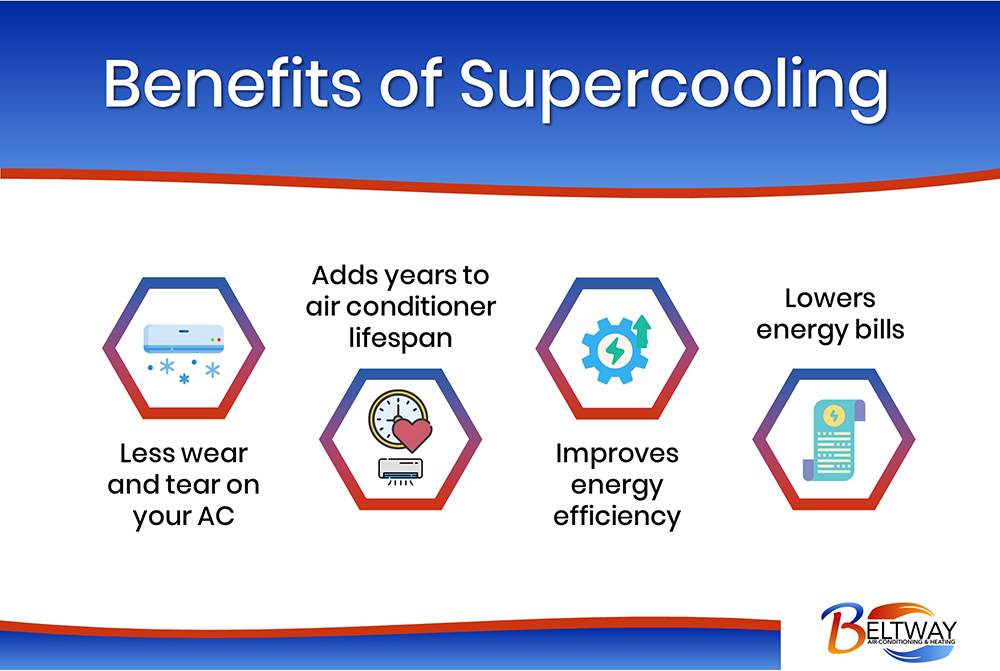
On the other hand, there are many benefits of supercooling. You can save so much money in the process. During the day, electric companies charge their clients much higher rates for using electricity. This makes sense as so many residential and commercial properties are running at full power. This puts additional stress on power plants, and the company needs compensation for all of these demands. However, when you consume electricity at off-hours, rates tend to be much lower. In essence, think of it like putting in a retirement fund or bank account. You bank energy and coolness in the early morning so that you can enjoy it throughout the day.

If you have never done this sort of practice before, you might be surprised just how well your home retains coolness. Make sure to close all windows and doors in the process. While your home certainly is not airtight like a refrigerator or freezer, it does a solid job of creating a barrier between you and the outside world. In particular, air does not seep out as much as you might think.

Caring for Your Cooling System

Overall, supercooling does not harm your cooling system. What are some related ways you can take care of your cooling system? One important approach is to run the AC in cycles. If you put your AC on full blast all the time, it has to work overtime to meet these high demands. If you can alternate your settings and at least provide your unit with some time to recover, you will extend its lifespan by many years. Supercooling helps this approach. You work the AC to an extreme in the early morning and let it recover in the afternoon, perhaps on a fan mode.

Other methods of cooling are also good for the system. Anything besides running the unit all day to exhaustion is essentially a good thing. This can range from supercooling to periodic cooling to lukewarm temperatures that can be complemented by a fan. As a homeowner, there is more to cooling nowadays than just turning the unit on. With so much smart technology at your fingertips, you will want to take advantage of all this with intelligent cooling strategies.

Supercooling in the Evening

One interesting idea is to supercool in the evening. Depending on your county, electricity rates could be low at this time, and you can get in many hours of supercooling before you head to sleep. This could lead to a solid night of rest. It is a slightly unorthodox approach, but it can definitely work if you do not mind staying up late. In general, it results in the same effect on your cooling system. You have simply shifted the cycle to the opposite part of the day. Homeowners who are out at work or in the community all the time can look into this method. After a couple of weeks of supercooling in the evening, you will condition your AC to operate at these hours. It is a net benefit for everyone and all appliances involved.

Supercooling Properly

There are right and wrong ways to supercool. If you supercool improperly, it is possible that you incur damage on your cooling system. However, supercooling the right way is fundamentally harmless. One of the best practices when supercooling is to monitor the system as much as possible. There is no doubt that you do not want to have to keep your eyes on the interface at all times, but you should still oversee your AC as it does its job. You will be able to turn off the unit immediately once your home reaches the correct temperature.

Another good way to supercool is to close as many doors as possible in your home. It is clear that you need to shut all the windows, but doors often get overlooked in the grand scheme of things. If you can create confined spaces, cool air will get trapped in these spaces for the rest of the day. It is well known that cool air settles and warm air rises. This means that the basement or ground floor of your home is an excellent target for supercooling.

Contact Us for Supercooling

The bottom line is supercooling is not bad for your cooling system. In fact, it is one of the most efficient ways to cool your home when done correctly. A professional service like Beltway Air Conditioning and Heating in Columbia, MD, and the surrounding areas, can get you started on the basics of supercooling. We will set up your AC unit and prepare it for a season of supercooling. Moreover, we can handle AC maintenance, furnace repair, and heat pump installation. Get in touch with us right away so you can reap all the benefits of supercooling.

Benefits of an Automated Thermostat

Many homeowners control the temperature in their homes by manually adjusting thermostats that regulate their air conditioning and heating systems. If you have an automated thermostat, you will enjoy setting temperatures for different times of a day. That means you do not have to turn any dial from the unit’s panel to adjust the temperature according to your needs. Instead, you can command your HVAC unit to turn off or on from an application on a mobile gadget.

Your automated thermostat will not only regulate the temperature in your home, but it will also show you the duration it’ll take to make the changes you requested. Furthermore, you can also keep track of how much you are spending on heating and cooling costs. Here are some of the benefits you will enjoy after switching to an automated thermostat.

1. It Lowers Your Energy Bills

One of the biggest benefits offered by automated thermostats is saving on energy costs. Energy costs continue to skyrocket in every part of the globe, and one of the best ways to combat that is to try to minimize your energy usage. However, with automated thermostats, you can precisely regulate the temperature in your home to suit your comfort.

For each degree you lower or raise your home’s temperature during winter or summer, you can save a maximum of 2% on your energy bill. For instance, you do not have to keep your heat or air conditioning system high when you are not at home. You can develop a schedule that follows the routine of your family to avoid wasting energy. You can keep the temperatures warm or cool when you are at home and ease up using power when you are away from your home.

2. It Uses High-Tech Tools and Features

Most automated thermostats come with a wide array of technological tools and functions, including Wi-Fi capability and the ability to control your smart thermostat with a smartphone, tablet, or laptop. Having a programmable thermostat that’s linked to your home’s network can assist you in creating a connected home that you can easily control virtually from any place, including the comfort of your favorite couch. If you are on vacation or a business trip and you realize there is an unusually cold or warm day back at home, you can easily regulate the temperature of your thermostat from your gadget.

3. It Maintains a Constant Temperature in Your Home

The other advantage of automated thermostats is their capacity to maintain the ideal constant temperature in all parts of your home. Rather than setting your HVAC system high during summer, an automated thermostat can operate at a steady level. When the weather is cold, your heat can remain constant because it follows the programmed temperature schedule you’ve set for your home. With programmable thermostats, you can avoid cold and hot spots in various parts of your home, and your family can enjoy a cozy home throughout the year.

4. It Is Easy and Quick to Adjust

A manual thermostat takes some practice and a lot of time to read through the many steps of setting temperatures for different times. You will have to go to your wall unit to make some adjustments every time you leave your house, which is a practice most people neglect in the first place. You will also have to readjust the thermostat whenever you return home, once you wake up in the morning, and when going off to bed.

Homeowners can spend less time regulating their thermostats with an automated version. Using automated thermostats can eliminate all the time that you spend adjusting your manual unit. You can set your schedule one time every season and forget about the device. That will help you focus on other important things in your home or life.

5. It Reduces Your Air Conditioner’s Wear and Tear

Without an air conditioning system, it might be almost impossible to keep your residence cold during the summer or warm during winter. However, as your HVAC ages, its efficiency will most likely decrease, making your residence less comfortable while also increasing your energy bills. The best way to optimize your air conditioner’s performance and to minimize its wear and tear over time is by installing a programmable thermostat.

An automated thermostat helps decrease your air conditioner’s typical workload, which prevents severe damage and assists in optimizing efficiency. While every air conditioner can benefit from an automated thermostat, these options are particularly beneficial for older units. If your HVAC unit is not efficient or is older, before you can get another one, you can try to help it do its job better by pairing it with an automated thermostat.

6. It Maximizes Zoned Cooling and Heating in Your Home

An automated thermostat can also help keep your home running well if you have multiple climate zones in your residence. Having different climate zones around your home can significantly increase your property’s energy efficiency. An automated thermostat allows you to customize each temperature and climate throughout your residence’s square footage using programmable controls in every zone.

7. It Allows You to Take Advantage of Different Times During the Day

The other benefit of having an automated thermostat is that it will enable you to take advantage of the temperature variations based on the season and the sun’s position as well as the different times during the day. Once the afternoon or morning sun begins to heat your residence during the summer, you can change your cooling schedule.

Similarly, during the winter season, you can minimize your heating energy and allow the sun’s warmth to take over some of your furnace’s warming duties. During cold nights in winter, you can boost the HVAC system’s heating energy to keep your home warm and comfortable.

8. It Increases the Efficiency of Your Home

Keeping your residence energy efficient is one of the major problems that every homeowner thinks about when the seasons change. An energy-efficient residence uses the available resources more effectively and does not cause a lot of wear and tear to major household systems and appliances. Your home should not contribute to adverse environmental impacts and energy wastage, and using an automated thermostat is one of the ways you can help control your waste.

Conclusion

As you can see, having an automated thermostat for your heating and cooling needs might be one of your home’s most cost-efficient investments. You can enjoy the benefit of additional energy savings that might reflect in a reduced utility bill. Apart from the money savings, an automated thermostat can assist you in maintaining the best and most comfortable environment in your interior spaces.

If you are interested in upgrading your residence with a programmable thermostat, your best solution is consulting a Beltway Air Conditioning & Heating professional in Hanover. We offer a wide array of cooling and heating services to keep your home cozy.

Our team of professionals can advise you on the best automated thermostat that will suit your needs. We also offer other services, including AC installation, AC repair, AC maintenance, heat pump installation, furnace installation, furnace repair, heat pump repair, furnace maintenance, boiler service, and heat pump maintenance. Contact us to schedule your automated thermostat installation and to learn how you can keep your residence comfortable throughout the year.

How to Go Green With Your HVAC Installation

When you replace an old HVAC system, you receive many benefits in return. One of the most obvious benefits you receive is reliable heating and cooling versus your old system that likely couldn’t keep up during extreme weather in Hanover.

Another unexpected benefit, though, is that your new system will likely save quite a bit of energy compared to your old system, making your new system much more “green.” Plus, with some basic adjustments, you can make your system even more efficient, resulting in an environmentally conscious HVAC installation. Here are five ways you can make your new HVAC system from Beltway Air Conditioning and Heating as environmentally friendly as possible.

1. Utilize a Programmable Thermostat

With a new HVAC system comes new possibilities for increased comfort. The best way to customize this comfort and increase the efficiency of your new system is to install a programmable thermostat alongside your new system. The most efficient thermostats are smart thermostats that learn your living patterns so that they can automatically adjust the temperature in your home, meaning your HVAC system will run only as often as is absolutely necessary.

However, even a basic programmable thermostat is still better than a manual thermostat. All programmable thermostats can be set to keep your house at one temperature while you’re away from home and then change to a more comfortable temperature when you return. Rather than keeping your home at a constant temperature all day, these temperature changes save significant energy, making your system more environmentally friendly.

Even if you opt for a basic mechanical thermostat, though, you can still set it so that your HVAC system runs less. By adjusting the thermostat by just one or two degrees, you can see a significant drop in energy use that results in lower utility bills for you.

2. Use a Heat Pump

Thanks to the temperate weather in Hanover, a heat pump from Beltway Air Conditioning and Heating is another great way to supercharge your energy savings from your new HVAC system. The biggest advantage of using a heat pump is that it uses heat that is present in the air outside to heat your home during the winter.

Rather than using electricity or natural gas to heat the air, a heat pump pulls in heat from the outside and brings it inside to warm your home. In the summer, this process is reversed, much like a traditional air conditioner, as the heat pump pulls heat from inside your home and expels it outside. All throughout the year, this process of heat exchange is far more efficient than a traditional HVAC system, allowing you to be environmentally conscious while still keeping your home at an optimal temperature.

3. Use Zones

If you have a larger home, one of the best ways to keep your new HVAC installation “green” is to use zoned heating and cooling. Rather than using one HVAC system to heat and cool your entire home, a zoned system uses two or more closed-circuit HVAC systems to heat different areas in your home. This allows you to keep the different areas at different temperatures, which is especially handy if you don’t use these areas very often.

Of course, if you have a smaller home, that doesn’t mean you have to be left out of the “zone fun.” At Beltway Air Conditioning and Heating, we install mini-split systems in addition to zoned HVAC systems. A mini-split system is essentially a small heat pump that is meant to heat and cool just one room in your home.

These systems are ideal for bedrooms, living rooms, or any other rooms that you occupy for long periods of time. Since they are smaller, these systems are highly energy-efficient, meaning you can keep essential rooms comfortable while not wasting energy to heat and cool rooms around your home that you don’t use.

4. Optimize Your Ductwork

The ways in which conditioned air moves throughout your home make a big impact on your HVAC system’s energy efficiency. That’s why at Beltway Air Conditioning and Heating, we believe that your home’s ductwork is just as important as the other components in your HVAC system.

Before we begin a new HVAC installation, we will analyze your ducts to ensure that they’re properly routed, with no tight turns or other unusual elements that could restrict airflow. In addition, your ducts will be checked for signs of damage that could allow air to escape from your ducts before it reaches its intended destination.

The main goal in optimizing your ductwork is to ensure that all of the air that you are paying money to heat or cool makes it to the areas that need to be heated or cooled. This is important because the more conditioned air that reaches these areas, the less time that your HVAC system will have to run to bring these areas to a comfortable temperature.

5. Hire Quality Installers

Another great way to have an efficient HVAC system is simply to ensure that the new system is installed correctly. If any component of your HVAC system isn’t installed correctly individually and then optimized to work correctly with the other components, you will have efficiency problems from the first day you use your system.

For example, when your system is charged with refrigerant, the volume of refrigerant needs to be carefully measured to ensure that the system isn’t over- or under-pressurized. If the wrong amount of refrigerant is present, your air conditioner will struggle to remove heat and humidity from the air in your home, meaning your system will have to work longer to keep your home comfortable.

This is just one of the many elements that have to be correct to ensure your system works well, which is why it’s crucial that you choose an experienced HVAC contractor such as Beltway Air Conditioning and Heating. We say that “our work reflects our passion,” meaning that we take great pride in every job we complete because we are passionate about doing great work and keeping you and your family comfortable in your home.

Trustworthy AC Installation

At Beltway Air Conditioning and Heating in Hanover, MD, we work hard to provide the HVAC solutions you need so that you can heat and cool your home as efficiently as possible. That’s why, compared to some HVAC companies, we offer solutions that aren’t as common, including heat pumps and mini-split systems. Along with operating efficiently, we offer humidifier and air purifier installation services to ensure that your HVAC system provides you with air that is healthy to breathe. If instead, you need to increase the efficiency of the HVAC system at your business, we are proud to offer a full range of commercial services for a variety of applications.

Our commitment to each project we do is reflected in the phenomenal feedback we receive from our customers. Five-star reviews are common on Yelp, Google, and other review sites. That is why we are a Google Guaranteed business and are Screened & Approved by Home Advisor.

If you want your next HVAC installation to be as efficient as possible, give us a call at Beltway Air Conditioning and Heating today. We offer comprehensive heating and cooling services.
How to Ensure an HVAC Company is Reliable

Whether you need a new system installed, old equipment replaced or just a seasonal tune-up, it is important that you deal with an HVAC company you can trust. Selecting a new HVAC provider can be challenging. There are often many businesses to choose from, and it can be difficult during the exploratory phase to tell whether an organization possesses the characteristics of trustworthiness, including:

  • Competence
  • Consistency
  • Dedication
  • Dependability
  • Integrity
  • Sincerity

Seek an Established Brand

The common advice is to seek an HVAC company that has been in business at least five or even 10 years. The idea here is to avoid the fly-by-night outfits and ensure that you choose an enterprise that will be there to stand behind its work. But there are new companies out their making names for themselves and old companies that manage to stay in business despite subpar customer service.

Instead of focusing on how old an HVAC provider is, emphasize how established it is. Longevity can certainly be part of that, but consider the experience of the ownership and the roots the company has laid down within your community and the other communities it serves.

Also, consider the business’s affiliations not just locally but within the HVAC industry at large. Local affiliations can include the Chamber of Commerce as well as business and trade associations relevant to your city and state. Manufacturer affiliations are quite informative as well.

If an HVAC company is a Lennox Dealer, for instance, then you know those technicians are competent since they have to meet certain training thresholds in order for a company to be recognized as such. Also, if an HVAC provider is a Lennox Premier Dealer, then you know that the dedication to customer service is such that Lennox is willing to vouch for and promote that business.

Be Aware of Regional Expectations

HVAC companies will vary from state to state and city to city and even county to county. Some of these differences are due to the regional needs of the homeowners those businesses serve. A homeowner in the Northeast, for instance, has heating and cooling concerns that are quite different than someone in the Southeast.

You may also want to contact your local Chamber of Commerce in order to identify the requirements and guidelines for local businesses in general and local HVAC providers in particular. You should know how much insurance is legally mandated and how much is recommended as well as which licenses and certifications are required and advised.

Request Insurance Details

Be direct in asking about insurance. A company that is sincere and values integrity will be forthright in disclosing amounts as well as showing you liability insurance forms, workers’ compensation documents, and other related paperwork.

Determine the scope of the coverage. You want to ensure that in addition to the company itself, all employees and subcontractors are insured. It is very important that workers’ compensation insurance covers injuries incurred on the job. Without that protection, the onus is likely to fall to your home insurance policy.

Ask About Licensing and Certification

In Maryland, HVAC contractors require an HVACR license and must present it to you upon request, and through the Maryland Department of Labor website, you can look up a license, check if it is valid and inspect all that it entails. An HVACR license has various tiers: apprentice, journeyman, inspector, limited, master restricted and master. Each tier has education and examination requirements and must be renewed, and the license tier dictates the insurance requirements. When hiring a company, you should expect that the owner of the business or at least the team supervisor holds a master license and that apprentices will never perform work without direct supervision.

Most well-established HVAC providers will have certifications beyond state requirements. Perhaps the most notable organization is North American Technician Excellence, which provides a wide range of HVAC-related certifications. If a company has NATE-certified technicians, you can have confidence in not just skill and training but in ongoing education and thus dependability and consistency. Many HVAC providers are certified with the EPA as well so that they can perform home energy audits and give clients confidence that equipment will be installed, repaired and maintained with energy-efficient performance in mind. Other notable trade associations include:

  • Air Conditioning Contractors of America
  • Air Conditioning, Heating & Refrigeration Institute
  • National Air Duct Cleaners Association
  • National Comfort Institute

Consider Reviews, Ratings and Referrals

A company’s reputation can inform you about its sincerity and all the other factors of trustworthiness. Begin this process with the Better Business Bureau. You can also check with the Maryland Department of Labor. An HVAC provider with numerous complaints is probably best avoided. A company that has earned BBB accreditation and a high rating, on the other hand, should instill you with peace of mind because you know that you will be dealing with a reputable outfit.

Request references from the company. Those references should be recent customers who have had major work performed, such as an installation. You can also find information on the internet through resources like Google My Business, Yelp, HomeAdvisor, Angie’s List and so forth. With online reviews and ratings, consider the perception as a whole rather than focusing too much on a particularly enthused or angry client. If you have neighbors, coworkers or family who have hired the company, then they, of course, can be an invaluable resource as well.

Pay Attention to the Details

This process can be involved but is worth the effort. As you progress, you may rule out certain companies before requesting a quote, and ideally, you should receive written estimates from at least three companies before finalizing your decision. Estimates are a great opportunity to interact with these companies. Professionalism is a choice, and when an HVAC provider is uniformed, courteous and well-spoken, it shows that the company is detail-oriented.

Getting three quotes gives you a clearer pricing picture. Beware of the company that underbids as much as the one that overbids. A company that underbids is more likely to cut corners and more prone to run into troubles regarding time and other resources. When considering an estimate, factor in customer care. Know going in about what kind of warranties, satisfaction guarantees, post-job support and so forth that a company provides.

A Trustworthy HVAC Company in Your Area

If you are a homeowner in Maryland, then Beltway Air Conditioning and Heating would love an opportunity to demonstrate why you can trust us. We are a locally owned and operated HVAC provider that serves Hanover and the neighboring communities. Our team is also Google Guaranteed and HomeAdvisor Screened & Approved. We offer commercial services as well as residential. Our team installs, replaces and maintains air conditioners, furnaces and heat pumps, and our indoor air quality services extend to air purifiers and whole-house humidifiers. Call us today to learn more about these services and to schedule an appointment.

The Best Air Purifiers For Germs

Do you know what a pathogen is? A pathogen is a particulate usually found in the air that can produce disease. This includes germs, bacteria, and viruses. You may not realize this, but your Hanover house could be full of pathogens right now. Pathogens can attach to microscopic dust and dirt particulate floating in the air of your house right into your mouth, nose, or ears, making you sick.

Everyone wants to avoid getting sick, but they may not even realize that the reason they are getting sick is the air in their own home. Is the air in your house clean? Is it clean enough? If you are like most homeowners, the answer to that is probably no.

One thing you can do to improve the overall air quality in your home and, in turn, the overall health of the people living in it is using an air purifier. Air purifiers come in a variety of shapes and sizes with different power capabilities and energy usage.

Pathogens can linger in the air for hours, sometimes even days, so it is a good idea to do everything you can to get rid of them with a filtration system of some kind. If you are considering getting an air purifier to use in your home or place of business, here are some great models you can check out to help you get started in your search.

GermGuardian AC4100

The GermGuardian AC4100 is a lower-priced model offered by one of the most recognizable brands in the air purifier market. It is a 3-in-1 design, meaning it has a HEPA filter, pre-filter, and carbon filter in its housing.

This model is diminutive in size and is not meant to filter a large area, making it an ideal unit to clean the air in your bedroom or an office. This model does not have many luxury features, but it features an easy-to-use, no-frills design. The following are some of the specs and features of the GermGuardian AC4100.

  • 7.5 x 6.5 x 11 inches
  • UV and dioxide germ killer
  • Filter replacement reminder
  • 3-speed fan
  • 1-year factory warranty

Levoit LV-H132

This purifier model is designed to purify a 129-square-foot area, making it a great model for small- to medium-sized rooms. The Levoit LV-H132 is not the most powerful small air purifier you will find in someone’s house, but it has a lot of features other smaller units do not have.

This is an especially useful air purifier for homeowners who want to use it at night. This is for two reasons. The first is you can turn off the lights by selecting Night Mode, which offers two levels of brightness. The second is it runs quietly. Because of the options and features of the Levoit LV-H132, it is a sophisticated machine, but it is still easy to interface with. It features the following specs.

  • 22 inches tall
  • 3-speed fan
  • 2-year factory warranty
  • Soft button controls
  • Two color options
  • IQAir

If you want to experience some of the best quality in-home air purifiers have to offer, the IQAir is worth checking out. It has HyperHEPA filtration, meaning it can filter out particles sized all the way down to .003 microns. That is just about 10 times smaller than a virus!

Not only is the purifier powerful, but it can also cover a pretty big area. Covering 1,125 square feet, it is powerful enough to filter the air in a smaller house. This combined with filters that are 100 times more powerful than standard HEPA filters gives the unit a lot of bang for its buck. On top of its easy-to-use controls, here are some other specs of the IQAir purifier.

  • 16 x 15 x 28 inches
  • Triple-seal technology
  • Even flow diffuser
  • 35 pounds
  • Swiss-made

Medify MA-14

This air purifier is medical grade thanks to the H13 HEPA filter housed in the unit. H13 is the highest-rated HEPA filter and removes 99.7% of the pathogens found in the air in your home.

Compared to other purifiers with this level of power, the MA-14 is lightweight and portable. This means you can move it multiple times a day as it purifies the 470-square-foot area around it in around an hour. One of the best aspects of this purifier is its lifetime warranty, meaning it will be replaced if anything mechanical goes wrong with it that is not your fault. Here are some additional specs and features of the MA-14.

  • 12 x 8 x 8 inches
  • 4.4 pounds
  • 3-speed fan
  • Night light

Alen BreatheSmart FLEX

Do you have kids? The Alen BreatheSmart FLEX is a great model for larger families because it can purify a big area quickly. It is known to purify an entire one-bedroom apartment in just half an hour with a reach of 700 square feet. This is an impressive power rating considering the sleek design of the unit.

Installed in the Alen BreatheSmart FLEX is a HEPA Silver Filter, so you can be sure your air purifier is getting a variety of pathogens out of the air. Even at Turbo Speed, the fan uses less than 40 watts of power, making it one of the best purifiers when it comes to energy ratings. At most, it will add $1 a month to your energy bill using the following specs.

  • 19 x 16 x 28 inches
  • 21 pounds
  • 4-speed fan
  • True HEPA filter

Pure Enrichment PureZone

This is the air purifier for you if you want one you will barely notice throughout the day. The PureZone is designed with an extremely quiet fan, preventing it from becoming disrupting if it is in use while you are asleep.

Another cool feature of this effective purifier is the built-in timer. You can set the purifier to shut off in various increments of time. This prevents it from wasting energy by running when it does not have to. It is rated to purify an area of 200 square feet, making it ideal to use in a den, an office, or a bedroom.

The Pure Enrichment PureZone air purifier has the following specs and features.

  • 10.8 x 7 x 12.5 Inches
  • 5-year warranty
  • 3-stage purification
  • 3-speed fan
  • 6 pounds

Blue Pure 121

This is the air purifier for someone who enjoys both form and function. It has a sleek two-color design that will not take away from the aesthetics of a room while it is cleaning it.

Just because it looks good does not mean it does not work effectively. The Pure 121 removes 99% of the pathogens in a room, making the area healthier in a short period of time. One or two of these can purify an entire space thanks to its 700 square foot reach, along with the following specs.

  • 13 x 13 x 28.2 inches
  • 18.2 pounds
  • 3-speed fanv
  • Recyclable filters
  • 3-part filtration

Pathogens are everywhere, but that does not mean you should not do everything you can to get them out of your house. If you are considering purchasing an air purifier, call Beltway Air Conditioning and Heating in Hanover today for more information. In addition, our team offers heating and cooling repair, installation, and maintenance.

How to Fix Uneven Heating in Your Home

Beltway Air Conditioning and Heating understands how frustrating it can be to have rooms in your home at different temperatures. Uneven heating can be caused by a variety of issues and create drastic temperature differences between the various rooms in your home. Fixing these problems can lead to a more enjoyable and comfortable home environment.

Use a Zoned Heating System

Ductless mini-split heating systems are a great way to combat uneven heating in your home. These units are installed high on the walls of your home and don’t require a central heating system. You’ll be able to set different temperature zones for various areas of your home.

Add Insulation and Energy-Efficient Windows

Heat loss in certain rooms of your home can cause the temperature to drop. Single-pane windows can cause a lot of heat to escape. Replacing them with an energy-efficient alternative can keep your home cool. Adding insulation in critical places, especially your attic, will also reduce heat loss and minimize uneven heating.

Clear Air Vent Areas

Having objects in front of the vents in rooms can reduce the amount of warm air that can heat that particular space. Remove all furniture and anything else that can obstruct airflow to ensure maximum airflow in each room of your home.

Keep the Fan Running

Switching the fan on your heater from “auto” to “on” can keep it running even if you aren’t actively heating. This will encourage the mixing of air throughout your home and help prevent cold spots.

Your Skilled Heating Technicians

Beltway Air Conditioning and Heating in Hanover, MD can assist with furnace and AC installation, replacement, and maintenance. We can also work with heat pumps, boilers, ductwork, and indoor air quality solutions. Our team works hard to maintain an A+ rating with the BBB by putting customer needs first. We’re fully licensed, bonded, and insured for our work. Give Beltway Air Conditioning and Heating a call today to learn more about our services.

Are Annual Furnace Inspections Necessary?

In Hanover, Maryland, Beltway Air Conditioning and Heating is the place to call when you need help with your heating system. Our skilled technicians can handle any problem you throw at them. However, many homeowners do not realize that you can avoid emergency repairs with an annual furnace inspection and tune-up.

Keep Your System at Peak Efficiency

When we install a new heating system, it powerfully heats your home, providing comfort through the winter months. With each season, the system loses some of its initial power and efficiency. The natural process of wear and tear can loosen parts and affect the burner settings. You may notice that you are using a little more fuel each season. A maintenance appointment with the experts at Beltway Air Conditioning and Heating can make a huge difference. They will clean out any accumulated dust, lubricate moving parts and re-calibrate the settings. This series of small adjustments will keep your system running at its best.

Increase Your System’s Life

A new system may be able to go for a couple of years without routine maintenance, but ignoring routine maintenance will probably cost you in the long run. Our technicians see a lot of furnaces. An annual inspection can be the difference between a short life and a long life. If you want your furnace to last for extra seasons, keep it well-maintained.

Avoid Emergency Repairs

There is nothing worse than realizing that your furnace is not working in the middle of winter. While the experts at Beltway Air Conditioning and Heating will get there as soon as we can, it is far better if we can handle small repairs before they shut your system down. During your annual inspection, our technicians will look over your furnace for any potential problems. They can replace parts that are showing signs of stress. You can rest assured that your heating system will supply you with another season of home comfort.

Beltway Air Conditioning and Heating is ready to handle the heating and cooling needs of residents and businesses in the Hanover area. We have the expertise and experience to get the job done. If it is time for your annual furnace inspection, contact Beltway Air Conditioning and Heating today.

Book Online

"*" indicates required fields

This field is for validation purposes and should be left unchanged.