Author: Kevin

New Year, New Goals: Maximizing Your Heater’s Efficiency

As we approach another year, it’s time to think about your new goals. If you’re a homeowner, you may want to set goals regarding your household. A great area to focus on is your heater to ensure that it’s working efficiently so that you can better manage your energy and fuel bills.

Join an Annual Maintenance Plan

Probably one of the most essential tasks that you have as a homeowner in regards to your heating system is making sure that it gets professional maintenance every year. This cleans up your unit and ensures it’s working efficiently. Additionally, it allows you to be alerted of any foreseeable problems so that you can plan a fix on your own time. Remembering to schedule annual service can be a real pain. Instead, opt for joining an annual maintenance plan so that your HVAC service provider can remind you when it’s time for heater maintenance.

Check Your Air Filter More Often

Look anywhere online, and you’ll find many recommendations stating that your air filter should be changed every three months. The problem with this is that every home is going to be different. Homes with lots of pets, young children, and a lot of foot traffic are going to need their HVAC’s air filters changed more often than other homes.

A good habit to get into is to check your air filter every few weeks. Whenever you can’t see through it, replace it. You’ll want to keep a few air filters on hand so that you can change a clogged one immediately.

Don’t Ignore Unusual Noises and Smells

When your heating system is working effectively, you shouldn’t be able to smell anything odd or hear any unusual noises. However, when something is amiss, your heating system will alert you by having an odd noise or smell. Don’t ignore this alert, as the problem could end up creating more damage to your system over time. And, more damage typically results in a higher repair bill.

Upgrade Your Thermostat

If you have a dial thermostat, it’s time to throw it out and replace it with an updated model. Both programmable and smart thermostats are great options. They both allow you to set the temperature for every day of the week and hour of the day. This means you can lower your household temperature during the workday when no one is at home. Then, you can raise the temperature back up just before you arrive home. This way, you arrive home to a nice, warm house.

If you opt for investing extra money in a smart thermostat, you can enjoy even more convenient features. These thermostats can be easily controlled via an app on your smartphone, which means you can adjust the temperature setting in your home when you’re not actually there. Additionally, they have eco modes that will learn your previous heat usage activity and make recommendations on how to best save energy with alternative settings.

Actively Keep Those Drafts Out

If you’ve ever walked by a door or window in your home to feel an icy cold draft, it’s likely that you thought about fixing it. However, if you’re like most homeowners, you haven’t got around to it yet. Make it your new year’s resolution to proactively get rid of those unwanted drafts throughout your home. Using weatherstripping, door snakes, and door sweeps are all great options to block cold air from drafting into your home.

Bump up Your Insulation

If you moved into an existing home, its insulation might not be up to the recommended level in your area. Do yourself a favor and evaluate the insulation in your attic. If it’s below the recommended R-value for your region, then upgrade it. If you know that some exterior walls in your home lack insulation, consider having foam insulation added. The more insulation you have, the more significant barrier you’ll have to keep the cold air out.

Assess Your Air Vents

There are air vents that run throughout all the rooms of your home. Their jobs are to deliver warm air and remove cold air. For these vents to work efficiently, there needs to be open space around them. Unfortunately, homeowners tend to put objects and furniture in front of these vents without even realizing it. Do yourself a favor and assess the air vents in your home at least once a month. Any obstructions that are blocking the free flow of air around these vents should be removed immediately.

Clean Your House Frequently

While we all try to clean our homes on a frequent basis, it doesn’t always happen. Rather, cleaning tends to get put on the backburner while we enjoy funnier activities. Unfortunately, the longer you let your home go without cleaning, the more time airborne particles have to get into your ductwork and your heating system. Remember that your vents pull air in on a consistent basis. When you keep your home fairly clean, it will reduce the amount of dust, pollen, and other airborne debris that makes its way inside of your heating system.

Clean Your Vents and Ducting

When you’re sweeping your floor or dusting your coffee table, it can be easy to overlook your air vents. Unfortunately, a lot of dust and other debris can accumulate on the grates of your vent. When you’re undertaking your regular weekly cleaning, take the time to clean your vents.

If your vents pop out, soak them in soapy water. Just make sure to completely dry them before reinserting them into the wall. Otherwise, they can create the perfect breeding ground for mold and mildew. While you have your vents out, clean up the inside of the ducting that you can reach. Again, remember to make sure they dry out before running your system.

Find the Right Temperatures for Your Comfort Level

When the winter months hit, it can be easy just to revert back to the temperature that you had set last year. The reality is that you should invest the time in testing out different indoor temperatures. Most experts recommend setting your thermostat between 68 and 72 degrees in the winter.

Start with 68 degrees and see how your day goes. If you’re cold, bump it up one degree and go from there. You may currently be running your thermostat at 72 degrees when you’re perfectly comfortable with it at 68 degrees. Having it set at 72 degrees, in this scenario, is simply a waste of your hard-earned money.

Learn More About Your HVAC System

As a homeowner, the more you learn about your HVAC system, the more it’s going to benefit you. From performing easy repair work to determining the right replacement unit to meet your needs, it’s worth the investment. Make it your new year’s resolution to sit down a couple of hours a week and learn about your heating system. Think about learning about the different parts, how they work to produce heat, and new technology for more energy-efficient operation.

Top-Quality Heating Services

Beltway Air Conditioning and Heating provides top-quality heating services for the Hanover, MD, area. Also, let us help you with all of your cooling, ductwork, indoor air quality, and HVAC design needs. Call us today to set up an appointment with our knowledgeable professionals.

Should You Panic If You See Rust on Your Furnace?

Updated: September 12, 2023

Rust may be reddish-brown or yellowish flakes found on iron or steel. Rust forms because of oxidation. You will typically see rust in areas where there is high humidity. There must be metal, water, and oxygen for rust. That is why it is unsurprising to see rust form on a water heater.

However, your furnace doesn’t heat or use water as part of the heating process. It is understandable if you are curious about why rust forms in your furnace. You may also wonder what problems rust on your furnace or HVAC system could cause.

Why Is There Rust on Your Furnace?

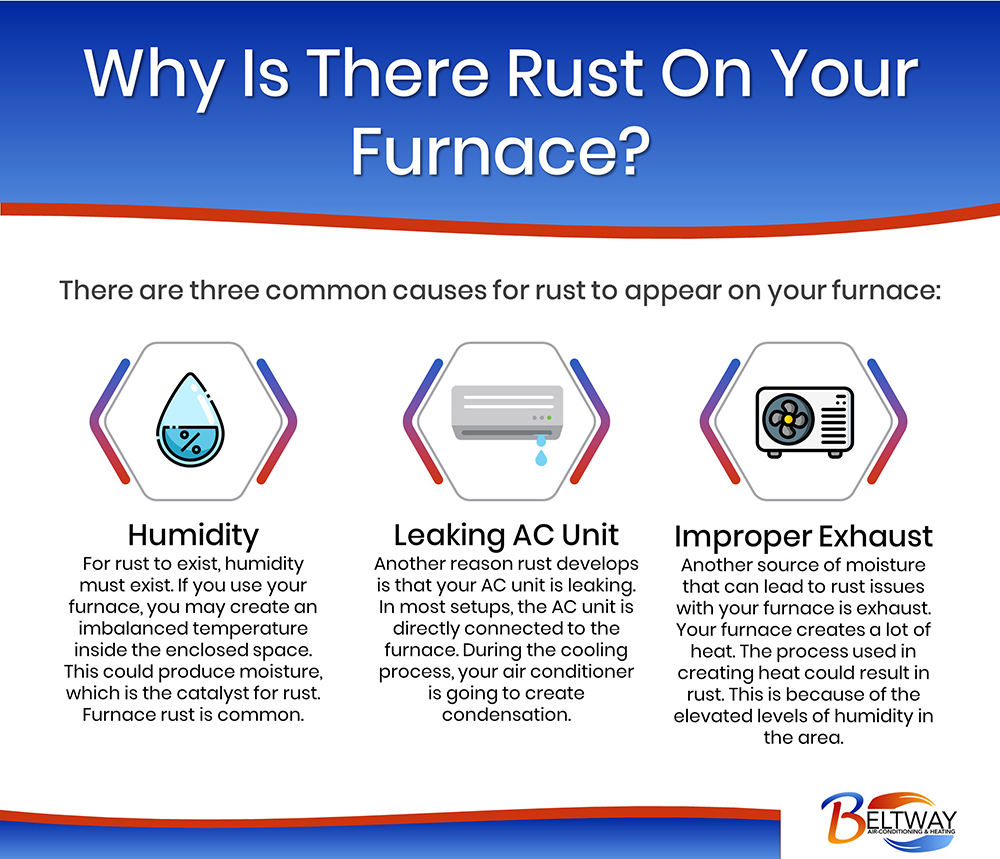
There are three common causes for rust to appear on your furnace:

Humidity: For rust to exist, humidity must exist. If you use your furnace, you may create an imbalanced temperature inside the enclosed space. This could produce moisture, which is the catalyst for rust. Furnace rust is common.

There is typically much moisture in the air if you live in a humid climate. You may inadvertently make the problem worse by adding more moisture into the air by not repairing water leaks or filtration in the area around your furnace.

why is there rust on furnace

Leaking AC Unit: Another reason rust develops is that your AC unit is leaking. In most setups, the AC unit is directly connected to the furnace. During the cooling process, your air conditioner is going to create condensation.

Your AC unit should have a condensation tray to collect this moisture. However, the condensation tray may be full or broken. This allows water to infiltrate your furnace, creating conditions where rust can form.
Additionally, your air conditioner is integrated into the same ductwork as your furnace if you have central AC. If there is any leak in your AC unit, it can find its way into your heating system and then produce the circumstances where rust can develop.

Improper Exhaust: Another source of moisture that can lead to rust issues with your furnace is exhaust. Your furnace creates a lot of heat. The process used in creating heat could result in rust. This is because of the elevated levels of humidity in the area.

Your furnace will raise the temperature of the surrounding air to a high level. However, that air will cool quickly as it leaves the burners. This will generate enough moisture in the system’s interior, leading to rust production.

Remember that your furnace, like every other heat exchanger, uses the process of condensation, evaporation, convection, and combustion to heat and move air.

Some energy-efficient furnaces have two heat exchangers. The second heat exchanger takes any water vapors from the hot flue gases and condenses them. This way, more heat can be extracted, allowing you to heat your house more efficiently. However, when there is condensation, there is water and the potential for rust.

When everything is working correctly, your condensation drain should remove the water from your furnace. However, your condensation line may be damaged or inefficient.

During frigid winters, your condensation line can freeze. Or your drain line may become clogged with dirt, algae, or another residue. In some cases, a leaky drainpipe is causing your furnace to rust over time.

Should You Be Concerned About Rust on Your Furnace?

Just about every furnace is going to rust eventually. Most furnaces are designed to work for between 10 and 15 years. Rust does not happen overnight. It is a gradual process that occurs as your furnace repeats the heating and cooling process.

If you notice that an older furnace has rust, there is no reason to panic. Beltway Air Conditioning and Heating has experienced HVAC technicians who can evaluate your furnace’s condition and provide you with solutions to either repair damaged areas or start the process of replacing your furnace.

If your heat exchanger is rusting and you do not replace or repair the unit, you risk having carbon monoxide enter your home. While a small amount of rust on an older furnace is not a significant cause for immediate concern, rapidly expanding rust on a newer model or a lack of rust on your older furnace would merit further investigation.

The Dangers Produced by a Rusting Furnace

If left unchecked, rust will make your system degrade faster than it typically would. For example, rust on the burner jets will eventually clog them, diminishing their effectiveness. This means that your unit will need more fuel to provide the same level of heat. This inefficient performance leads to an increase in carbon monoxide being released into your home. This is dangerous for you and your furry friends.

Rust may affect your unit’s fuel supply lines. If this happens, you are in a hazardous situation. A life-threatening and property-damaging fire or explosion could occur. A severely rusted furnace is more than just an eyesore. If you notice that the exterior of your furnace has rust, the interior is likely already corroded by rust.

Purchasing a furnace is a considerable investment. You want your furnace to last for as long as possible. Thankfully, you can do a few things to keep your furnace working its best.

Monitor and Prevent Rust With Annual Furnace Maintenance

Yearly furnace maintenance includes an in-depth inspection of your system. It is affordable and will save you money in the long run, especially when you compare the price of maintenance to the cost of repairing or replacing your unit. Our HVAC technicians will thoroughly inspect your unit during a maintenance check, so you will know that your system is working as it should.

Fix Furnace Issues Quickly

A severely rusted furnace not only impacts how well the furnace functions, but it also puts the health and well-being of your family at risk. Therefore, you should make it a priority to repair HVAC issues immediately.

The goal is to identify the reason behind the rust in your furnace. Resolve those issues or eliminate them promptly. Once the problems have been resolved, all corroded parts should be repaired or replaced.

In some cases, depending on the age of your furnace and the severity of the degradation, your system may require more than just a repair. The expense of bringing your furnace back to safe conditions may be more than what the unit is worth. Please consult with our HVAC technicians. We will be happy to help you with any rust furnace problems.

If You See Rust, What Should You Do?

If you see rust on your furnace, contact our experienced HVAC technicians. Rust means that there is condensation somewhere, which could indicate a more significant problem. Remember, just because you see rust, it doesn’t mean that you will necessarily have an expensive repair bill.

At Beltway Air Conditioning and Heating, we have been serving Handover and the surrounding area by providing top-notch HVAC system installation and repairs for years. We are proud to be distributors of the most energy-efficient, dependable furnaces, boilers, air conditioners, and heat pumps on the market. Whether residential or commercial, our technicians have the experience, skills, and tools needed to keep your space comfortable.

Do you need your furnace inspected? Do you need to heating repair or furnace replacement? If so, contact us today. We have the knowledge, expertise, and experience to do the job right.

Heating System Installation Costs: What You Need to Know

A central heating system is instrumental to homeowners, especially to people living in cold areas. Installing a heating system may sound hectic and expensive. However, you don’t have to worry about that when you have Beltway Air Conditioning and Heating doing the work for you. We offer the best services with our qualified technicians at affordable rates. Our technicians are highly skilled and will efficiently install or replace your heating system. Enjoy a new functional, effective heating system that’s reliable.

Factors That Affect the Cost of Installing a Heating System

The cost of installing a heating system encompasses many other activities, such as the system’s cost, labor, removal, and disposal of an old furnace. The cost also includes any upgrades if possible. Installation costs of a furnace are affected by several factors.

For instance, the size of your home is essential. It would be best if you had a furnace whose size is comparable to the size of your house. A system too big will not heat your house well, while a minor system will struggle to heat the home. This might damage or overwork the system, causing damages that might result in unnecessary costs. This will affect the costs as a bigger house requires a more extensive system and more labor to install.

The energy efficiency of the system is also an important matter. Heating systems are rated by the Annual Fuel Utilization Efficiency (AFUE). They rate how much energy is converted to heat by a furnace. The higher the AFUE, the higher the efficiency of a system. A more efficient system is constantly compared to a lower-rated one. In the long run, the lower-rated one may be cheaper, but it may result in more hidden costs such as repair costs. You may also have a house that is not well heated, which may result in health complications.

The level of comfort you want will also affect the cost of the system. Homeowners who wants a basic furnace will pay less than those who want a more elaborate one where they control nearly all aspects, such as fan speeds.

In addition, the cost of installing your heating system will depend on how long you want to live in your current house. If you have plans to move to a new prospective home in the near future, it may be wise to install a basic model that might not cost you much. If you plan on staying longer, it’s better to invest in a quality heating system to get the best of the home.

Before installing your heating system, you should consult technicians from Beltway Air Conditioning and Heating who can give you the best advice on the type you should get. Don’t get a system that will not benefit you.

The Cost of Installing a Heating System

Considering the factors we have discussed, the average cost of installing a unit furnace ranges between $2,672 and $6,575. This will depend on the location of your furnace, the size of your home and the type of furnace you want to be installed. The total costs of installing a furnace, including labor and other expenses, will range between $4,820 and $9,350.

Depending on the type of furnace, the installation costs differ, too. For instance, on average, a natural gas furnace will cost $1,825 and $5,500 to be fully installed. A propane gas furnace will cost roughly $1,400 and $3,750 to be fully installed. An oil furnace will cost roughly $1,500 and $4,000 to be fully installed, and an electric furnace will cost roughly $850 and $3,000 to be fully installed.

Consult our technicians at Beltway Air Conditioning and Heating to get more info and a personalized budget on installing your heating system.

Why Heating System Maintenance Is Important

A heating system, just like any other mechanical device, requires maintenance to function well and for longer. We offer maintenance and repair services at affordable costs. One benefit of maintaining a heating system is reduced costs of energy. A well-maintained heating system does its work seamlessly hence uses less energy to function. A system that is, for example, dirty uses more energy to raise the temperature.

A well-maintained system enhances the comfort of the occupants of the home. The system has no leaks and heats the house consistently according to the setting you want. It also maximizes the best airflow; hence the house does not feel congested. All these benefits enhance comfort.

A sound heating system also ensures enhanced air quality. As the air is being heated, it goes through the ductwork in your home. If the ductwork is dirty or has loose items such as trapped dust, the dust may be carried along and make the air uncomfortable. You may also have weird smells in your house that may come with leaked gases. These issues may affect anyone in the house who has respiratory conditions.

A well-maintained heating system also ensures the safety of the occupants of the house. The venting system carries away any carbon monoxide formed. A faulty system will have some of this carbon monoxide leaking into the home. We all know carbon monoxide is a poisonous gas and may affect the people in a house adversely, such that it may cause death in extreme conditions.

If your heating system is well maintained, it will be reliable. This is because scheduled checks and repairs get rid of any problems that may arise. Without maintenance, the issues may grow and become harder to repair or become more expensive. A well-maintained heating system will serve you for a long time. It will also cost you minimal repair costs as the issues are detected and dealt with earlier.

Routine maintenance also reduces wear and tear on your unit. Any unit especially that functions mechanically is prone to wear and tear on its parts. This may cause reduced efficiency and general damage to the system. It’s wise to conduct routine maintenance checks to resolve any causes of wear and tear. Ignore this and you might incur higher costs in repair later or a total overhaul of the system.

Contact Beltway Air Conditioning and Heating to get maintenance services at an affordable cost. Our maintenance service includes:

  • Cleaning air ducts and air filters
  • Lubricating any moving parts of the system
  • Inspecting ductworks
  • Tightening loose parts

A heating system is essential in a home. A heating system ensures the homeowners are comfortable in the house by distributing heat efficiently. A heating system also prevents dust and other particles from circulating around in your home. This is a plus in keeping the home clean and keeping people healthy.

At Beltway Air Conditioning and Heating, we offer quality heating installation and replacement, routine maintenance services for your heating services, repair and servicing of heating system and indoor air quality service. Dealing with your heating system is very difficult and may cost a lot. That is why we are here. We will take care of everything for you, making sure you get quality heating in your home.

We have qualified technicians on call who are well equipped to handle all your heating problems. Your heating system is essential for you. So, why not let the best handle it for you? For a free quotation, contact Beltway Air Conditioning and Heating in Hanover, MD, now. We provide heating, cooling, and indoor air quality solutions.

7 Things to Look for When Choosing a Heating Contractor

Whether you need a new heater in your Hanover home or simply require routine heater maintenance, finding the right professionals to handle the job is important. The best heating contractors offer competitive rates, pride themselves on transparency, and have a broad range of capabilities. They’re also aligned with the top heating equipment manufacturers. Following are seven key things to look for when hiring a heating contractor.

1. Significant Industry Experience

Choosing to hire an established heating contractor with ample work history can be beneficial in many ways. To start, you can rest assured that the technicians working on your project know what they’re doing. Seasoned professionals have encountered a vast range of HVAC problems, and they’re expertly familiar with the top heating system brands and models. These attributes ensure fast and accurate diagnosis of problems, the application of the most economical and effective solutions, and fewer issues going forward.

It’s also much easier to learn more about an experienced company than it is to research one that’s only recently started in this field. Established companies can often provide a number of solid references, and they usually have plenty of online feedback to peruse. Before hiring any HVAC contractor, take some time to read through the reviews that other consumers have left. This will give you insight into their quality of workmanship, their response times, their level of customer service, and many other pertinent factors.

2. Professional Licensing and Insurance

Never hire an unlicensed and uninsured entity to complete any project on your property. Doing so can result in the cancellation of your own home insurance. It can also leave you footing the bill for any resulting property damages or personal injuries sustained on your premises. Although this seems like a no-brainer, many homeowners make the mistake of only looking for license numbers and insurance certificates rather than directly verifying these things with the issuing bodies.

Although many HVAC companies publish copies of their insurance certificates on their web pages, the only way to make sure that these policies are still in effect is by contacting insurers before work is started. Calling insurance companies to verify insurance is especially important if you have a fairly large project to complete. Should a contractor’s policy ever lapse during the work process because of non-payment or failure to meet the included terms, you’ll be notified right away. Contacting state boards to check the validity of contractor licenses will give you the opportunity to learn whether or not a company’s license has been suspended and whether a licensed party is currently facing any major legal issues.

3. Capabilities That Are in Line With Your Project Goals

Not all HVAC companies are equal in terms of their quality of work and their capabilities. You may have an aging furnace that needs to be serviced or replaced, or you could be looking to have your very first boiler installed. Working with companies that are familiar with the equipment type that you currently own or want is important. However, you also want to learn more about some of the expanded services that HVAC contractors provide. This is especially true if you’re looking to add heat to a home that lacks ductwork for supporting a central forced-air heating system or if you want to have a ductless heat pump installed. A good company can offer a diverse range of heater types. They can also assist with additional needs such as duct cleaning, custom ducting, indoor air quality, and cooling system maintenance, repair, or installation.

4. Excellent Customer Service

It’s not enough for an HVAC company to provide a broad range of services and products. Not all homeowners in Hanover, Maryland, are aware of the latest innovations in this field. More importantly, there are few consumers who are capable of determining which solutions are exactly right for their needs. The best HVAC contractors will always take the time to carefully explain each of your available options. This remains true whether they’re performing minor heater repairs or full-on heating system replacements. Understanding the benefits and drawbacks of each option helps homeowners make their own informed decisions about their heating and cooling needs. Some companies take the time to explain different services and solutions in person. Others maintain vast online knowledge bases that consumers can peruse at their own discretion.

Another sure sign of excellent customer service is a solid satisfaction guarantee. When HVAC contractors provide both the labor and the materials for any project, reputable companies will reliably correct any errors or oversights or replace defective products. They’ll also state their willingness to do so in writing. As you shop your options in local providers, ask to see copies of their standard job contracts. These should include clear language pertaining to any guarantees being offered.

5. Timely Service

Nearly every HVAC company in the region is inundated with service requests whenever the weather turns excessively hot or cold. Many homeowners make the mistake of waiting until they absolutely need their heating and cooling equipment before turning it on, checking its functionality, and performing important seasonal maintenance. Whether you’re caught with a last-minute issue resulting from negligence or have a well-maintained system that breaks down unexpectedly, you’ll want to have an HVAC contractor that can schedule an appointment fairly quickly. Moreover, if you need immediate service, you shouldn’t have to pay ultra-high rates to get it.

6. Competitive, Transparent Pricing

Don’t make the mistake of hiring the absolute cheapest HVAC contractor that you can find. Although price is definitely an important factor to check, you shouldn’t make it your sole consideration. Instead, look for companies that work hard to maintain competitive prices and that are totally transparent when issuing their estimates. When reading consumer reviews, check to see whether the contractors that you’re considering are known for having hidden fees. The top professionals in this field maintain strong supplier relationships and have established partnerships with many leading HVAC brands. This allows them to source essential products and components fast and at affordable prices. More importantly, it enables them to pass generous discounts down to you. A good HVAC contractor will additionally offer an in-person quote. Before any job is accepted or completed, you should get a line-by-line breakdown of all associated costs.

7. A Commitment to Energy Efficiency

When upgrading your home heating and cooling equipment, you always want to work with contractors who are committed to offering energy-efficient models and helping you enjoy their full benefits. These entities will explain the ongoing rewards of paying a bit more up front in order to limit your energy consumption, cut your home heating bills, lower your carbon footprint, and increase your overall comfort. They take the time to explain the advantages of having the latest and most cutting-edge features. They also train their clients in effectively using their upgraded heating equipment, whether they’re installing high-efficiency heaters, programmable thermostats, smart thermostats, or high-end heat pumps.

Energy efficiency doesn’t stop at installing high-performing heaters and teaching customers how to use them. HVAC contractors can also recommend important changes to the building’s interior. These might include ductwork replacement or repairs, sealing off gaps, cracks, and other air leaks in building materials, upgrading or adding insulation, and more.

At Beltway Air Conditioning and Heating, we offer top-rated HVAC products from Daikin, Trane, Goodman, and Lennox. We also provide first-rate heater repair, heater replacement, and indoor air quality services. Homeowners in the greater Hanover, Maryland, area can turn to us for custom ductwork, heat pumps, and much more. If you’re looking for a reputable, reliable heating contractor, call us today.

Heater Replacement in Hanover, MD

8 Ways to Know if You Should Repair or Replace Your Heating System

Having problems with your furnace is stressful enough, and the worry of having to replace it only adds fuel to that fire. Fortunately, there are eight simple ways to evaluate whether you should repair or replace your system.

1. How Old Is Your System?

When properly maintained, the average heating system should last roughly 15 to 20 years. As your system ages, it naturally loses efficiency, so the older your system is, the more it’ll cost to run. In addition to using more energy, your system’s components will eventually wear out and need repairs.

Even if your system seems like it’s strong right now, an aging system could give out at any time. If your system is nearing the end of its expected service life, start planning your replacement now. This helps ease the burden of replacing your system, keeping it from becoming an emergency when you need it most.

2. Have You Kept Up With Routine Maintenance?

Your heating system needs routine maintenance to serve your family for its full intended service life. This is so important to the function of your system that most manufacturers require it as a term to maintain their warranty.

Your system naturally collects contaminants on the circulating fan and heat exchanger as it runs. When this happens, it puts strain on the entire system, causing it to wear out more quickly. This extra wear increases over time if not resolved and erodes your system’s service life.

During routine maintenance, your technician will clean these areas of your furnace to keep air flowing freely. They’ll also test your system’s components to ensure they are working optimally. Suboptimal components also cause additional wear and should be repaired before they lead to more substantial damage.

3. Is Your System Leaking Carbon Monoxide?

We all know how dangerous carbon monoxide can be. It’s known as the silent household killer. What you may not know is that your furnace is one of the primary sources of carbon monoxide in your home.

This deadly gas is one of the byproducts of burning fuel in your furnace. With a properly designed and maintained system, this easily escapes through the vent and dissipates in the air outside.

However, some problems with the system allow this to leak into your home. You should always keep a carbon monoxide detector in your home to let you know if there’s an issue. A technician will also do more testing during routine maintenance to detect smaller leaks that may not have set off your household detector.

A cracked heat exchanger is one of the more common causes of carbon monoxide leaks in a furnace. Part of your routine maintenance is a visual inspection of your exchanger to see if there are any cracks. A cracked heat exchanger commonly means it’s time for a new heating system.

4. Are You Consuming More Energy?

You likely keep an eye on your energy bill every month and cringe as the prices keep jumping. However, more important than the cost of your utility bills every month is the energy you consume.

As your system gets older, it naturally loses some of its efficiency, extending your heating cycles. Your system uses the same amount of fuel while running, so longer cycles mean more fuel used. You’ll notice this in your energy bill when you compare your fuel consumption to the same month last year.

If every month has higher consumption, then you know you have an efficiency problem. While some maintenance tasks may fix some efficiency problems, they are also a sign of an aging system nearing the end of its service life.

5. How Much Are Your Repair Bills?

Repair bills are another key indicator of what’s happening with your system. Common knowledge among HVAC professionals is that repairs increase in the last two years of a heating system’s service life. Not only do the number of repairs increase, but so do the complexity and cost of those repairs.

There’s an easy way to determine if the repairs warrant a new system. Take the total costs of your repairs over the last two years and multiply that by the age of your system. If that cost equals more than the cost of the new system, it’s time to get the replacement.

6. Is Your Furnace Making Strange Noises?

Strange noises also let you know when there’s something wrong with your system, and potentially when it needs replacing. Nearly all furnaces make some level of noise, and not all noises mean you need a new unit.

However, most noises, especially ones that are loud or get louder over time, indicate problems that need attention. Ignoring those problems only causes more damage to the entire system. Some noises, like a rattling from within your furnace unit when it first starts up, may indicate a serious problem, like a cracked heat exchanger.

7. How Soon Do You Plan to Sell Your Home?

As you’re looking at heating repairs and home investments, consider how quickly you want to sell your home. If you’re considering a move in the next two or three years, it may be time to replace an aging system, even if it may be a little earlier than if you were to stay longer.

One of the considerations for many buyers is major repairs and investments the home will need in the first couple of years after the purchase. An aging heating system means they’ll have that expense sooner over later. While this may not have a large effect on an offer, it may mean your ideal buyer would make an offer on a similar property with a newer system.

8. Could You Use a Tax Break?

Who doesn’t like to get a break on their taxes at the end of the year? If your system is aging, and you’re looking at repairs, that’s sunk money. However, if you replace your system, there are tax credits available for qualifying units. For instance, there is a $150 federal tax credit for natural gas, oil and propane furnaces with an Annualized Fuel Utilization Efficiency rating of 95% or better.

Choosing a New Heating System

It’s important to choose the right heating system for your home. You may be able to swap out an old gas furnace for a more efficient heat pump or geothermal system. Or upgrade to a high-efficiency system to help reduce your operating costs.

You’ll also need to make sure you get the right size heating system for your home. While knowing your serviceable square feet is a good start, there are other considerations that affect your need. This could be the environment around your house, how many people occupy your home, your windows and insulation, just to name a few. An experienced installation professional will take all of these into account when recommending an appropriate unit for your home.

People around Hanover have turned to Beltway Air Conditioning and Heating for trusted heating installation and repairs since 2015. Our team of expert technicians provides a full range of heating and cooling installation, maintenance and repair services, along with indoo

Space Heater Safety Tips to Prevent House Fires

One of the leading causes of house fires in the wintertime is the misuse of space heaters. If you’re thinking of supplementing your regular heating system with a space heater, you’ll want to follow the tips below.

Never Run Attended

One of the biggest mistakes that homeowners make when using their space heater is running it when they’re not at home. With the growth of space heaters with built-in thermostats, many homeowners are leaving their space heaters on all the time. Whenever the room temperature drops below your set temperature, the space heater turns on. This may seem like a good idea on the surface, but it can actually be detrimental to your home.

It’s not uncommon for pets to knock over your space heater. Whenever you’re not home, the thermostat could cause your space heater to automatically turn on while it’s lying on the floor. This can easily lead to overheating and a house fire. Instead, always unplug your heater when you’re done using it. In addition, never have your space heater on when you’re sleeping.

Purchase One That Is Safety Certified

To ensure safe consumer operation, space heaters can undergo safety certification testing by three major consumer health companies. If the space heater is deemed safe after extensive testing, it will receive one of three labels. These include UL, ETL, and CSA. Make sure that whatever space heater you want to purchase has one of these safety certifications on its label.

Always Place on the Floor

Due to the fact that heat naturally rises, it’s a good idea to place your space heater on the floor. You want to be mindful of where exactly you place it so that it’s out of the way of any doorways or major traffic routes throughout your home. In addition, you want to make sure that whatever material the floor is made of that it’s not flammable. You don’t want to be placing your space heater on a carpet that is flammable as it will likely overheat and catch fire.

You also want to be mindful of where you position the cord for your space heater. Avoid trying to hide it underneath carpeting or furniture. Not only does this create a tripping hazard, but it can also cause the wiring to overheat and result in a fire. It’s best to position your cord out of the way and visible for those walking in the area.

Don’t Use Power Strips

It’s essential to realize that space heaters draw a lot of power to run effectively. Many power strips and even extension cords are not rated to handle the amount of power that your space heater needs to pull to run. It’s best to avoid using either of these options. Rather, you want to plug your space heater directly into a wall outlet and make sure that the other outlet is not in use.

Give It 3 Feet

When positioning your space heater in a room in your home, it’s a good idea to pay attention to what’s around it. You’ll want to give it a good 3 feet of open space the whole way around the entire space heater. This helps to prevent the unit from overheating and ensures that it doesn’t catch any flammable objects on fire. Make sure that you’re looking out for all objects like curtains, bedding, or even photographs on the wall.

Make Sure It’s in Good Condition Before Each Use

Over time, your space heater can be susceptible to deterioration, depending on how long you’ve had your heater and how careful you are with its physical structure. The most obvious type of deterioration is that the cord becomes loose or exposes its wiring. Another problem may be that the actual housing on the space heater has started to crack in various areas.

Every time you go to plug your space heater in, you should be looking it over to check its condition. If you notice any of these wear and tear problems, it’s best to avoid using the space heater. Simply throw it out and invest in a new one.

Talk to Your Kids About Safety

As you know, space heaters can be quite dangerous when not utilized correctly. While you likely understand the dangers, it’s very unlikely that your children do as well. Rather, you’ll need to sit down and discuss the dangers associated with space heaters and create some boundaries for your children. These boundaries should include who is allowed to operate the space heater and what distance they should stay from the space heater at all times.

Consider Investing in the Pet Sense Safety Feature

If you have pets in your home, they can create a hazard when it comes to your space heater. Simply sitting next to it it may cause them to receive burns, and running around it may cause them to tip it over. One great safety feature that many newer space heaters have is referred to as Petsense.

There is a sensor inside the space heater that determines if anything comes too close to it. If it does, it will turn the space heater off to prevent it from burning or causing a fire. This can be a great safety feature to purchase for people who have young children as well as pets.

Get Tip-Over Protection

Another great safety feature that you may want to consider investing in is tip-over protection. This particular safety feature provides a sensor inside of the space heater that will shut the unit off if it senses that it’s no longer level. This can be an especially useful safety feature for homes with children and pets.

Look for Overheat Protection

Overheat protection is another safety feature that many space heater manufacturers are integrating into their newer models. This feature works by using an internal sensor inside of the space heater that pays attention to the heat of its internal components. Whenever it senses that the internal components are getting too hot, it will automatically shut off the unit for a specified period of time.

Consider Cool-Touch Housing

Another must-have safety feature for any new space heater is cool-touch housing. One thing that you may have noticed with older model space heaters is that they can get very hot when they’re run for long periods of time. Whenever you touch the outside of them, they can get to the point where they burn your skin. Investing in a space heater with cool-touch housing can allow the outside of your space heater to remain cool to the touch regardless of how often it runs. Again, this is a great option to invest in for houses with young children and pets.

Premier Heating Services

Beltway Air Conditioning and Heating provides premier heating services for the entire Hanover, MD, community. We’re also proud to take care of all of your indoor air quality, custom ductwork, heat pump, AC repair, AC maintenance, AC installation, furnace conversion, furnace repair, furnace maintenance, furnace installation, and commercial HVAC service needs. Call us today to schedule a consultation appointment.

Knowing When to Repair or Replace Your Heating System

Heating system problems commonly lead to significant stress. They usually happen during the times you depend on it most, making repairs an emergency. It’s easy to think you’re going to need an entirely new system with even the slightest problems. However, not every problem necessitates a replacement. Here’s how to know when to consider repairing versus replacing your heating system.

Your System’s Age

Your system’s age is one of the first things to consider when determining how to proceed with your problem. With proper maintenance, the average heating system will last 15 to 20 years. If your system is less than 10 years old, you may be able to repair your system. You may even have a warranty to cover those repairs. As you approach and exceed 15 years, some other factors will play a more significant role.

Maintenance History

Your heating system will need periodic maintenance if you want it to reach its full expected service life. This maintenance includes deep cleaning, plus testing to check for small problems that will quickly escalate into major repairs. If you haven’t given your system regular maintenance, you’re likely going to need a replacement sooner, with repairs cascading due to excessive strain.

Climbing Energy Bills

As good practice, you should keep an eye on your energy consumption both month to month and year to year. Seeing your actual consumption increase every month over the previous year indicates your system is losing efficiency. This may be as simple as your system needing a tune-up, or it could be a symptom of an older system nearing the end of its service life.

Increasingly Frequent Repairs

You may have parts fail or wear out over the years you’ll use your system. However, steadily increasing repairs indicates you’re heading toward the end of your service life. In fact, it’s common knowledge you’ll face the most repairs over the last two years of your heating system’s usefulness.

Skyrocketing Repair Costs

Not only will your system need more frequent repairs, but those repairs will also become increasingly more expensive as the major components fail. You can easily determine whether the costs to repair your system warrants replacing the system instead.

Simply multiply the cost of the repairs needed by your system’s age in years. If the product is greater than the cost of a new system, you’re better off replacing your system. Consider adding the last 12 months’ repairs together, and do the calculation if your system is greater than 15 years old.

Inconsistent Temperatures

Your system should evenly heat your home when everything is working properly and your vents are all open. Inconsistent temperatures only indicate your system has a problem. This could range from an ineffective duct system to a failing circulating fan or a major burner problem. Combine this problem with other variables to determine if you should solve this problem on its own or look at a new system.

Unusual Cycle Length

Your system should not run constantly but should have a cycle length of 10-20 minutes, depending on the outside temperature. Longer cycles indicate your system’s efficiency is waning. Shorter cycles are often more frequent and indicate your system may be overheating. This is common both when a sensor fails and when your system nears the end of its service life. A professional evaluation will help you determine which is the case for your system.

Color of Your Burner Flame

Your burner should produce a blue flame when it’s working properly. However, a flickering or yellow flame indicates your fuel may not be burning completely. This both reduces your energy efficiency and indicates an increased risk of carbon monoxide issues with your system. This may be a simple problem with the gas regulator or the burner itself. It could also indicate a problem like a cracked heat exchanger, which likely means you need a new system due to the cost of a replacement.

Soot Around Your Unit

Another common symptom of your furnace not fully consuming its fuel is soot. You’ll notice this around the burning chamber when it’s time to clean your system. In extreme cases, you may also notice it around your vents or on the floor around your unit. The most common cause for significant soot buildup is a cracked heat exchanger. One of our technicians can help you determine the underlying problem and whether you should repair your system or consider a replacement.

Carbon Monoxide Leak

Almost everyone knows that carbon monoxide is a significant health risk and is nearly undetectable without a device to catch it. It’s also one of the most significant risks of using a natural gas or propane-fueled heating system. If your carbon monoxide detector is going off, get your family out of the house and call for help.

If the source of the carbon monoxide turns out to be your heating system, you will likely want to replace it. The most common source of carbon monoxide leaks is a cracked heat exchanger.

Lack of Heating Power

You may notice your heating system is running, but there’s not much heat coming from your vents. There may simply be less air coming from your vents, which indicates an airflow restriction of some kind. In contrast, you may have plenty of air, but it’s just not as warm.

In either case, this may be an issue that’s easily resolved with routine maintenance. A dirty circulating fan or heat exchanger may cause this issue. It may also be indicative of your system turning the corner on its age, heading quickly toward a replacement. If you haven’t had maintenance this year, start there, and let the technician test your system and see if there are any other underlying causes. Most companies charge nearly the same for a maintenance visit as they do for a service call.

You’ve Increased Service Variables

When your system was installed, it should have been sized based on the serviceable area’s square feet. The size also took into consideration other variables such as how many people occupy your home, the size and number of windows, and the height of your ceilings, among other things.

If you’ve made any major changes to your home, your system may no longer be appropriately sized. If you’ve replaced windows with larger ones or added heating to your garage or attic, you may need to upgrade your system.

Trying to run an improperly sized system for your space puts excessive strain on the system and drives up utility costs. If your system is too big, it’ll cause short cycling due to generating too much heat and not effectively circulating it. This also causes excessive strain from constantly starting and stopping and near continual cycling.

Beltway Air Conditioning and Heating is a heating service provider for residents in and around Hanover, MD. Our team of reliable technicians provide both heating and cooling installation, maintenance, and repair in addition to indoor air quality solutions. Call to schedule your consultation with one of our experts to discuss whether it’s time for a new heating system for your home.

Cost of New AC in Hanover

The Cost to Install a New AC Unit

In today’s Hanover, MD, weather, it’s a necessity to have air conditioning in your home, especially if you live in an area with hot or humid weather. Before you go ahead and invest in a brand-new AC unit, it’s essential to know what kind of system you need and how much its installation will cost you. Keep reading to get yourself informed about AC installation factors and potential costs.

AC Installation: Factors to Consider

The overall cost of installing an air conditioner in your home will depend on a variety of factors.

Square Footage

First and foremost, the cost of installing an AC system will depend on the size of your home as well as the size of AC that you need for it. If you have a larger space, then you’ll need a more robust and customized system. Luckily, advancements in home-cooling technology have made it easier to keep even larger rooms cool. Still, expect to pay around $2.50 to $6 per square foot or more if you live in an area with a very hot climate.

Desired Level of Comfort

Do you want your whole house to feel cool? Or do you want specific spaces in your home to maintain a comfortable temperature? Or maybe you’re looking for a unit you can take around from room to room? Will you be keeping your AC on all the time or only at 50% during the hotter months? Ask yourself these questions while doing your pre-installation evaluation for your AC unit.

Home Efficiency

Look around your house and check if it’s currently doing an excellent job at staying cool. Do you have lots of west-facing windows that bring in the wind? Do you have lots of trees that provide coverage around your property? Do you live in an area where few buildings can block the wind? If you answered yes to these questions, then chances are your home already does an excellent job of naturally staying cool during the summer months. By contrast, your house will benefit from a more robust air conditioning system if your home has poor insulation or if you live in a more crowded and urban part of the city.

Needed Efficiency

In layman’s terms, AC efficiency is the ratio between the amount of heat that the unit removes and its power to cool up that space. In AC terms, this can be found in an air conditioner’s “SEER” rating. Some of the best AC units can save you a considerable amount of money on your average heating and cooling energy bill costs by having a higher SEER rating. However, it’s also important to note that ACs with higher SEER ratings usually have higher installation costs. Furthermore, it’s also important to consider what efficiency level is best suited to your home and preferences.

Typically, the average price for a standard AC unit providing a 13 to 14 SEER rating will cost you around $2,700 for installation. In contrast, a unit with a SEER rating of 24 will cost up to $6,800 for the total installation. Remember that while efficient systems cost more upfront, you will benefit more from lower utility bills over time.

Noise Requirements

Another factor that you may need to consider is the unit’s noise. Some people may need to adhere to their HOA’s noise restrictions, while some are noise sensitive and prefer a quieter model. Whatever your preferences and noise-related requirements are (if you have any), you’ll be glad to know that there are many units nowadays that operate quietly.

Types of AC Units

Other than the factors listed above, it’s also essential to consider the options available for your home. Here, we’ve listed down the four types of air conditioning systems you can choose from:

Window Unit

This is the cheapest type of AC you can get and will net you anywhere between $150 to $500. However, cooling is limited to just one or two rooms.

Split-Air AC

This three-part system includes an air handler, an indoor evaporator coil, and an outdoor condenser and compressor unit. The cost of a split system is between $2,000 to $7,500. However, you can cut costs by opting for an all-in-one package if you don’t have a furnace and ducts yet.

Packaged AC

If your home already has a furnace and you’re just adding air conditioning but do not have much space, then a packaged AC (central air AC) is a good choice. This system contains all the same elements as a split system but is bundled into one unit placed on your roof or the side of your house. The price of these units is between $3,000 and $7,000, depending on the brand.

HVAC Package

If you’re looking to get a furnace and air conditioner in one, then an HVAC packaged unit is a great choice. These would cost you anywhere between $8,000 and $10,000. These also tend to have lower installation costs because the ducts they use are easy to install.

Portable Unit

If you live in a mild climate and only require AC for a few weeks every year, then a portable unit is a safe purchase. While prices may vary per brand, the average cost is comparable to a window unit. These also need no installation since they need to be plugged.

How to Reduce Air Conditioning Installation Costs

To help minimize the price of an AC unit, it’s a good idea to shop around and to see providers that can fit your home’s budget. It’s also a good idea to time your installation around the off-season, like the milder months of spring and fall. You may also qualify for federal and state rebates and discounts with an Energy Star-based system.

AC Financing

When it comes to financing a new AC for your home, cash is always the fastest option. However, if you don’t have thousands of dollars at your disposal, there are several ways to finance your unit.

You can opt for a personal loan, especially if you need to receive the funds quickly. You can also apply for a home equity loan, often referred to as a second mortgage. A home equity line of credit is also available in which your bank gives you a credit limit that can be reused over and over if you pay on time.

We’re Here to Help with Your Home Cooling Needs

Now that you know all about AC installation costs and factors that affect them, you’re all set to find the perfect unit for your home!

And if you’re looking for an affordable team of technicians to assist with your AC installation, we’re always ready to assist at Beltway Air Conditioning and Heating. Specializing in a wide variety of cooling and heating services, our certified and friendly technicians are always just a call away to help with your home’s comfort systems. We also provide installment loan solutions for qualified borrowers with excellent consumer interest rates and extended repayment terms.

Contact us today at Beltway Air Conditioning and Heating to learn how we can help with your new AC installation. We’re here to answer any questions you have and to help you make the best decision for your home and family. We can also help you with furnace installation, heat pumps, duct work, and indoor air quality. For your business needs, we handle all aspects of commercial heating and cooling.

Heating System in Hanover, MD

The Most Efficient HVAC System for Your Home

One of the most common questions when it comes to home heating and cooling concerns is which equipment is the most efficient. Homeowners often want a simple and clear answer, but the truth is that the question is quite complex. It involves numerous factors and demands context. The most efficient HVAC system in the South, for instance, may not provide enough heat here in Maryland and would therefore not be practical. In order to provide the best possible answer for you, we will break the question down into its most important components and provide you context for each.

Central Heating and Cooling

All of the HVAC systems that are in the discussion for most efficient all have one thing in common, and that is a centralized design. Central systems have ductwork that is normally installed above the ceilings but can also be installed in walls and under the floors. The heating and/or cooling equipment conditions the air, which is then distributed throughout the ducts by force via an air handler. Used air enters the system via one or more intake registers, and the air is provided to individual rooms via exhaust vents. This is a pressurized system that ensures that the air is being distributed evenly throughout the building.

Zoned Heating and Cooling

Although debatable as the technologies continue to evolve, an argument can be made that zoned systems are the most efficient subset of centralized systems. In a traditional central air setup, there is one fixed-speed air handler, and the entire home is a single zone. In a zoned system, the residence is broken up into various zones that can be heated and cooled on an individual basis. Such systems often have a variable-speed air handler, and there can also be multiple air handlers and even multiple heating and cooling units. Zoning allows you to minimize heating and cooling in those areas of the home that are not being used, and that can make a significant difference in total energy used over the long term.

SEER, AFUE, and HSPF

The HVAC industry, along with the federal government, has developed ratings that let you compare energy efficiency across like-technologies. SEER stands for seasonal energy efficiency ratio, and it represents the electrical input to cooling output over a typical cooling season. You can use this value to compare one AC unit to another and determine which is more efficient. Likewise, AFUE—which stands for annual fuel utilization efficiency—lets you compare furnaces and other heating equipment. A furnace with an 80 AFUE rating converts 80% of the fuel it consumes into heat.

Another metric to be aware of is the heating seasonal performance factor. HSPF is used to evaluate heat pumps when they are in heating mode. Heat pumps can cool as well, and SEER ratings are available so that you can compare heat pumps to other heat pumps and air conditioners in regard to cooling. AFUE does not apply, however, since heat pumps transfer heat rather than extract it.

Air Conditioners

Central air conditioners all share one thing in common, and this is the use of electricity. Most work on the same basic premise as well, which involves a compressor, a condenser coil, and an evaporator coil. All three of those components work together to manipulate the refrigerant, which cools the air. The higher the SEER rating, the more efficient the unit will run and the lower your utility costs. Most modern AC units have a SEER rating of at least 13. Air conditioners must have a 14.5 rating to qualify for the ENERGY STAR label. There are SEER ratings as high as 21, but this is where it gets complex because there is absolutely a point of diminishing returns depending on the size of your home and other factors.

Heat Pumps: Air-Source vs. Geothermal

Traditional air-source heat pumps are an excellent alternative to pairing an air conditioner with a furnace if the home is in a moderate climate. If the climate is too cold in winter or too hot in summer, an air-source heat pump will generally be inefficient. Geothermal heat pumps are a newer technology that transfers heat to and from the ground. This technology is in the running for the most efficient HVAC system in a vacuum, and what is interesting about them is that they are well suited to cold climates where traditional heat pumps are not an option. They still come up short in hot climates, however.

Furnaces: Electric vs. Natural Gas

This can be a polarizing aspect of the discussion because it depends on perspective. In terms of pure efficiency and what is best for the environment, electric wins out. AFUE ratings can be as high as 100, and electric is simply a cleaner fuel source. AFUE ratings for gas furnaces get close at 97. However, natural gas is usually the cheaper option, and many people prefer the feel of the heat. In addition, most people are making a choice base on what they have available. If you are already set up for an electric or gas furnace, it usually does not make financial sense to switch to another source.

High-Efficiency Furnaces

Most furnaces have an AFUE rating between 80% and 85%. HE furnaces are able to achieve superior ratings by using a second heat exchanger to recapture some of the loss. These units are absolutely cheaper to run over the long term. However, the difference in initial cost is significant, and the average homeowner cannot justify the savings.

Smart Thermostats and Other Smart Features

The most energy-efficient HVAC systems are smart systems. HVAC systems are getting smarter all the time and being better integrated into the overall smart home. The concept of smart HVAC begins with a programmable automatic thermostat that can adjust your system based on context. This can save you a considerable amount of money, for instance, when the system can dial back the cooling or heat because everyone is asleep. Other smart features include shades that can open and close based on the amount of sunlight and vents that can open and close in the zoned system based on room use.

Humidifiers and Dehumidifiers

Relative humidity is an important component of home comfort. An air conditioner can remove moisture from the air, but in particularly warm environments, a dedicated whole-home dehumidifier can make a big difference. The AC unit does not have to work as hard, and you can be comfortable at a higher temperature. Furnaces, on the other hand, tend to dry out the air. A whole-home humidifier not only improves indoor air quality but allows you to heat your home comfortably at a lower temperature.

Your Local HVAC Pros in Maryland

Beltway Air Conditioning and Heating is a leading HVAC company that is proud to serve homeowners and businesses in Hanover and throughout the surrounding areas. Our company designs, installs, services, and repairs heating and cooling systems for residential and commercial clients throughout the region. We also specialize in air purifiers and whole-home humidifiers. If you have any questions about our services or would like to schedule an appointment or on-site consultation, call us today or contact us online.

9 Reasons Why Your AC Won’t Cool Your Home

Having an air conditioning system is essential to stay comfortable during the hot summer weather. While most of the time your air conditioning system will work perfectly, sometimes it may have problems. If you notice that your air conditioning system isn’t adequately cooling your home, it could be due to several different issues.

1. Too Much Direct Sunlight

If you’ve noticed that your system is having more problems than usual, it could be due to the sun. If direct sunlight is able to come into various windows throughout your home, it can drastically heat up the temperature in those rooms.

As the temperature heats up, your air conditioning system is constantly trying to compete by cooling those rooms, making it run harder and longer. You can easily fix this over-working problem by blocking out any direct sunlight coming into your home. You can do this by adding blinds, curtains, or even blackout filters to your windows.

2. Clogged Air Filter

Another common problem that you may face with your air conditioning system is a clogged air filter. Your air filter works to remove unwanted airborne particles from the air inside of your home. When it reaches the end of its lifespan, the filter will be clogged with debris. This creates an unnecessary barrier that makes your air conditioning system work extra hard to force air through the filter.

It’s best to pull out your air filter and look through it. If you can’t see through the filter, it’s time to replace it. You can find the filter model number on the existing filter. You’ll need to find a replacement filter with the same model number to fit your system.

3. Blocked Condenser Unit

Your air conditioning system has an outdoor condenser unit that is responsible for removing the hot air from your system. The AC grille cover that goes over the condenser unit has a series of openings that allow fresh air from the outdoors to flow through the unit. When these openings get blocked with unwanted debris like leaves and overgrown shrubs, fresh air can’t make its way through the system.

You should take a moment to clear out the area around your condenser coil. This includes cutting back overgrown shrubs and low-hanging tree limbs. It’s recommended to remove the AC grille cover and to clean out any debris inside of the unit as well.

4. Frozen Evaporator Coil

Your air conditioning system has an evaporator coil that is filled with refrigerant. When the air inside of your home is forced over the evaporator coil, the heat is transferred to the refrigerant. At the same time, humidity is removed from the air and drips off the evaporator coil to the drain. When air is unable to be forced over the evaporator coil, it can cause the refrigerant to get extremely cold. This cold temperature will cause the water that is on the evaporator coil to freeze.

To fix this issue, you need to first identify why there is a lack of airflow to the evaporator coil. This could be due to a rodent infestation in your ductwork, dirty coils, or a broken fan. Once you fix the issue restricting your airflow, you can thaw out your evaporator coil. It will take a few hours of having your system off before the coil will defrost.

5. Clogged Drain

As your air conditioning system pulls heat out of the air inside of your home, it also removes excess humidity. That humidity appears on the evaporator coil and drips down into the drain pan. The water will naturally go down the drain and into the drainpipe to be removed from your home.

However, it’s very common for loose debris and water sediment to create a clog in your drain or drainpipe. When this happens, the water pulled out of the air starts to back up inside of your system. Most newer air conditioning systems have a safety sensor that will turn off their compressors when water is sensed to be at a high level in the drain pan.

You can easily diagnose this issue by taking a look at your system’s drain pan to see if it’s filled with water. If so, you’ll need to use a wet vac to remove the excess water. You’ll also need to remove the clog from your drain. It’s a good idea to pour a 50/50 water and bleach solution down the drain to help clear away the debris and hard-water scaling.

6. Bad Compressor Unit

The compressor inside of your air conditioning system is responsible for circulating the refrigerant between the inside and outside units. When the compressor goes bad, the refrigerant gets stuck in one place and can’t move the heat from inside of your home to the outdoors. You’ll need to call in an air conditioning professional to replace the compressor unit to get your system to produce cold air again.

7. Thermostat Malfunction

Your thermostat is the mind behind your entire air conditioning system. Whenever it malfunctions, it can stop your system from working correctly. It’s best to check your thermostat to ensure that it’s on the cooling function and that it’s is set at a temperature that is lower than your actual indoor temperature. It’s not uncommon for kids to hit buttons and mess with your settings.

If everything is set appropriately, but your air conditioning system just won’t turn on when it’s supposed to, you could have a faulty thermostat. Before replacing the thermostat, it’s typically best to call in an AC professional to verify that your thermostat is to blame. Sometimes it could end up being the electrical wiring between your thermostat and the air conditioning system.

8. Low Refrigerant Level

Refrigerant works to transfer heat from inside to outside. This is the main substance that allows your air conditioning system to work effectively. If the refrigerant level is low, there’s not enough refrigerant to move large amounts of heat outdoors. You’ll still notice that your system is running; it just won’t be producing a whole lot of cold air.

Low refrigerant is a two-fold problem that’s best addressed by an air conditioning professional. First, the source of the refrigerant leak needs to be identified and sealed. Second, the refrigerant level needs to be recharged with specialized equipment.

9. Leaky Ductwork

To bring air to and from your air conditioning system, there is a series of ducting that runs throughout the walls in your home. Over time, this ducting can develop small leaks. Rodent infestation could also cause large gaps in your ductwork if the problem is not addressed right away.

When the cold air travels from your air conditioning system to the rooms in your home, you can lose a large majority of it when you have leaky ductwork. To fix this issue, you’ll want to call in an air conditioning professional. They have specialized equipment that allows them access to your ducting in the wall cavities. They’ll need to seal your ductwork backup.

Unrivaled AC Repair Specialist

Beltway Air Conditioning and Heating is your air conditioning repair specialist for the Hanover area. Let our experts assist you with all of your cooling, heating, ductwork, and indoor air quality needs. Simply give us a call to get the help that you need today!

Book Online

"*" indicates required fields

This field is for validation purposes and should be left unchanged.